Avidon Health is transforming how organizations promote healthier lifestyles through behavior change science and technology-driven coaching. Our mission is to empower individuals to achieve better health outcomes while driving measurable business success for our clients.
With over 20 years of expertise in health coaching and cognitive behavioral training, we’ve built a platform that delivers personalized, 1-to-1 well-being experiences at scale.
Today, organizations use Avidon to reimagine engagement, enhance health, and create lasting behavior change—making wellness more accessible, impactful, and results-driven.
How to Reduce Employee Absenteeism: What HR Leaders Need to Know
By Avidon Health | May 2026 | 8 min read
Employee absenteeism costs U.S. employers an estimated $1,685 per employee per year in lost productivity. Factor in presenteeism alongside absence and the real cost of unhealthy habits at work runs closer to $3,350 per employee. Attendance problems rarely start with a single bad day. They build slowly, driven by burnout that goes unrecognized until it shows up as a pattern of missed shifts, mental health days, and quiet disengagement.
The most effective way to reduce employee absenteeism is to address its root cause: burnout. According to Gallup, burned-out employees are 63% more likely to call in sick than peers who feel supported at work. Absenteeism is, in most cases, a burnout problem wearing a different label, and catching it early is what separates reactive HR from strategic HR.
Why Burnout Is the Primary Driver of Employee Absenteeism.
Burnout and absenteeism are treated as separate HR issues in most organizations. They're tracked in different systems, addressed by different people, and measured by different metrics. That separation is the problem.
The World Health Organization classifies burnout as an occupational syndrome resulting from chronic workplace stress that hasn't been successfully managed. It shows up in three dimensions: exhaustion, a sense of inefficacy, and increasing mental distance from work. Each of these directly predicts attendance problems before they show up in the data.
Research tracking employees across dozens of companies has found burnout to be the single strongest behavioral predictor of unplanned absence, outranking commute time, compensation satisfaction, and even job fit. Employees in the high-burnout group consistently average more unplanned absences per quarter than their lower-burnout peers.
The implication for HR leaders is straightforward: if you want to move your absenteeism numbers, you need a system for catching burnout early. Attendance tracking tells you when the problem has already happened. Burnout detection tells you when it's building.
The Three Warning Signs HR Leaders Miss.
Most burnout goes unrecognized at the organizational level because it's invisible until it isn't. By the time absenteeism spikes, the underlying cause has typically been developing for months. Here are the three dimensions to watch, along with the questions that help surface each one before it becomes an attendance pattern.
Dimension 1
Sustained Exhaustion
Exhaustion is the first and most common burnout dimension to appear. It shows up as consistently low energy, difficulty engaging in meetings, and a noticeable drop in output quality on familiar tasks, not just hard ones. The APA's 2024 Work in America survey found that 25% of workers reported emotional exhaustion in the prior month alone. The signal isn't one tired employee. It's a team that consistently looks drained by mid-week, or a department where sick day usage spikes every quarter.
Questions to ask:
What tasks or aspects of my role feel particularly draining right now? Are there tasks that energize me, and how often do I actually get to do them? When did I last feel genuinely recovered after a weekend?
Dimension 2
Feelings of Inefficacy
A reduced sense of effectiveness is subtler and often gets misread as a performance issue. Employees experiencing inefficacy doubt the quality and value of their own work, even on tasks they've handled confidently before. Research from Gallup found that employees who feel their workload is unmanageable are 70% more likely to experience burnout than those with better balance. When people feel like they're running hard but getting nowhere, the behavioral response is often avoidance, and avoidance translates directly into unplanned absence.
Questions to ask:
What barriers are preventing me from feeling accomplished in my role? Are there resources or process changes that would help me actually finish things? Does my effort feel like it's producing results, or just activity?
Dimension 3
Mental Distance From Work
The third dimension is the hardest to catch and the most predictive of chronic absenteeism. Mental distance shows up as detachment from team activities, decreased enthusiasm for work the employee previously found meaningful, and a subtle but noticeable shift in attitude. Managers often describe it as someone "checking out." The 2024 Deloitte Gen Z and Millennial Survey found that employees who feel their work lacks purpose report significantly higher stress levels and are more likely to take unplanned mental health days. Purpose isn't a soft benefit — it's a resource that buffers against the energy depletion that drives absenteeism.
Questions to ask:
What aspects of my work do I feel genuinely connected to right now? Have there been recent changes in how I feel about coming to work, and when did that shift? Does my role feel like it contributes to something meaningful?
63%
Burned-out employees are 63% more likely to call in sick than peers who feel supported at work — Gallup
Practical Steps to Address Each Driver.
Identifying which dimension of burnout an employee is experiencing is only useful if the response is tailored to it. Generic wellness programs produce generic results. The interventions with the strongest evidence are the ones that match the specific driver they're addressing.
For Exhaustion: Build Recovery Into the Day, Don't Just Encourage It
The most common organizational response to exhaustion is telling employees to take breaks. Research suggests a more effective approach is structuring recovery into the workday rather than leaving it to individual willpower. APA research indicates that short, regular breaks spaced every 75 to 90 minutes can meaningfully boost focus and reduce fatigue accumulation. Organizations that build this into team norms, rather than leaving it to individual discretion, consistently see better sustained performance and lower absenteeism than those that rely on break policies alone.
Practical steps: adjust assignment volume proactively, implement flexible scheduling where you can, and frame recovery time as a performance strategy rather than a productivity cost.
For Inefficacy: Remove Friction First, Then Build Competence
When employees feel ineffective, adding more courses, workshops, and reading rarely helps. The evidence points toward two specific interventions: simplifying the processes that create unnecessary friction, and providing targeted skill-building that directly addresses the gap the employee is actually experiencing.
Avidon Health's coaching methodology emphasizes competence-building as a core burnout intervention, particularly for employees who feel overwhelmed by scope rather than volume. The distinction matters. Overwhelm from too much work requires workload management. Overwhelm from skill gaps requires development support. Treating them the same way doesn't work.
For Mental Distance: Reconnect Work to Meaning
Employees experiencing mental distance need reconnection to purpose, not more recognition programs. They need genuine opportunities to contribute to work they actually find meaningful. Research from Deloitte consistently finds that employees who feel their work has a larger purpose report higher engagement and lower stress across the board.
Practical steps: restructure roles to include real project ownership, create channels where employees can raise concerns without risk, and make sure recognition reflects actual contribution rather than just activity.
How to Build a System, Not Just a Response.
Reducing absenteeism in a lasting way requires shifting from reactive case management to proactive systems. Most HR teams only engage with burnout after attendance patterns emerge. A system catches it earlier.
Step 1
Measure Before You React
Use a validated pulse survey (even a simple three-question instrument tracking exhaustion, inefficacy, and sense of connection) to establish a team-level baseline. Without measurement, you're managing symptoms rather than causes.
Step 2
Train Managers to Recognize Early Signals
According to the 2025 Avidon Health Coaching Efficacy Report, 76% of HR professionals identify leadership gaps as a root cause of the burnout they're trying to address. Managers who can recognize the three dimensions of burnout and respond appropriately are your most effective early-warning system.
Step 3
Pair Individual Support With Structural Change
The research on burnout interventions is consistent: individual programs like mindfulness tools, resilience training, and wellness apps produce short-term improvement that fades within six months without organizational changes that address the underlying conditions. Effective absenteeism reduction requires both — structural fixes for root causes and individual support for employees already in the cycle.
Step 4
Use Behavior-Change Coaching, Not Content Libraries
A collection of wellness articles isn't an intervention. Structured, evidence-based coaching built on cognitive behavioral principles, the kind that builds actual habits around stress response, sleep quality, and perceived competence, around stress response is what produces lasting results. A randomized controlled trial published in Behaviour Research and Therapy found CBT-based coaching produced substantial burnout reduction, with improvements maintained at the 12-month follow-up.
63%More likely to call in sick when burned out (Gallup)
25%Of workers reported emotional exhaustion in the prior month (APA 2024)
70%More likely to experience burnout with unmanageable workload (Gallup)
76%Of HR professionals cite leadership gaps as a root cause of burnout (Avidon 2025)
Common Questions About Employee Absenteeism.
Answers for HR leaders working to get ahead of attendance problems.
What is the most common cause of employee absenteeism? +
Burnout is the leading driver of unplanned employee absence. According to Gallup, burned-out employees are 63% more likely to call in sick than peers who feel supported. Burnout builds gradually through exhaustion, reduced sense of effectiveness, and growing detachment from work. All three dimensions predict attendance problems before they show up in your data.
How can HR leaders identify burnout before it becomes an attendance problem? +
The three dimensions of burnout (exhaustion, inefficacy, and mental distance) are detectable before they produce absenteeism. Structured pulse surveys, manager check-ins using targeted questions about energy and workload, and behavioral signals like declining output quality or reduced team participation are all early indicators HR leaders can act on.
Do wellness programs actually reduce employee absenteeism? +
Programs that combine organizational-level changes with individual behavior-change support show the strongest and most lasting results. Individual-only programs produce short-term improvement that typically fades within six months without structural changes underneath them. Research consistently shows that comprehensive programs addressing both root conditions and individual support can produce meaningful, sustained reductions in absenteeism.
What role do managers play in reducing absenteeism? +
Managers are both the highest-risk group for burnout and the most effective early-warning system for their teams. Training managers to recognize burnout signals, model healthy work habits, and respond with genuine support rather than performance management is one of the highest-leverage interventions available to HR teams.
How long does it take to see results from a burnout prevention program? +
Programs combining organizational and individual interventions typically show meaningful results within 4 to 8 weeks, with sustained effects lasting 12 months or more. The key variable is whether structural conditions are addressed alongside individual support. Programs that skip the organizational piece consistently see their effects fade within six months.
Reduce Absenteeism With a System That Gets to the Root Cause.
Attendance problems are rarely about attendance. They're about burnout that wasn't caught early enough. Avidon Health's behavior-change platform helps HR leaders build the early detection, coaching support, and structural accountability needed to address absenteeism at its source — before it shows up in your reports.
59% of employees are financially stressed right now. Learn what that costs your business and what HR leaders can do to build resilience before it becomes a crisis.
The short answer: Financial stress is now one of the leading drivers of lost workplace productivity. According to PwC, 59% of employees are stressed about their finances right now, and 56% say that stress has directly harmed their performance at work. For HR leaders at small and midsize companies, it's already inside your organization. This guide covers what the research says, what it is costing employers, and what interventions actually work.
Why Financial Stress Has Gotten Worse in 2026.
Economic uncertainty has compounded financial anxiety in ways that go beyond normal cost-of-living pressure. According to the American Psychological Association's 2025 Work in America Survey, 54% of U.S. workers say job insecurity is significantly impacting their stress levels at work, up sharply from prior years.
The drivers are structural. Trade policy uncertainty has hit small and midsize businesses especially hard. The Federal Reserve Bank of Boston tracked SMB decision-makers across three survey waves in late 2024 and early 2025 and found that tariff uncertainty rose markedly across all firm sizes, with that uncertainty closely tied to decisions about headcount. When business owners are unsure about their cost structures, employees feel it.
The APA survey found that 65% of employed adults say their organization has already been affected by recent government policy changes. Workers in heavily affected companies are 70% more likely to cite job insecurity as a major stressor than workers in less affected organizations.
"When people feel their jobs are at risk, it creates a sense of uncertainty that can affect every aspect of their lives." — Arthur C. Evans Jr., PhD, CEO, American Psychological Association
The Financial Layer Underneath the Job Anxiety.
Job insecurity and financial stress are not separate problems. They compound each other.
PwC's 2026 survey of approximately 3,500 employed adults found that 53% have less than $5,000 saved for emergencies, and 30% have less than $1,000. Nearly half of workers say their compensation is not keeping pace with costs. More than half say they do not feel capable of planning for long-term financial goals.
53%of employees have less than $5,000 saved for emergencies (PwC 2026)
30%have less than $1,000 in emergency savings (PwC 2026)
54%of U.S. workers say job insecurity is significantly impacting their stress (APA 2025)
65%of employed adults say their organization has been affected by recent government policy changes (APA 2025)
An employee worried about a potential layoff who also has no financial cushion is not experiencing additive stress. The two anxieties amplify each other in a cycle that researchers have specifically documented. A 2025 peer-reviewed paper in the Human Resource Management Review describes "financial security spirals," in which financial insecurity becomes self-reinforcing and current organizational approaches are, in the authors' words, "inadequate" at interrupting it.
This cycle helps explain why standard wellness approaches keep falling short.
What It Is Costing Your Business.
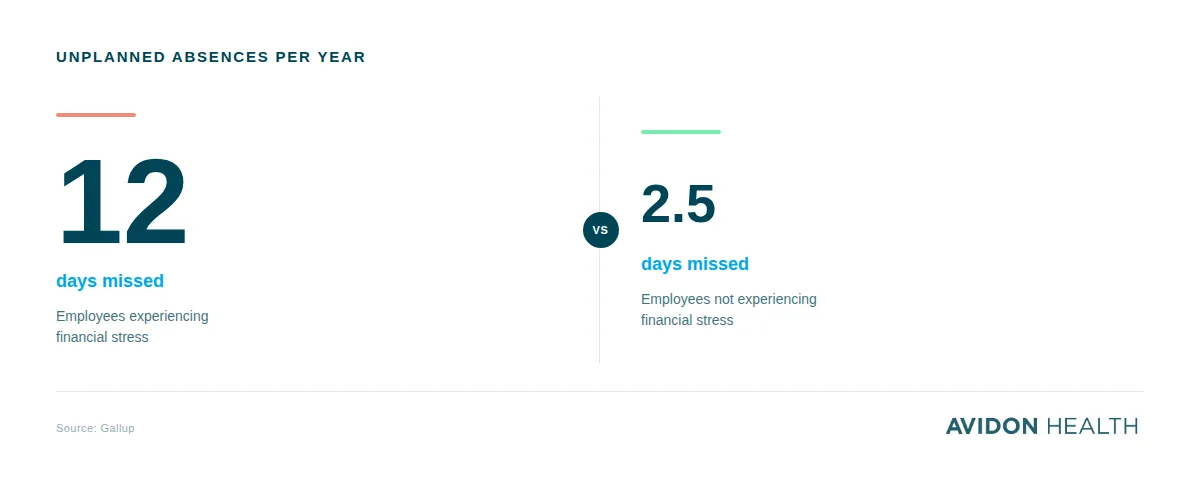
The productivity cost of poor employee mental health is not abstract. Gallup research found that workers with fair or poor mental health report nearly 12 unplanned absences per year, compared to 2.5 for peers with good mental health.
$47.6B
Estimated annual cost to U.S. employers from stress-driven absenteeism and lost productivity, per Gallup research
At the individual employer level, the math is direct. Each missed workday costs approximately $340 for a full-time employee. For an SMB with 50 employees, even a modest uptick in stress-driven absenteeism adds up to tens of thousands of dollars in direct costs annually, before accounting for presenteeism, errors, or turnover.
The Hartford's 2025 workplace research found that nearly three-quarters of U.S. workers report financial stress, with 56% saying it has negatively affected their productivity. That is not a fringe population. It is most of your workforce.
The most common employer response to employee mental health challenges is the Employee Assistance Program. According to HR.com's Future of Employee Well-being 2025 report, 88% of organizations offer one.
EAPs are valuable as a crisis resource. But they are reactive, not proactive, and the evidence on utilization is consistent: single-digit participation rates, access barriers, and persistent stigma mean that most employees never engage with them until they are already in crisis.
The HR.com report specifically notes that small employers may need to engage in more creative, low-cost interventions that can still drive meaningful impact. Proactive, behavior-change-based programs that build coping skills before crisis hits represent exactly that category.
What Actually Works: The Case for Behavior Change Coaching.
A 2025 peer-reviewed randomized controlled trial published in the International Journal of Business Management tested an 8-session coaching intervention with employees facing organizational uncertainty. Researchers found statistically significant improvements in adaptability, motivation, and performance, with large effect sizes across both post-intervention and one-month follow-up assessments. The researchers specifically noted that coaching builds "introspection, behavioral change, goal alignment, and self-regulation competencies" for operating in volatile and uncertain environments.
Those are exactly the conditions U.S. workers are navigating in 2026. A meta-analysis of psychologically informed coaching approaches, covering 20 studies and 957 participants, confirmed significant effect sizes on goal attainment and self-efficacy, with cognitive-behavioral frameworks shown to be particularly effective.
Financial behavior change follows the same pattern. PwC found that 48% of employees are highly motivated to learn financial coping skills including budgeting, debt management, and savings behaviors. Among younger workers whose employers offered financial wellness support, Gen Z (83%) and Millennials (79%) actively used those programs when they were available.
The gap is not employee motivation. The gap is employer provision.
What HR Leaders Can Do Right Now.
You do not need a large budget or a lengthy procurement cycle to begin building employee resilience. The evidence points to a few high-leverage starting points.
Action 1
Address financial wellness directly.
Employees want it. Programs that offer judgment-free coaching on budgeting, debt, and savings behaviors see high engagement when they are accessible and stigma-free. This does not require a comprehensive benefits overhaul.
Action 2
Prioritize proactive access over reactive resources.
EAPs are a floor, not a ceiling. Supplementing them with programs that employees engage with before a crisis is where the productivity return lives.
Action 3
Train managers on psychological safety.
The APA research found that transparent, supportive communication from leadership is one of the most consistent buffers against stress amplification. This is low-cost and high-impact.
Action 4
Use behavior change frameworks, not wellness perks.
Step challenges and meditation apps show weak evidence for reducing financial or job-related stress. Programs grounded in cognitive behavioral approaches show strong evidence. The distinction matters when you are trying to demonstrate ROI.
How Avidon Health Approaches Economic Anxiety.
Avidon's methodology is built on cognitive behavioral training, the same evidence base the coaching research above draws from. Our programs are designed specifically for the SMB environment: scalable, accessible, and built to engage employees who would not self-identify as needing mental health support.
Where EAPs wait for employees to seek help, Avidon's approach builds coping capacity proactively through habit-based coaching that addresses both financial wellness behaviors and broader stress resilience. Employees develop practical skills they apply immediately, not just awareness of resources that exist if things get worse.
For HR leaders working with limited budgets and no dedicated wellness staff, that distinction is what makes a program usable. Avidon is built to run with minimal administration: monthly wellness challenges launch automatically, and most employers are up and running within a day of getting started. You can see outcome data from real client programs in the Avidon Health Coaching Efficacy Report.
Common Questions About Financial Stress at Work.
Research-backed answers for HR leaders navigating economic uncertainty.
How does financial stress affect employee productivity? +
According to PwC's 2026 Employee Financial Wellness Survey, 56% of financially stressed workers say their financial health has negatively affected their workplace productivity. Gallup research links poor mental health broadly to nearly 12 unplanned absences per year per affected worker, compared to 2.5 for healthier peers, a gap that costs U.S. employers an estimated $47.6 billion annually.
What is the difference between financial wellness programs and EAPs? +
EAPs are reactive resources: employees access them when they are already in distress. Financial wellness programs are proactive: they build skills like budgeting, savings behaviors, and debt management before a crisis hits. EAP utilization rates are typically in the single digits. When employers offer financial wellness programs, Gen Z and Millennial employees use them at rates above 79%, according to PwC.
Are small businesses more affected by employee financial stress than large companies? +
Yes, in meaningful ways. SMB employees generally have fewer organizational buffers: less HR support, less organizational communication during uncertainty, and often thinner personal financial reserves. The Federal Reserve Bank of Boston found that trade policy uncertainty among SMBs was directly linked to headcount decision uncertainty, meaning SMB employees are more likely to feel the economic stress their employers are experiencing.
What does behavior change coaching have to do with economic anxiety? +
Economic anxiety affects behavior: employees disengage, avoid difficult decisions, and stop making the healthy choices that would actually help their situation. Behavior change coaching, particularly approaches grounded in cognitive behavioral frameworks, interrupts this cycle at the cognitive level by building coping skills, self-regulation, and tolerance for uncertainty. A 2025 RCT found statistically significant improvements in employee adaptability and performance after 8 coaching sessions in an organizational uncertainty context.
How much does employee financial stress cost a small business? +
The costs are direct and indirect. Each unplanned absence costs an employer approximately $340 for a full-time employee (Gallup). For a 50-person company where even a modest number of employees are experiencing significant financial stress, the annual absenteeism cost alone can reach five figures, before accounting for presenteeism, errors, and turnover. Turnover costs for a single mid-level employee typically range from 50% to 200% of annual salary.
What should HR leaders do first if they want to address economic anxiety? +
Start with access and stigma. Most employees who are financially stressed do not seek help because they do not know what is available or feel embarrassed. A low-barrier, judgment-free program that addresses financial coping skills directly, communicated clearly by leadership, is the highest-leverage starting point. Manager training on psychological safety and transparent communication is a parallel step that costs almost nothing and has strong evidence behind it.
Build Financial Resilience Across Your Team.
Avidon Health gives small and midsize employers a proactive, behavior-change approach to employee well-being that runs with minimal HR overhead.
As spring gets moving, we often feel a burst of fresh energy. But let’s be honest, it can also bring a lot of pressure. New projects are kicking off, and calendars fill up fast, leaving people feeling stretched. Even employees who enjoy busier seasons can find it a little harder to stay focused and balanced.
For HR teams, this often shows up as low morale, scattered focus, or more people struggling to keep up. That’s where the right kind of support can really help. A wellness platform makes space for small, helpful habits that fit into the workday. Instead of piling on one more thing, it gives employees tools to slow down, reset, and handle the spring rush with a little more ease. These tools serve as ongoing support, helping everyone deal with the season’s unique challenges and maintain a steady pace.
The Spring Stress Buildup at Work
As the weather shifts and the daylight stretches out, the pace at work often speeds up too. New planning cycles begin. Departments launch fresh goals. People start catching up from slower winter months. That momentum can be exciting, but it’s also where stress sneaks in.
Spring stress creeps up in small ways. We might see:
Meetings taking over lunch breaks
Project plans jamming the calendar
Teams pushing past normal hours
Restlessness showing up in quieter employees
The trouble is, spring stress doesn’t look the same for everyone. Some people get scattered and distracted. Others might go quiet or pull back. By the time stress gets noticed in the workplace, it can feel like it’s part of the normal routine. That makes it harder for HR leaders to help in the moment, as stress may already have impacted team dynamics.
Spotting these early signals can make a big difference. When support comes before burnout builds, we have a better shot at keeping employees steady through the season. Recognizing the patterns early lets HR teams introduce helpful changes that prevent bigger issues down the line.
Making Wellness Easy to Reach During the Day
Wellness doesn’t need to be another big task. The best support shows up in small, helpful moments during the day. When wellness tools fit into what people are already doing, they’re more likely to be used, and that’s where real shifts happen.
One way to do this is by using tools that reach people right when they need a break. That might mean little nudges that say:
Take one minute to stretch after your last call
Try three deep breaths before jumping into your next task
Grab some water before you dive into email
These ideas sound simple, and they are. But when they’re built into someone’s day using a wellness platform, they’re easier to stick with. Employees don’t need to log in, block time, or do something extra. The support just shows up when it’s helpful, making it easier to form steady routines.
This kind of light-touch help brings down stress without slowing work. That’s good news for both busy teams and the people leading them. Small changes, like automatic reminders or supportive messages, add up through the week and help people stay grounded.
Avidon Health’s digital wellness platform sends automated, evidence-based prompts for stretching, movement, and healthy habits right when employees need them. Employees can receive support through the devices and channels they already use, making it easy to engage without disrupting workflow.
Real Support That Helps People Stay Steady
When things feel tense, most people don’t need a full reset. They just need a small moment to feel seen, supported, and okay. That’s why steady, low-pressure support works so well during spring.
With the right system in place, steady coaching check-ins or light wellness messages create that space. These can include:
Quick prompts asking how someone’s day is going
Gentle mindfulness tips at midweek
Encouraging notes for staying grounded during peak times
Moments like these don’t add stress. They lighten it. And because there’s no big effort needed to take part, even the busiest team can stay connected. These simple touches can make tough days a bit easier and help everyone feel supported by their company.
The goal isn’t to change schedules or take away work. It’s about creating a little breathing room in the middle of full days. That leads to better focus, steadier moods, and fewer crashes by Friday. Over time, this helps build a culture where employees trust they’ll get support during busy periods.
Letting Data Guide Smarter Support
It’s not always easy to know what your team needs right away. Even when you can feel the pressure rising, it helps to have more than just a hunch. That’s where a good wellness platform makes a big difference.
With the right tools, HR can take a light look at team trends. No deep dive needed. We can learn things like:
When wellness check-ins are being used the most
Which nudges get high engagement and which get skipped
Whether one team is showing signs of extra stress
Because this data is at the team level, it stays respectful and easy to act on. It helps us adjust our support without having to guess or wait too long. We can choose what’s working and remove what’s not. When HR has a clearer picture of what’s really going on, they can respond quickly and gently rather than relying on assumptions.
Avidon Health’s platform gives HR access to real-time analytics, trend tracking, and aggregated participation data, enabling leaders to quickly spot engagement peaks and stressful periods. Adjusting wellness strategies is simpler because the insights are accessible and actionable. This means that as spring goes on, changes can be made easily to keep support relevant and useful for everyone.
A Calmer Season Starts With the Right Support
Spring brings fresh starts, but it brings full calendars too. That’s why it helps to give employees something solid to lean on as the pace picks up. A wellness platform makes small, helpful moments easier to use, so teams can stay focused without running on empty.
It doesn’t take a huge effort to create steadier workdays. With smart, flexible tools in place, we can meet people where they are and support them in ways that actually work. This spring, calm is possible, one small reset at a time.
At Avidon Health, we understand that HR teams need effective, easy-to-manage solutions. Our digital-first tools support smart, flexible wellness strategies that empower employees through quick nudges, check-ins, and real behavior change. Discover how our wellness platform can simplify your wellness initiatives and help your team thrive, reach out to learn more today.
What Is Health Coaching? And Why Smart CEOs Are Making It a Business Strategy
By Avidon Health | May 2026 | 7 min read
Health coaching is one of the highest-ROI investments in your benefits stack, reducing absenteeism, cutting healthcare costs, and improving retention in ways that show up directly on the bottom line. Here is what it actually is, what the data says, and how to get started.
Quick answer: Health coaching for employees is a structured, personalized program that helps workers set health goals, build sustainable habits, and stay accountable over time. For employers, comprehensive wellness programs that include health coaching return $3.27 in reduced healthcare costs and $2.73 in reduced absenteeism costs per dollar spent, a 6:1 return before productivity gains are factored in. Digital platforms like Avidon Health make this accessible for organizations of 50 employees or more, at less than a coffee a month per employee.
The Business Case Is No Longer Theoretical.
Let's skip the feel-good framing. Here is what the data actually says.
According to a Harvard meta-analysis of peer-reviewed studies, mature wellness programs that include health coaching return $3.27 in reduced healthcare costs for every $1 invested, plus an additional $2.73 in reduced absenteeism costs per dollar spent. That is a 6:1 return before you factor in productivity gains.
6:1
Average return on investment from comprehensive wellness programs that include health coaching, per Harvard meta-analysis — $3.27 in reduced healthcare costs plus $2.73 in reduced absenteeism per dollar spent.
Unplanned absenteeism costs U.S. businesses roughly $600 billion annually, approximately $4,080 per employee per year. A single absent employee reduces team productivity by nearly 36%. Health coaching directly attacks this problem by addressing the root causes: chronic stress, poor sleep, inactivity, and unmanaged health conditions.
Health coaching is not a gym subsidy. It is not a wellness app that sends push notifications nobody reads. And it is not a one-size-fits-all program built around a step challenge.
Real health coaching is a personalized, behavior-change process. A health coach works with each employee to:
Component 1
Identify specific, achievable goals
Health goals are tied to each employee's individual circumstances, not a generic program template applied across the entire workforce.
Component 2
Build accountability structures
Accountability structures that sustain behavior change over weeks and months, not a one-time assessment that goes nowhere.
Component 3
Address the underlying habits
Stress management, nutrition, sleep, and movement drive most chronic health costs. Real coaching works at this level, not just symptoms.
Component 4
Adapt as circumstances evolve
The coaching approach adjusts as the employee's health situation, goals, and life circumstances change over time.
The difference between generic wellness perks and genuine health coaching is the difference between handing someone a gym membership and having someone meet them at the door. One gets used. The other doesn't.
Why Small and Mid-Size Businesses Win Biggest.
Enterprise companies have been running health coaching programs for decades. But the ROI hits harder for smaller organizations, and here is why.
When you have 50 to 500 employees, every person matters more. One employee with unmanaged diabetes, chronic back pain, or severe burnout doesn't just affect your healthcare claims. It affects team morale, coverage capacity, and your ability to deliver for customers.
A 2024 industry report found that 77% of companies reported an ROI greater than 100% on their wellness investments. Companies with high workplace well-being also experience a third less annual voluntary turnover, a figure drawn from a global dataset of over 25 million workers.
For a 100-person company where replacing an employee costs 50–200% of their annual salary, reducing turnover by even two or three people per year pays for an entire wellness program.
Digital Health Coaching: The Scalable Play.
The historical knock on health coaching was cost and logistics. Live, one-on-one coaching doesn't scale easily across remote or hybrid teams.
Digital health coaching platforms solve this. The right platform delivers personalized coaching experiences at scale, using behavior change frameworks, automated check-ins, habit tracking, and data-driven insights to replicate the accountability structure of live coaching without the per-session cost.
At Avidon Health, our platform is built specifically around cognitive behavioral training principles, not generic wellness content, to drive real, measurable behavior change across entire employee populations.
The result is not theoretical. Across 13 independent studies spanning 60,000+ participants in 7 industries, here is what Avidon's programs have produced:
77%of previously inactive employees increased exercise to an acceptable level after completing Avidon's exercise course
93%of stress management participants reported feeling more confident and in control
33%of tobacco users quit, rising to 38.1% in a San Diego State University controlled study
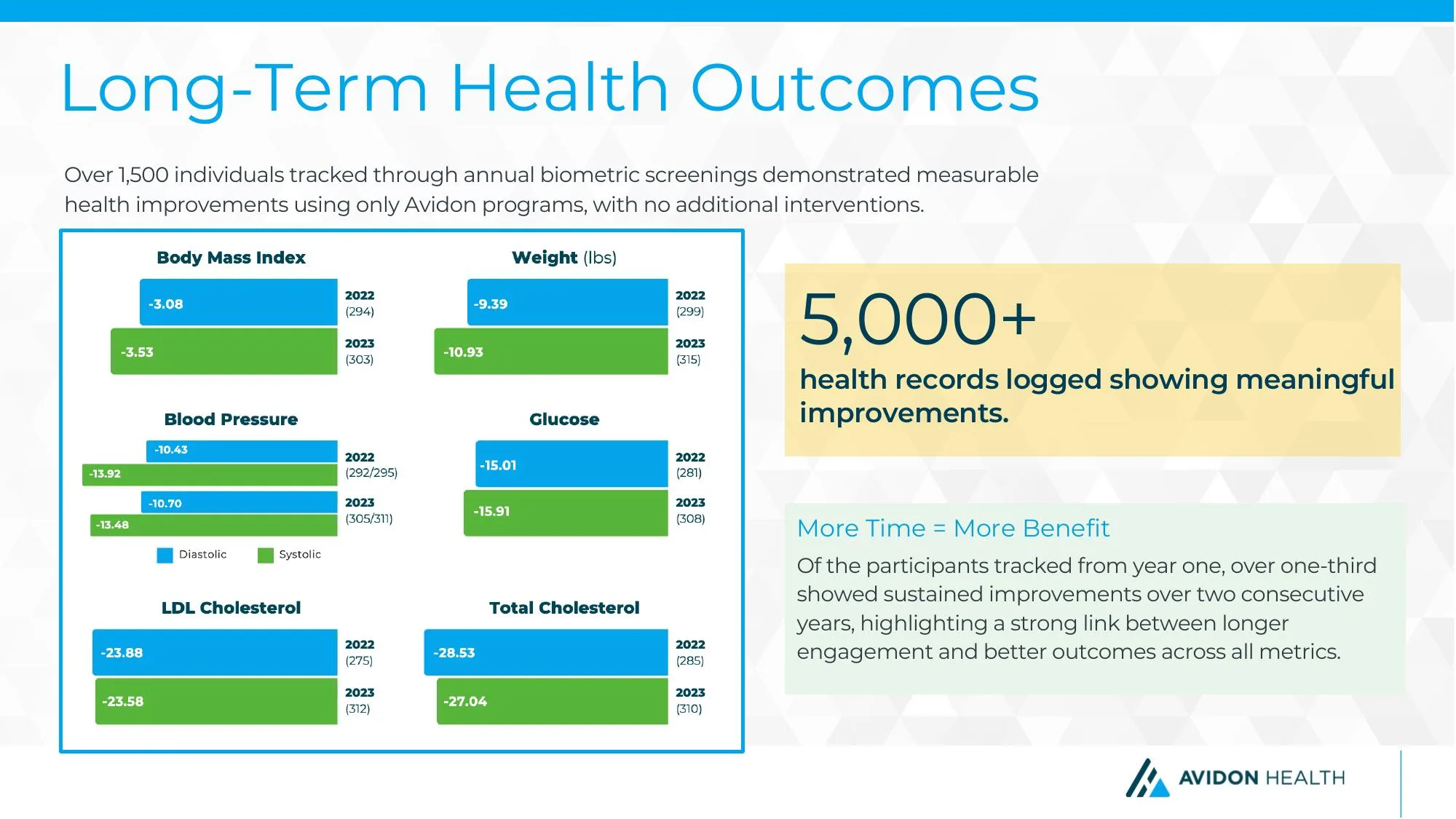
10.93 lbsaverage weight loss in 2023 biometric tracking across 315 participants
97%of health coaching participants said they would recommend their coach to friends and family
4.7 / 5.0average coaching satisfaction rating across participants
Adding Avidon's technology platform to live coaching increased program completion by 112% compared to no coaching, confirmed in a controlled, three-group study of 300 non-incentivized participants.
The result: employers get coaching-level outcomes at software-level pricing. Employees get a program that meets them where they are, whether that is stress management, weight management, sleep improvement, or chronic condition support.
What This Looks Like Under Budget Pressure.
The most common objection to launching a wellness program isn't skepticism. It's timing. Budget cycles, competing priorities, and the assumption that "we'll figure it out next year" push the decision out indefinitely.
Here is what that delay actually costs: a large healthcare system managing 40,000 employees faced a $32,000 budget shortfall in their wellness program during a workforce crisis. Rather than cut the program, they redesigned their approach around Avidon's digital-first platform. The outcome: coaching costs cut by 30% while participation increased by 67%, without reducing program quality or employee access.
If a 40,000-person health system can absorb a budget crisis and come out with better outcomes, a 200-person business can launch a program from scratch for less than most organizations spend on a single team offsite.
What to Look for in a Digital Health Coaching Platform.
Not all platforms deliver these results. The difference between a program employees actually use and one that collects dust comes down to three things.
Factor 1
Affordable pricing
Enterprise-level wellness is now accessible at SMB pricing. Avidon costs less than a coffee a month per employee.
Factor 2
Fast setup
A quality platform should be live across your entire organization in under a day. No IT project, no 6-month implementation, no dedicated wellness coordinator required.
Factor 3
Content variety that reaches every employee
Courses covering stress, tobacco, weight, sleep, alcohol, diabetes, and exercise. Avidon offers 40+ behavior change courses, 700+ resources, monthly challenges, trackers, and optional live coaching.
If a platform can't deliver all three, it's not built for how small and mid-size businesses actually operate.
What to Measure Before You Start.
If you can't measure it, you can't defend the budget next year. Before launching a health coaching program, establish baselines for:
Absenteeism rate (the national average hit 3.2% in 2024), healthcare claims cost per employee, employee engagement scores, and voluntary turnover rate. Track turnover quarterly, not annually. Set a 12-month review, and document your baseline before the program launches.
Companies that track these metrics consistently are the ones who can show a clear before-and-after and justify continued or expanded investment.
The Bottom Line.
Every month you wait is another month of preventable absenteeism, avoidable turnover, and healthcare claims that a wellness program could reduce. The average employer spends $4,080 per absent employee per year. A full digital health coaching platform through Avidon costs less than a coffee a month per employee.
You don't need a pilot program to justify that math. You can have a program running for your entire team this week, and Avidon's Challenges Autopilot will keep it running without you lifting a finger after that.
The question isn't whether health coaching works. Thirteen studies and 60,000 participants have answered that. The question is how much longer you're willing to pay for not having it.
Common Questions About Employee Health Coaching.
Everything HR leaders and business owners ask before getting started.
What is health coaching for employees? +
Health coaching for employees is a structured program that pairs workers with a coach, live or digital, to help them set and achieve personal health goals. It typically covers stress management, nutrition, physical activity, sleep, and chronic condition management, using accountability and behavior change frameworks to drive lasting results.
How much does employee health coaching cost? +
Live, one-on-one coaching typically runs $50–$150 per session per employee. Digital health coaching platforms offer employer-wide coverage at a fraction of that cost. Avidon Health costs less than a coffee a month per employee, making full-scale wellness programs accessible for organizations of 50 employees or more.
What is the ROI of health coaching at work? +
According to a Harvard meta-analysis, comprehensive wellness programs that include health coaching return $3.27 in reduced healthcare costs and $2.73 in reduced absenteeism costs per dollar spent, a combined 6:1 return. Companies with strong wellness programs also report a 20% increase in employee productivity.
Is digital health coaching as effective as in-person coaching? +
For most employer use cases, yes, and the data supports it. In a controlled study of 300 non-incentivized participants, Avidon's combined coaching and technology platform produced a 112% improvement in program completion over no coaching. Digital programs built on cognitive behavioral training methodology produce outcomes comparable to live coaching at significantly lower cost.
How long does it take to see results from health coaching? +
Most programs show measurable engagement improvements within 90 days. Meaningful reductions in absenteeism and healthcare claims typically emerge within 6–12 months of consistent participation. Avidon's biometric data shows sustained improvements across two consecutive years for participants who remain engaged, confirming that longer engagement produces better long-term outcomes.
How quickly can we get started? +
Avidon is designed for organizations without a dedicated wellness coordinator. Setup takes under a day. Your first automated wellness challenge can launch the same week you sign up.
Start your free demo today.
No credit card. No commitment. Your entire team could have a wellness program running this week.
Employee Burnout Prevention: Why Mental Health Leaves Keep Rising (And What HR Can Do)
By Avidon Health | May 2026 | 7 min read
Mental health leaves of absence have increased 300% since 2017 and now account for 1 in 10 workplace leaves in the U.S. The core problem isn't that employers lack mental health programs; 90% now offer coverage. It's that the programs they have aren't reaching employees until a crisis is already underway.
The short answer: Mental health leave isn't rising because coverage is lacking — 90% of employers already offer it. It's rising because the programs in place aren't engaging employees until a crisis has already formed. The prevention window sits earlier, in the silent burnout phase, and closing the gap requires consistent, low-stigma touchpoints before distress becomes a clinical event.
According to ComPsych data, which tracks absence data across more than 6 million covered employees, mental health leaves surpassed combined absences for accidents, cancer, COVID-19, heart disease, and heart attacks in Q1 2024. That's not a visibility problem. Most HR teams know leaves are increasing; 61% of HR leaders confirmed as much in a 2026 workplace mental health survey. What's invisible is the employee who hasn't left yet.
The Real Gap Isn't Coverage — It's Engagement.
That coverage figure has grown steadily, up from 84% in 2019. Coverage is no longer the bottleneck.
The bottleneck is use. Traditional employee assistance programs (EAPs) average just 2–5% utilization across the industry. That means the overwhelming majority of a workforce (employees who may be quietly struggling) that never touches the support their employer is paying to provide.
The trust data makes this gap more specific. Only 33% of employees strongly agree their employer values their mental health, according to Modern Health's April 2026 U.S. Workforce Report, an 8-point drop from 2025 in a single year. More telling: 50% of employees don't use employer mental health days at all. Not because they don't need them. Because they fear being judged for it.
"Leave is usually the output. It's the final signal that flares up when early warnings go unnoticed, manager support is inconsistent, or care is simply too hard to access." — Kelsey Witmer, VP of Total Rewards and People Operations
Employee burnout prevention, at its most practical, is an engagement problem before it's a clinical one.
What "Silent Burnout" Looks Like From the Inside.
Standard burnout is visible enough to trigger a conversation. Silent burnout isn't. According to a 2026 workplace mental health annual report, roughly 30% of employees are currently experiencing it: showing up, appearing functional, and quietly deteriorating. Nineteen percent of HR leaders estimate that 50 or more employees per 100 are silently burned out at their organizations right now.
This matters because the window for prevention is inside that silent period. Once an employee reaches clinical-level distress, the intervention calculus changes entirely; what's needed is treatment, not prevention.
The complicating factor is that the stressor environment in 2025–2026 is accelerating the timeline from "stressed" to "burned out" in ways that traditional benefits weren't designed for. Three accelerants stand out in the data:
Accelerant 1
Political climate pressure
According to Modern Health's April 2026 report, 70% of employees say the current U.S. political climate has made it harder to maintain positive mental health at work.
Accelerant 2
AI-related job anxiety
Twenty-four percent say AI is already negatively affecting their mental health today — not as a future fear, but as a present stressor on par with financial pressure.
Accelerant 3
Productivity-over-well-being culture
Seventy-two percent say their employer actively encourages productivity at the expense of personal well-being, up from 61% in 2025 — an 11-point single-year increase.
These aren't background conditions. They're accelerants landing on top of a burnout baseline that was already elevated.
The Cost of the Fivefold Gap.
The productivity math is unambiguous. According to Gallup research, workers with fair or poor mental health take nearly 12 unplanned absence days per year. Workers in good mental health take approximately 2.5.
$47.6B
Estimated annual U.S. productivity loss from the mental health absence gap, per Bureau of Labor Statistics data. That's not a wellness stat — it's a business risk figure.
The gap also has a directional shape: it narrows significantly when employees actually use available mental health support. A large-scale peer-reviewed study published in JAMA Network Open found that employer-sponsored behavioral health benefits produced a 1.9x ROI, roughly $1,070 in net savings per participant in year one. Care utilization rose 47% when access friction was removed.
The ROI isn't theoretical. It's contingent on utilization. Which brings the problem back to engagement.
What Early Intervention Actually Does.
The most consistent finding across intervention research is that timing matters more than modality.
Research analyzed by Nilo Health found that a short intervention applied immediately after stress symptoms appear produced approximately 15 fewer absence days within 12 months. A separate long-term study found 43 fewer sick days over five years in early-intervention groups versus controls.
A 2025 systematic review in the Journal of Psychosomatic Research analyzed 75 randomized controlled trials on interventions to reduce sick leave in workers with mental illness. The strongest evidence supported CBT-based and problem-solving approaches, combined employee-supervisor interventions that modified the workplace environment, and multifaceted programs that paired individual therapy with work-focused adjustments. The work-focused component mattered: symptom improvement alone didn't reliably predict return-to-work outcomes.
The practical implication for HR: early outreach, regular check-ins, and accessible digital touchpoints aren't just "nice to have." They're where the leave reduction actually happens.
Why Traditional EAPs Miss the Prevention Window.
EAPs aren't ineffective tools. CuraLinc's 2025 study found that 79% of EAP users at clinical risk for anxiety or depression experienced reduced distress within 30 days of engagement. The problem is structural: only 2–5% of employees ever engage. An intervention with strong clinical outcomes and 3% utilization isn't a prevention strategy. It's a response strategy with a narrow reach.
The design features that limit EAP utilization are well-documented: call-center gatekeeping, session limits, stigma associated with seeking help through an employer-sponsored channel, and perceived complexity of access. According to a 2025 Forrester Consulting study, 44% of employees are more stressed now than five years ago, and only 30% find traditional EAP offerings meet their needs.
Enhanced digital mental health platforms that offer same-day or next-day access, single-platform experiences, and no phone triage show utilization rates up to 10 times the EAP baseline. The access design is doing as much work as the clinical program underneath it.
How Behavior Change Programs Fill the Gap.
Behavior change programs occupy a different lane than clinical EAPs, and that lane is where LOA prevention leverage sits.
Clinical EAPs are designed for employees already at distress thresholds. Behavior change programs are designed for the earlier, broader population: employees who are stressed, sliding toward burnout, and not yet in crisis. That population is substantially larger. And it's where the leave pipeline begins.
A 2025 study published in JMIR Formative Research (Peiper et al., University of Louisville / University of Oregon / Stanford) evaluated an 8-week blended-care digital coaching program deployed by 45 employers to approximately 100,000 employees. Among the 588 enrolled participants, the program showed significant improvement in WHO-5 well-being scores, the benchmark clinicians use to flag individuals who need attention — over the 8-week period, with measurable emotional intelligence gains.
The design features that produced those outcomes align with what the engagement research consistently identifies as the missing ingredients: certified coaches, routine check-ins, low-stigma digital access, and structured habit formation rather than crisis-triggered outreach. Programs built around regular engagement create an early-detection signal that on-demand benefits, by design, cannot.
The Engagement Gap Is Solvable.
The $47.6 billion productivity cost of poor mental health at work isn't a fixed cost. It's the cost of a utilization gap. Employees with well-utilized mental health support take 2.5 unplanned absence days per year. Those without it take nearly 12.
The distance between those two numbers isn't a program design problem. The programs exist. It's an access, trust, and early-engagement problem. Solving it requires reaching employees before a crisis, through regular touchpoints, low-stigma digital channels, and the kind of habitual engagement that keeps support accessible when it's actually needed.
At Avidon Health, our behavior change programs are built around exactly that logic: nudges, coaching check-ins, and automated wellness challenge delivery that keeps employees engaged without requiring HR to manage it manually. The CBT-based evidence for early, work-focused intervention maps directly to our behavioral science foundation, grounded in 25 years of applied behavior change methodology. The early-detection signal that regular engagement creates is the layer most traditional benefits programs are missing.
Common Questions About Employee Burnout Prevention.
Evidence-based answers for HR leaders navigating mental health leaves.
What is the primary driver of mental health leaves of absence in 2025–2026? +
Mental health leaves have increased 300% since 2017, driven by a combination of chronic workplace burnout, financial pressure, AI-related job anxiety, and political stress. According to Modern Health's 2026 Workforce Report, 70% of employees say the current political climate is affecting their mental health at work, and 24% say AI is already a present stressor.
Why do employees avoid using employer mental health benefits? +
Stigma is the most documented barrier. Modern Health's 2026 report found 50% of employees don't use employer mental health days out of fear of judgment. Among senior managers, 61% avoid using mental health days entirely, and 54% have experienced direct judgment for doing so.
Does early intervention actually reduce employee absenteeism? +
Yes. Research shows a short intervention applied immediately after stress symptoms appear can produce approximately 15 fewer absence days in 12 months. A long-term study found 43 fewer sick days over five years in early-intervention groups. Timing matters more than the specific modality.
What's the ROI of employer-sponsored mental health benefits? +
A 2025 peer-reviewed JAMA Network Open study covering 13,990 participants found employer-sponsored behavioral health benefits produced a 1.9x ROI, approximately $1,070 in net savings per participant in year one. That ROI depended heavily on utilization — care use rose 47% when access friction was removed.
How is a digital behavior change program different from an EAP? +
EAPs are designed for employees already at clinical distress thresholds, with utilization rates of 2–5%. Behavior change programs engage employees upstream, before crisis, through regular check-ins, structured habit formation, and low-stigma digital access. They create the early engagement layer that EAPs can't, because they're built for the prevention window rather than the response window.
Reach Employees Before Burnout Becomes a Leave Event.
Avidon Health's behavior change programs create the early-engagement layer that traditional EAPs and mental health coverage can't — keeping employees supported before crisis, not after.
Health Coach Software: How to Choose the Right Platform for Your Team
By Avidon Health | Updated July 2026 | 6 min read
If you run a coaching business or a clinic with a coaching arm, the software you pick decides two things: how many clients each coach can carry, and how many of those clients are still engaged in month three.
Quick answer: Health coach software is purpose-built technology for professional coaching teams, not a repurposed CRM or a stack of spreadsheets. The right platform combines behavior-change content, caseload management, between-session engagement, and HIPAA-compliant outcomes reporting so a growing team can coach more clients without losing results or burning out coaches.
Get the software choice wrong and you feel it as churn, coach burnout, and renewals that quietly don't happen. This guide covers what actually separates purpose-built health coach software from tools that look fine in a demo and fall apart at scale.
What Health Coach Software Actually Is.
Health coach software is technology built specifically to support the coaching relationship across a team and a caseload. It typically includes client communication, behavior-change content delivery, goal and progress tracking, caseload dashboards, and reporting you can hand to whoever funds the program.
The distinction from generic tools matters more than it sounds. In one documented case, an organization that moved to a purpose-built coaching platform cut program costs by 30% while lifting participation by 67%. The pattern is consistent: coaches spend less time on administration and more time on the work that drives outcomes.
The market is moving the same direction. According to Grand View Research, the global digital health coaching market was worth roughly $11 billion in 2024 and is projected to hit $22 billion by 2030, driven by clinics and coaching organizations adopting scalable, technology-supported models.
Health Coach Software vs. the Tools Teams Outgrow.
Most coaching teams start on tools they already have, then hit a wall as the roster grows. Here is how purpose-built software compares to the two most common stopgaps.
What you need
Purpose-built health coach software
Generic CRM (HubSpot, Salesforce)
Spreadsheets + video calls
Behavior-change content
Built-in, evidence-based library
None; you supply everything
None
Caseload dashboard
See who's engaged and who's slipping
Deal pipelines, not client engagement
Manual, out of date fast
Between-session engagement
Automated nudges, check-ins, assignments
Not built for it
Fully manual
Outcomes reporting
One click, exportable
Sales metrics, not health outcomes
Hours of hand-entry
HIPAA compliance + BAA
Standard
Enterprise tier only, if at all
No
Onboarding a new coach
Days, with templates
Weeks of configuration
Tribal knowledge
The Five Features That Actually Matter at Scale.
The strongest platforms share a foundation: structured content, individualized workflows, and reporting that proves value to whoever pays for the program. Here is what to evaluate.
Feature 1
A real behavior-change content library
Look for content grounded in cognitive behavioral frameworks, motivational interviewing, or the Transtheoretical Model, not generic wellness tips. The research consistently favors theory-based behavior-change content over unstructured advice. A strong library spans nutrition, activity, stress, sleep, and chronic-condition support, because your clients' needs rarely stay in one lane.
Feature 2
Personalized coaching workflows
Effective platforms let you build individualized journeys instead of pushing every client through the same sequence. You want customizable plans tied to each client's readiness to change, automated check-ins between sessions, and progress both coach and client can see.
Feature 3
Caseload management that scales
Carrying a large caseload without losing the personal touch is the hardest operational problem in coaching. Caseload size is a well-documented driver of coach burnout and lower client satisfaction, and the right dashboard shows your whole roster at a glance: who's engaged, who's at risk of dropping off, and who's ready for a deeper push.
Feature 4
Outcomes and reporting you can hand upward
If your coaching is paid for by a clinic, an employer, or a health plan, you will be asked to prove it works. Your software should generate clean, exportable reports on engagement, goal completion, and health-risk change without hours of manual entry. Inability to show results is one of the most common reasons programs get cut.
Feature 5
HIPAA compliance
Non-negotiable. Any platform touching client health data needs full HIPAA compliance, a signed Business Associate Agreement, encrypted storage, and access controls. Confirm this before you evaluate anything else.
Why This Matters More for Specialty Clinics Right Now.
If you run a GLP-1, metabolic, or weight-loss program, this is not abstract. The clinical results depend on what the patient does between visits, and that is exactly where patients drift. A platform that automates between-session engagement, keeps patients on protocol, and shows the clinic its own retention data is the difference between a patient who renews at month six and one who quietly disappears. The same logic holds for concierge and direct primary care practices adding a coaching tier: the software is what lets you deliver a high-touch experience without hiring a coach for every ten patients. More on that in our guide to supporting patients on GLP-1 therapy.
What to Avoid.
Generic CRM or project-management tools
Salesforce, HubSpot, or Asana can be bent into managing clients, but they were not built for it. No behavior-change content, no health-specific tracking, no client-facing features. Teams using them spend far more time on admin and lose the structured content that drives results.
AI-only platforms with no human coaching layer
MIT research found 95% of organizations deploying generative AI on its own saw no measurable return. AI is great for nudges and reminders. Behavior change, especially for complex health needs, still needs a human coach. Your software should make coaches more effective, not try to replace them.
Platforms that lock your data
Some vendors make it slow or expensive to export client data when you leave. Confirm full ownership and portability before you sign. The wrong platform doesn't just underperform, it makes leaving painful.
How Avidon Was Built for Coaching Teams.
Avidon's platform was built by a professional coaching team, for coaching teams. The behavior-change content is grounded in cognitive behavioral training methodology developed in real coaching practice, not assembled by a product team that has never run a session.
112%
Improvement in program completion versus no platform support, in a controlled study of 300 non-incentivized participants.
Across 13 independent studies spanning 60,000 participants, Avidon's programs show an average 20-point blood-pressure reduction, roughly 11 pounds of weight loss, and a 4.7 out of 5.0 coaching satisfaction rating. Full methodology is in Avidon's Efficacy and Outcomes Report.
If you want to see the caseload dashboard, between-session tools, and reporting in action, that's what the health coaching platform walkthrough is for.
Frequently Asked Questions.
What coaching teams ask before choosing health coach software.
What is health coach software used for? +
It helps professional coaches manage clients at scale: delivering personalized content, tracking goals, automating check-ins between sessions, and generating outcomes reports. It replaces spreadsheets and generic tools with purpose-built workflows that cut admin time and improve results.
How is health coach software different from a wellness app? +
Wellness apps are self-guided tools for individual consumers. Health coach software is for professional coaches managing many clients, with caseload management, coaching workflows, content libraries, and reporting that consumer apps lack. The coaching relationship is central to the design.
Does health coach software need to be HIPAA compliant? +
Yes. Any platform handling client health information in a professional context must be HIPAA compliant, including encrypted storage, access controls, and a signed BAA with the vendor. Confirm this before evaluating other features.
How much does health coach software cost? +
Most platforms price per member per month, typically $2 to $15 PMPM depending on content, coaching support, and reporting. Ask specifically about implementation costs and data-export fees, which are where surprise costs hide.
What happens when clients stop engaging between sessions? +
Between-session drop-off is one of the biggest challenges in coaching. Look for platforms that automate engagement touchpoints, so the program keeps moving when you are not in a live session. Good software turns between-session engagement from a manual chore into a built-in feature.
Can health coach software support a GLP-1 or metabolic program? +
Yes, and it is one of the strongest use cases. GLP-1 and metabolic outcomes depend on what patients do between visits, which is exactly where they tend to drift. Software that automates between-session engagement, keeps patients on protocol, and reports retention back to the clinic helps convert short-term prescriptions into sustained results.
How long should it take to onboard a new coach? +
With a purpose-built platform and prebuilt templates, days, not weeks. If a vendor quotes weeks of configuration before a coach can take clients, treat that as a cost.
See What Purpose-Built Coaching Software Does.
Start with the Efficacy and Outcomes Report for the data and methodology, or book a walkthrough of the platform for your team.
What Is Digital Health Coaching? A Plain-English Guide for Employers
By Avidon Health | May 2026 | 9 min read
Digital health coaching is a structured, technology-delivered approach to behavior change that applies evidence-based methods to help employees build lasting healthy habits. Unlike passive wellness apps, it is designed to drive measurable change, not just track activity.
Quick answer: Digital health coaching is a structured, technology-delivered program that applies evidence-based behavior change methods (including cognitive behavioral techniques, goal-setting, and personalized learning) to help individuals build lasting healthy habits. It differs from wellness apps by delivering methodology, not just content access.
Most employers are familiar with wellness apps: step counters, meditation timers, fitness trackers. They are easy to deploy and look good in a benefits brochure. The problem is they rarely change behavior in any meaningful way.
According to research on real-world mental health app engagement, only about 4% of users who download a wellness app continue using it after 15 days. Health and fitness apps lose nearly 77% of users within the first 24 hours. For small business owners already juggling HR alongside five other jobs, that kind of adoption failure makes the whole category feel like a waste of time and budget.
Digital health coaching is a fundamentally different category. It is not a passive tool employees occasionally open. It is a structured program built around the science of how people actually change.
What Makes Digital Health Coaching Different.
A wellness app gives employees access to content. A digital health coaching platform delivers a program.
The distinction matters. Behavior change science has consistently shown that access to information is not the same as the ability to act on it. Knowing you should exercise more, eat better, or manage stress differently is rarely the hard part. The hard part is changing the underlying patterns (thoughts, habits, and triggers) that drive behavior in the first place.
Digital health coaching addresses this directly. Effective health coaching platforms are built on evidence-based frameworks including:
Cognitive Behavioral Training (CBT): A structured approach that helps individuals identify and reframe the thought patterns driving unhealthy behaviors. A 2021 retrospective study published in BMC Psychiatry found CBT delivered in workplace settings produced clinically significant outcomes across a wide range of mental health and behavioral challenges.
Goal setting and accountability structures: Rather than leaving employees to track steps passively, digital coaching uses structured check-ins, milestone tracking, and behavioral nudges that reflect how habits are actually formed.
Microlearning and progressive skill-building: Short, sequenced content builds knowledge and confidence incrementally, which research shows is more effective than information-dense one-time programs.
Personalization based on health risk and readiness: The most effective digital coaching platforms adapt to where each employee actually is, not where the program assumes they should be.
A 2025 systematic review in Frontiers in Digital Health, which analyzed 35 peer-reviewed studies on coach-facilitated digital health interventions, confirmed that all coaching modalities (human, AI, and hybrid) demonstrated feasibility and positive lifestyle outcomes when structured coaching methodology was embedded in the digital experience.
Digital Health Coaching vs. Wellness Apps: A Practical Comparison.
This is not a critique of wellness apps as a category. They have a role, particularly for employees who are already motivated and need a convenient tool to support habits they have already built. But for the majority of a workforce, especially employees managing chronic stress, weight, sleep, or tobacco, awareness-level tools do not close the gap between knowing and doing.
Why This Matters for Employers and HR Teams.
The business case for digital health coaching comes down to one question: are you paying for participation, or for outcomes?
Wellness programs that track activity tell you who showed up. Behavior-change programs built on coaching methodology tell you whether anything changed.
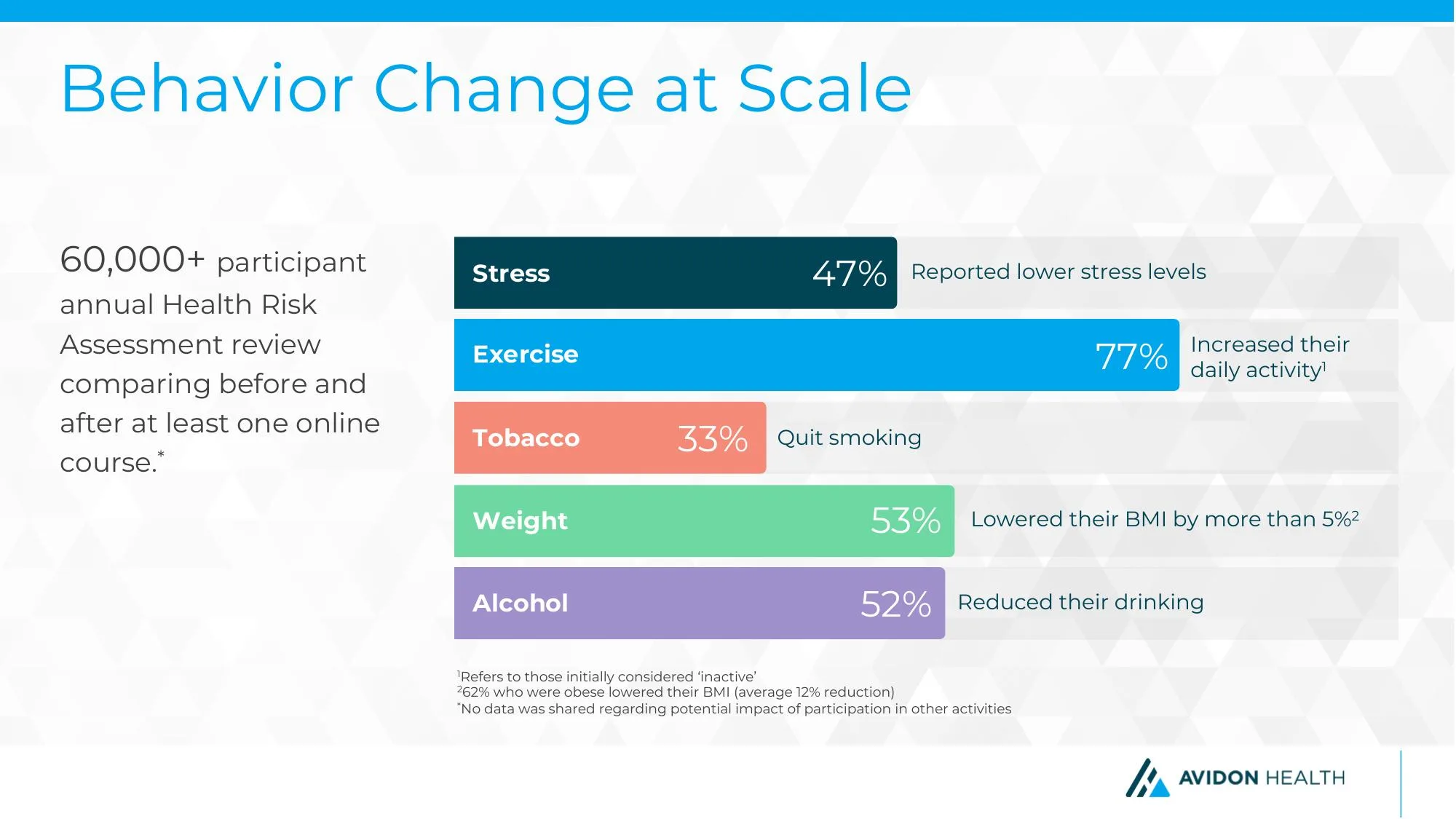
According to a 60,000-participant outcomes study conducted through a leading national wellness vendor using Avidon Health's CBT-based platform:
77%of previously inactive employees increased their physical activity
47%of participants reported lowered stress levels
53%of participants reduced their BMI by more than 5%
33%of tobacco users quit smoking during the program period
These outcomes do not come from employees at high-performing wellness companies with dedicated program staff. They come from employees at real organizations who came in skeptical and left with measurably different health behaviors. One Director of Total Rewards at a large regional manufacturer put it simply: "The ability to add our own videos and resources plus brand the experience has helped us create a wellness hub our employees actually use."
These are the kinds of outcomes that translate to lower healthcare claims and reduced absenteeism, and measurable ROI, which is increasingly what CFOs and benefits committees are asking HR leaders to demonstrate. According to industry data compiled by Recruiters Lineup, companies with comprehensive wellness strategies see a 2.5x return on investment from improved productivity and lower absenteeism.
For small businesses, digital health coaching has a specific advantage: it delivers what would otherwise require a full-time wellness staff (personalized programming, structured engagement, and outcome tracking) at a fraction of the cost.
Every month without a structured behavior change program is a month of preventable absenteeism, rising healthcare claims, and talent who look at your benefits package and do not see a reason to stay. The good news: modern digital health coaching platforms do not require a 6-month implementation or a dedicated wellness director. The right one can be running across your team in under an afternoon.
What to Look For in a Digital Health Coaching Platform.
Not every platform that uses the word "coaching" is actually built on coaching methodology. When evaluating options, HR leaders and small business owners should ask:
Question 1
What is the behavior change framework?
Look for explicit grounding in cognitive behavioral science, motivational interviewing, or health coaching best practices, not just gamification and step tracking.
Question 2
How is content personalized?
Platforms that adapt based on health risk assessment data, readiness to change, and individual progress produce better outcomes than one-size-fits-all programs.
Question 3
What does engagement actually look like?
Ask for real engagement data (completion rates, return usage, outcomes) not just login numbers.
Question 4
Is it HIPAA compliant?
Any platform handling employee health data must be. ISO 27001 certification is an additional signal of security rigor.
Question 5
How does it scale?
For small businesses, look for platforms with ready-to-launch configurations. Enterprise teams should ask about admin tools, segmentation, and reporting capabilities.
Question 6
Does it support the whole person?
The most effective programs address physical health, mental well-being, and behavioral habits together, not just one dimension.
The Role of Cognitive Behavioral Training in Digital Wellness.
Of all the methodologies used in digital health coaching, Cognitive Behavioral Training (CBT) has the deepest evidence base for behavior change in non-clinical populations.
CBT's core insight is straightforward: behavior is shaped by thought patterns. When someone repeatedly fails to exercise, manages stress poorly, or struggles to quit smoking, there is almost always a web of automatic thoughts and beliefs driving those patterns, including beliefs about self-efficacy, identity, and likelihood of success.
CBT-based programs work by surfacing those patterns and giving individuals structured tools to challenge and replace them. This is categorically different from tracking a step count or sending a reminder to drink water.
The BMC Psychiatry workplace CBT study found clinically meaningful outcomes across a broad range of mental health challenges and severity levels. When CBT principles are embedded in a digital platform, through structured courses, habit-building challenges, and guided microlearning, employers can deliver that depth of methodology at scale, without requiring a licensed therapist for every employee.
91%
Course completion rate across Avidon Health participants, vs. a 15% industry average
Digital Health Coaching at Avidon Health.
Avidon Health's platform is built on over 25 years of applied cognitive behavioral training and health coaching methodology, delivered digitally at a price point designed for organizations of all sizes, from small businesses to enterprise employers.
The platform includes 40+ behavior change courses built on CBT and Acceptance and Commitment Training (ACT) principles, covering high-impact areas like stress management, healthy weight, tobacco cessation, sleep, and alcohol reduction. Monthly wellness challenges, habit builders, health trackers, and a personalized recommendation engine adapt the experience to each participant's risk profile and readiness to change. Challenges Autopilot launches monthly engagement automatically, with no HR promotion required and no program management overhead.
The outcomes speak clearly:
96%recommendation rate across 7,000+ anonymous exit survey respondents
38.1%tobacco quit rate, verified through a San Diego State University controlled study
91%of participants completed their health courses, vs. a 15% industry average
60,000+participants across the outcomes study cited in the business case section above
For small businesses, the SMB SaaS version launches quickly with pre-built configurations and zero IT lift. For enterprise clients, full customization, API integrations, dedicated account management, and optional live health coaching are available.
For context on what a program like this costs, and how it compares to the cost of doing nothing, see how much a wellness program costs per employee and what the ROI research actually shows.
Common Questions About Digital Health Coaching.
What HR directors and small business owners ask most before evaluating platforms.
What is digital health coaching?+
Digital health coaching is a structured, technology-delivered program that applies evidence-based behavior change methods (including cognitive behavioral techniques, goal-setting, and personalized learning) to help individuals build lasting healthy habits. It differs from wellness apps by delivering methodology, not just content access.
How is digital health coaching different from a wellness app?+
Wellness apps primarily provide content and track activity passively. Digital health coaching platforms embed coaching methodology such as cognitive behavioral training, structured habit-building, and personalized programming to drive measurable behavior change, not just awareness.
Does digital health coaching actually work?+
Yes, when built on evidence-based methodology. A 2025 systematic review in Frontiers in Digital Health found all coaching modalities in digital health interventions demonstrated positive lifestyle outcomes. Behavior-change platforms grounded in CBT show meaningful improvements in stress, weight, tobacco cessation, and physical activity in workplace populations. Avidon Health's platform achieved a 38.1% tobacco quit rate in a San Diego State University controlled study and a 96% participant recommendation rate across 7,000+ respondents.
How much does a digital health coaching platform cost?+
Costs vary by platform and methodology. Basic wellness apps often run $150-$400 per employee per year and provide content access without structured coaching. Full-featured digital health coaching platforms with CBT methodology, automated challenges, and outcome tracking like Avidon Health typically start at $2-3 per employee per month, which works out to roughly $24-$36 per employee per year. For context, that is less than a single team lunch per employee, for a program that drives measurable behavior change.
Is digital health coaching right for small businesses?+
Yes, digital health coaching is particularly well-suited to small businesses because it delivers the impact of a structured wellness program without requiring dedicated wellness staff. Modern platforms offer ready-to-launch configurations, automated engagement features like Challenges Autopilot, and flexible pricing that scale from small teams upward. The right platform can be up and running in an afternoon.
What should HR leaders look for in a digital health coaching platform?+
Look for a platform with an explicit behavior change methodology (such as CBT), personalization based on health risk and readiness data, real outcome metrics (not just login data), HIPAA compliance, and the ability to support whole-person wellness across physical, mental, and behavioral health.
Ready to See What Real Behavior Change Looks Like?
Avidon Health's platform runs itself, so your team gets a structured wellness program without adding work to HR's plate. See how it works for teams of every size.
The way we support employee wellness has changed a lot recently. For many HR leaders, the old model of one-size-fits-all programs doesn’t work in today’s fast-moving, flexible workplaces. Employees are dealing with different stress levels, different schedules, and different needs depending on their roles.
That’s where fresh thinking from wellness companies comes in. Instead of relying only on step challenges or checklists, more companies are pairing behavior science with real-life support. The goal isn’t just to tick off boxes, but to bring simple, everyday help that helps people stay healthy, focused, and steady as they work. When wellness fits smoothly into people’s days, outcomes start to stick.
Meeting Wellness Goals Without Added Work
Health goals can be hard to chase when people are overwhelmed. That’s why newer approaches focus on doing more with less effort, especially for HR teams. The best ideas keep things simple, without extra admin time or long to-do lists.
Let’s look at what that actually means:
Small daily prompts that help people stay mindful, hydrated, or active
Check-ins that happen through tools employees already use, like Slack or emails
Wellness support that doesn’t need a meeting or form to be useful
When those tools are in place, employees can make stronger decisions throughout the day without feeling like their wellness plan is another chore. That ease matters just as much as the goals themselves.
Avidon Health’s digital-first wellness platform supports this with customizable messaging, automated reminders, and real-time tracking that works across devices, so employees engage when and where it makes sense for them. This all-in-one solution allows HR to remove admin barriers while making wellness more accessible to busy teams.
Building Flexible Wellness Into Company Culture
Flexibility used to be a bonus. Now it’s the baseline. People work from home, across time zones, or in cycles that shift each week. Good wellness support doesn’t assume everyone works a 9 to 5 schedule at a desk.
Wellness companies are reworking their tools so they meet people where they are. That might mean:
Mobile-friendly support for employees on the road or working off-site
Personal goal-setting that adjusts over time, based on recent habits
Guidance that works when teams are remote, hybrid, or changing shift times
With people’s routines always in flux, adaptable approaches are much more likely to stick around for the long haul. When work is flexible, wellness has to be too. When employees can see that their experience matters, they’re more likely to stay engaged, even during a busy season.
We incorporate coaching, nudges, and resources that employees can access from anywhere, letting workplace wellness fit around real schedules, not just office-based routines.
Supporting Whole-Person Health (Not Just Step Counts)
Moving more is helpful, but wellness goes beyond daily steps. More HR leaders are looking for ways to help the full scope of employee well-being, things like stress, recovery, sleep, or improving mental clarity. These aren’t extras. They’re part of what makes someone feel steady and supported at work.
Wellness companies are now bringing ideas that look at health across different pieces of someone’s life. The focus is shifting away from quick wins and more toward things that actually matter daily. Companies are focusing on:
Tools that help people build better sleep routines
Reminders to pause, stretch, or breathe during back-to-back meetings
Simple ways to recognize stress early and respond before burnout sets in
Looking after these other areas of health has become just as valuable as tracking steps or calories in day-to-day work life. When those parts are supported, it doesn’t just help someone feel better, it boosts how they show up for work, too.
Avidon Health’s platform brings all these facets together by providing behavior science-backed modules, micro-coaching, and wellness content that addresses nutrition, movement, stress management, and focus.
Smarter Coaching and Check-Ins That Drive Momentum
Keeping momentum going after the first few weeks of a wellness program can be tough. That’s where steady, thoughtful touchpoints make a difference. They don’t have to be long or formal. They just need to be consistent and helpful.
Digital coaching has made these check-ins easier to deliver at scale without losing the human feel. Some helpful touchpoints we’ve seen include:
Quick morning messages that ask how someone’s feeling
Reminders to stick with short goals like drinking more water or taking breaks
Simple nudges to reflect on energy levels after the workweek
Keeping employees encouraged comes down to delivering enough reminders that progress stays top-of-mind, but not so many that wellness feels pushy or like a task. Instead of asking HR to manage all that manually, smarter tools do the follow-up work in the background. As a result, employees stay connected, and HR gets their time back without losing engagement.
Using Insights to Shape What Comes Next
Another shift we’re seeing is how much better wellness tools are at helping HR plan. Instead of long reports full of numbers, modern wellness platforms give us high-level trends that are easy to see and act on. That way, we can adjust without needing an analyst on staff.
This kind of feedback helps us spot patterns like:
When energy across departments might be dipping
Where check-in completion is strong or falling off
What tools or messages are getting the most response
These kinds of insights help shape a program that really fits what people want and need. And it’s not about tracking individuals. It’s about supporting teams with what works best. By seeing what’s gaining momentum (and what needs tweaking), we can build wellness into our planning without guessing or guessing again next quarter.
Avidon Health’s reporting dashboards allow HR to quickly spot participation trends and wellness wins without manual data collection. This streamlines program planning and makes adjustments actionable in real time.
Why Fresh Thinking Helps Wellness Stick
Wellness doesn’t have to be big, long, or polished. When it fits people’s lives, they’re much more likely to keep going with it. That’s why the newest work from wellness companies isn’t about overhauling everything, it’s about helping daily life feel better in small ways.
From steady check-ins to flexible tools and smarter tracking, wellness gets more useful when it feels natural. The easier we make it for people to engage without friction, the more it becomes part of how they work, not just another program to remember.
Rethinking how to support your team without adding extra complexity? We help make wellness feel lighter and more doable by focusing on small actions that fit seamlessly into the real workday, with tools that keep engagement high and admin tasks low. When you’re ready to see how fresh thinking from wellness companies can drive better outcomes for your organization, our team at Avidon Health is here to help, reach out to start the conversation.
Corporate Wellness Programs: What Actually Works (And Why Most Don't)
By Avidon Health | May 2026 | 11 min read
Corporate wellness programs are employer-sponsored initiatives that support employees' physical, mental, and behavioral health. When designed around behavior change science rather than perks, they consistently reduce healthcare costs, lower absenteeism, and improve retention.
Quick answer: Corporate wellness programs work when they are built on behavior change science, not perks. The evidence is consistent across independent, vendor, and academic sources: programs grounded in cognitive-behavioral methodology, personalized to individual health risk, and designed to sustain engagement past the first session produce durable reductions in healthcare costs, absenteeism, and voluntary turnover. According to a 2024 analysis of over 2,000 HR leaders, 95% of companies that measure wellness ROI report positive returns.
What Is a Corporate Wellness Program?
A corporate wellness program is any employer-provided initiative designed to improve employee health outcomes. Programs range from basic (an EAP and a step challenge) to comprehensive (behavior change coaching, health risk assessments, chronic condition management, and real-time outcome tracking).
The difference between those two categories matters more than most HR leaders realize. According to the RAND Corporation's workplace wellness study, comprehensive programs that address root causes of health behaviors produce measurably better outcomes than single-intervention approaches. The gap shows up in every metric: engagement, retention, healthcare costs, and ROI.
Why Most Corporate Wellness Programs Fail.
Nearly three-quarters of U.S. employers offer some form of wellness program. Yet a 2024 KFF survey found only 31% of employees say those programs are "very or moderately effective" at reducing healthcare costs, and just 22% say they reduce absenteeism.
The gap between offer and impact comes down to program design. Most wellness programs are built around three flawed assumptions.
Assumption 1
Information changes behavior.
It doesn't. Employees who smoke know smoking is harmful. Employees who are sedentary know they should exercise. Knowledge is not the barrier. The barrier is the cognitive and emotional patterns that maintain the behavior. Programs that deliver health education without addressing those patterns see low sustained change.
Assumption 2
Incentives create lasting habits.
Behavioral economics research consistently finds that extrinsic incentives (cash, prizes, premium reductions) drive short-term participation but undermine intrinsic motivation once removed. A controlled comparison of non-incentivized participants found that programs combining behavioral coaching with technology produced completion rates 112% higher than coaching alone (Avidon Health internal data, 300-participant study), consistent with the broader literature on self-determination theory and sustained behavior change.
Assumption 3
One size fits all.
Stress looks different for a 28-year-old engineer than a 52-year-old manager. Chronic condition risk varies by role, shift, and life circumstance. Programs that don't personalize to individual health risk profiles consistently see lower engagement from the populations that need them most.
According to a 2025 meta-review in the Journal of Medical Internet Research covering 29 digital wellness studies, programs that fail to address mental health as the primary domain miss the most prevalent and costly driver of employee health decline.
The Business Case: ROI, Retention, and Recruitment.
The financial case for well-designed corporate wellness programs is no longer theoretical. The data is extensive and consistent across independent, vendor, and academic sources.
Healthcare Cost Reduction
Every dollar invested in comprehensive wellness programs returns up to $3.27 in reduced healthcare costs, according to a widely cited analysis published in Health Affairs. Johnson and Johnson's longitudinal data showed $250 million saved in healthcare costs over a decade, generating $2.71 per dollar invested. See how that math applies to your workforce with the real cost of unhealthy employees.
For absenteeism specifically, the numbers are more striking. For every dollar spent on wellness programs, companies save $5.82 in lower absenteeism costs (U.S. Chamber of Commerce). Companies with strong programs report 14 to 19% lower absenteeism rates compared to those without.
For a 500-person company at median turnover replacement costs (approximately $15,000 per employee), a six-point reduction in voluntary turnover produces roughly $450,000 in annual savings before accounting for productivity loss or institutional knowledge.
Retention
Companies with highly effective wellness programs see 9% voluntary turnover compared to 15% at organizations with low-performing programs. Employees who experience high well-being at work are three times more likely to stay with their employer, according to a 2024 employee well-being analysis.
Recruitment
Eighty-seven percent of job seekers consider health and wellness benefits when evaluating employers. More than half of Gen Z and millennial candidates rate wellness programs as important or extremely important in their job search. According to a Workhuman and Gallup report, 67% of employees at companies with wellness programs like their jobs more and are more likely to recommend their employer. This makes wellness programs a recruitment channel, not just a benefit.
What the Evidence Says Actually Works.
Behavior Change Science Over Perks
The most consistent finding across wellness research is that programs grounded in cognitive-behavioral approaches outperform perk-based programs on every long-term outcome measure.
A 2023 meta-analysis on cognitive-behavioral coaching found significant high-level improvements in performance and medium-level improvements in dysfunctional emotions among participants. A broader meta-analysis of psychologically informed workplace coaching programs found large effect sizes on organizational outcomes including ROI. A 2024 systematic review in Mental Health Science confirmed that CBT-based coaching is one of the two most empirically studied interventions in corporate wellness settings, with consistent evidence for improvements in employee mental health and work performance.
The mechanism is straightforward: CBT-based coaching works by identifying and restructuring the thought patterns and behavioral loops that maintain unhealthy habits. It addresses the why, not just the what. That's why the behavior change persists after the program ends.
The distinction between a behavior change program and a perk-based program is not cosmetic. RAND's 10-year analysis found that disease management programs (those with coaching, health risk identification, and chronic condition support) returned $3.80 per dollar invested. Lifestyle management programs (step challenges, gym discounts, general content) returned $0.50 per dollar. Disease management programs also drove 86% of measurable healthcare savings. A step-challenge app and a behavior-change coaching program are not the same investment.
Engagement Architecture
Engagement is not optional; it is the program. A program with strong clinical design and low participation produces no outcomes.
Avidon Health's internal outcome data, drawn from 6 years of 12-week program delivery across diverse employer populations, shows that 51% of the eligible population enrolled in the health coaching program and 52% who completed it requested participation in a subsequent program. That kind of voluntary continuation is rare in wellness and reflects what happens when participants actually experience results.
In a direct comparison of 300 non-incentivized participants across three conditions, Avidon's platform produced a 112% higher program completion rate than coaching alone, which itself outperformed no coaching by a wide margin. The variable that drove the difference was the combination of live behavioral coaching with technology-enabled accountability and follow-through. For a deeper look at what drives participation, see how the best programs approach engagement.
Personalization at Scale
Effective programs identify individual health risk and match intervention to need. A participant with elevated blood glucose needs a different program than one managing chronic stress. Serving both with a generic step challenge wastes the opportunity.
According to Avidon's data from 60,000-plus participants in behavior change programs, participants who completed at least one targeted behavior change course showed the following outcomes: 77% increased their daily physical activity, 53% lowered their BMI by more than 5%, 47% reported lower stress levels, 52% reduced their alcohol consumption, and 33% quit smoking.
The Metric Most Vendors Can't Show You: Two-Year Outcomes
Short-term gains mean nothing if they don't persist. Most wellness vendors report 12-week outcomes. Avidon tracks participants annually.
Over 1,500 individuals tracked through Avidon's biometric screenings showed sustained, measurable improvements across two consecutive years using only Avidon programs, with no additional interventions. Average results: 10.93 lbs lost, 3.51-point BMI reduction, 15.91 mg/dl drop in blood glucose, and 13/10 mmHg reduction in blood pressure.
The data shows a clear dose-response relationship: longer engagement produces better outcomes across all metrics.
10.93 lbsAverage weight lost over two years in Avidon's longitudinal biometric tracking study (1,500+ participants)
3.51 ptsAverage BMI reduction over two years across participants using only Avidon programs, no additional interventions
15.91 mg/dlAverage blood glucose reduction over two years in Avidon's biometric tracking cohort
13/10 mmHgAverage blood pressure reduction over two consecutive years of Avidon program participation
Corporate Wellness Programs for Tech Companies.
Tech companies face a specific and compounding wellness challenge that generic programs are not designed to address.
According to a 2024 State of Engineering Management Report, 65% of engineers experienced burnout in the past year. Some surveys put the figure higher: an analysis by Spill and CharlieHR found 82% of tech employees feel close to burnout. IT and finance consistently show the highest sector burnout rates of any industry.
The drivers are distinct from other industries. AI-driven workload increases, rapid skill obsolescence demands, return-to-office pressure, and the blurring of work-life boundaries in remote-first teams create a stress profile that standard wellness programming doesn't touch. According to the Upwork Research Institute, 77% of employees say AI has added to their workloads rather than reduced them, and burnout among Gen Z tech workers exceeds 83%.
What works for tech employees specifically is wellness programming that addresses cognitive load, not just physical health. It also needs to work without adding to HR's already thin bandwidth. Tech companies typically run leaner HR-to-employee ratios than other sectors, which makes zero-administration program delivery a functional requirement, not just a convenience.
96%
of participants in Avidon's stress management study said the course helped them deal with stressful situations more effectively (7,500+ participants)
In Avidon's stress management study across 7,500-plus participants, 96% said the course helped them deal with stressful situations more effectively, 94% reported a sense of clarity around sources of stress, and 95% would recommend the course to friends and family.
How to Evaluate a Corporate Wellness Program.
Not all wellness vendors make it easy to compare what they actually deliver. Here are the questions that cut through the noise.
What is your behavior change methodology? A vendor that can't articulate the psychological framework behind their program design is offering perks, not behavior change.
What does your outcome data show? Ask for pre-post data on health metrics, not just participation rates. Participation is an input, not an outcome.
How do you personalize to individual health risk? Programs that serve every employee the same content are not personalized. Ask how risk identification works and how it drives program assignment.
What does your engagement data look like over time? Session 1 completion is easy. Session 4 completion is the real measure. Ask for dropout curves.
How do you support managers and HR teams? A program your HR team has to actively manage creates administrative burden that undermines adoption. Ask what runs automatically and what requires human effort.
What is your HIPAA compliance posture? Any vendor handling employee health data should sign a BAA and maintain clear data handling protocols.
Avidon Health is a behavior change platform built on 25 years of cognitive behavioral training methodology. The platform combines CBT-based digital courses, personalized health coaching, monthly challenges, and real-time outcome tracking in a single system configured once during onboarding and run without ongoing HR administration.
That last part matters. The 12-month efficacy data below was generated without a dedicated wellness coordinator. Clients set up the platform, invite their employees, and the engagement runs automatically from there.
Across 23 diverse client groups in 7 industries: 88% of participants said health coaching was central to achieving at least one health-related goal, 97% would recommend their health coach to a friend or family member, and 81% reported increased confidence in achieving their health and wellness goals. Coach responsiveness scored 91% at the highest satisfaction level, a factor strongly correlated with sustained engagement.
Avidon's course outcomes span the conditions that drive the most employer healthcare spend: stress management, weight management, sleep, tobacco cessation, alcohol reduction, diabetes management, and exercise. Each course is built on the same CBT framework, which is why the numbers are consistent across topics rather than optimized for one showcase metric.
Frequently Asked Questions About Corporate Wellness Programs.
The questions HR leaders ask most before choosing a program.
What is the ROI of a corporate wellness program?+
Most well-designed corporate wellness programs return between $1.50 and $3.27 for every dollar invested through reduced healthcare costs alone. When absenteeism savings are included, that figure climbs further. According to a 2024 analysis of 2,000-plus HR leaders, 95% of companies that actively measure wellness ROI report positive returns, and nearly two-thirds see at least a 2:1 return.
How much do corporate wellness programs cost?+
Costs vary widely based on program scope and company size. Basic digital wellness platforms run approximately $3 to $8 per employee per month. Comprehensive platforms with health coaching, courses, challenges, and outcome tracking sit higher but often qualify for employer health insurance wellness dollars that many companies never claim. The relevant number is net cost after ROI, not sticker price.
What makes a corporate wellness program effective?+
The evidence consistently points to three factors: a behavioral science methodology (not just perks), personalization to individual health risk, and engagement architecture that sustains participation past the first session. Programs that address the cognitive and emotional patterns maintaining unhealthy behaviors produce durable change. Programs that rely on information delivery or incentives alone do not.
How long does it take to implement a corporate wellness program?+
Traditional enterprise wellness programs typically require 3 to 6 months of implementation: vendor evaluation, contract negotiation, platform configuration, benefits integration, and a coordinated employee launch. That timeline is one reason so many wellness intentions stall at "we'll get to it next quarter." Modern SMB platforms have compressed this dramatically. Avidon's platform is configured and ready to launch in under an hour, with the first employee wellness challenge available immediately.
How do you measure the success of a corporate wellness program?+
Meaningful metrics include pre-post biometric data, absenteeism rates, healthcare claims trends, voluntary turnover, and program completion rates at each session. Participation rate alone is not a success metric. The best programs track outcomes longitudinally and provide employers with real-time dashboards that connect health data to business impact.
Are corporate wellness programs worth it for small businesses?+
Yes, and the case is often stronger for small businesses because every absence, health claim, and turnover event hits the bottom line harder. Small businesses benefit most from turnkey platforms that require no internal wellness coordinator to manage, low per-employee costs, and programs that produce results quickly enough to demonstrate value to leadership. See the full guide to wellness programs for small businesses for sizing and implementation specifics.
What is the difference between a wellness program and an EAP?+
An Employee Assistance Program provides short-term counseling and referral services for employees facing personal crises. It is reactive. A corporate wellness program is proactive, designed to prevent health problems before they become crises through sustained behavior change support, health risk identification, and ongoing engagement. Many employers offer both, but they serve different functions and should not be treated as substitutes for each other.
Ready to See What a Real Program Looks Like?
Avidon Health is built on 25 years of cognitive behavioral training methodology. One platform. No wellness coordinator required. See how it works for your team.
Creative Employee Wellness Program Ideas Beyond Gym Memberships
By Avidon Health | May 2026 | 8 min read
The most effective employee wellness programs go beyond gym memberships to address mental health, financial stress, social connection, and skill-building. Here are 25 evidence-backed ideas that employees actually use.
Quick answer: The most effective employee wellness programs address five dimensions of well-being: physical, mental, financial, social, and career. Programs that cover multiple dimensions see 3x higher participation rates than single-focus fitness benefits, according to a RAND Corporation analysis. The 25 ideas below span every dimension and every budget, including a dozen that cost nothing to run.
According to the American Psychological Association, 92% of workers say how they feel at work affects how they feel at home, yet most wellness programs still default to fitness perks that only 20% of employees actually use. The good news: there are dozens of evidence-backed, affordable ways to build a wellness culture that employees actually engage with, whether your team is in-office, remote, or hybrid.
Why Gym Memberships Alone Don't Work.
Gym membership benefits have low participation rates because they only address physical fitness for people who already want to exercise. The reality is that most employees face a wider range of well-being challenges.
According to Gallup's 2024 State of the Global Workplace report, 44% of employees experience significant daily stress, and physical fitness perks do little to address that. True employee well-being spans five dimensions: physical, mental, financial, social, and career health.
3x
Higher participation rates in multi-dimension wellness programs vs. single-focus fitness benefits — RAND Corporation
25 Creative Employee Wellness Program Ideas.
Mental Health & Stress Management
Idea 01
Mindfulness and Meditation Challenges
Run a structured 21-day or 30-day mindfulness challenge with daily prompts, guided audio sessions, and peer check-ins. Apps like Headspace or Calm can be integrated at the company level. According to the Journal of Occupational Health Psychology, mindfulness programs reduce workplace stress by up to 28%.
Idea 02
Mental Health Days (No Questions Asked)
Designate 2–4 additional paid days per year specifically for mental health. Unlike general PTO, naming the days reduces stigma and signals organizational commitment. Companies that offer mental health days report a 25% reduction in burnout-related turnover, according to the Society for Human Resource Management, 2024.
Idea 03
Digital Detox Challenges
Challenge employees to reduce screen time outside of work hours for 14 or 21 days. Provide a tracking template and team check-ins. Reduced digital overload is directly linked to lower anxiety and better sleep quality.
Idea 04
Stress Management Workshops
Bring in a certified health coach to run 60-minute workshops on cognitive reframing, boundary-setting, and breathing techniques. These are especially effective when paired with follow-up one-on-one coaching. Avidon Health's behavior change coaching platform supports exactly this model, connecting group education to individual accountability.
Idea 05
Therapy and Counseling Access
Partner with a mental health service to offer subsidized therapy sessions. According to the National Alliance on Mental Illness, employees with untreated mental health conditions cost employers an average of $1,685 more per year in lost productivity.
Financial Wellness
Idea 06
Financial Literacy Workshops
Host monthly 30-minute lunch-and-learns on budgeting, debt reduction, retirement planning, and building an emergency fund. Financial stress is the number one source of anxiety for U.S. workers, according to PwC's Employee Financial Wellness Survey.
Idea 07
Student Loan Repayment Assistance
Offer even a modest monthly contribution ($50–$100) toward employee student loans. Under the SECURE 2.0 Act, employers can now match employee student loan payments with 401(k) contributions, a meaningful benefit for younger employees.
Idea 08
Emergency Savings Fund Matching
Help employees build a financial safety net by matching contributions to a dedicated emergency savings account. According to the Federal Reserve, 37% of Americans can't cover a $400 emergency expense, and that financial fragility shows up at work as distraction and presenteeism.
Idea 09
1-on-1 Financial Coaching
Give employees access to a certified financial counselor for personalized goal-setting. Even one or two sessions can significantly reduce financial anxiety and improve focus. This is a high-impact, relatively low-cost benefit.
Social Connection & Community
Idea 10
Wellness Challenges with Team Accountability
Run team-based wellness challenges around steps, hydration, sleep, or habit streaks, where small groups compete or collaborate together. According to the American Journal of Health Promotion, social accountability increases wellness challenge completion rates by up to 40%. Avidon Health's platform is built around exactly this model, with configurable team challenges and real-time leaderboards.
Idea 11
Volunteer Days and Community Service
Organize quarterly team volunteer events: food banks, habitat builds, mentorship programs. According to Deloitte, employees who volunteer are twice as likely to rate their corporate culture as positive and 27% more likely to feel optimistic about their career.
Idea 12
Interest-Based Employee Clubs
Fund and support employee-run clubs around shared interests: book clubs, running clubs, cooking groups, gaming leagues, language learning circles. These build cross-departmental relationships and give employees a reason to connect beyond their immediate team.
Idea 13
Buddy Programs for Remote Workers
Pair remote employees with an in-person or other remote colleague for a 30-day connection challenge. Weekly virtual coffee chats, shared goal-setting, and a simple check-in structure can dramatically reduce remote worker isolation.
Career Growth & Purpose
Idea 14
Learning Stipends
Provide $500–$1,500 annually per employee for professional development: online courses, certifications, conferences, or books. According to LinkedIn's 2024 Workplace Learning Report, 94% of employees say they would stay at a company longer if it invested in their career development.
Idea 15
Internal Mentorship Programs
Match junior employees with senior leaders for structured 6-month mentoring relationships. Mentorship programs increase retention by 50% among mentees and 69% among mentors, according to the Association for Talent Development, 2024.
Idea 16
Passion Project Time
Give employees 2–4 hours per month of dedicated time to explore ideas outside their core job function. Companies like Google and 3M pioneered this model, and it's strongly correlated with innovation and job satisfaction.
Idea 17
Skills Swap Sessions
Invite employees to teach each other skills: presentation tips, Excel tricks, cooking, photography, or a second language. Peer-learning creates connection, surfaces hidden talent, and costs nothing to run.
Physical Wellness (Beyond the Gym)
Idea 18
Walking Meeting Culture
Establish a walking meetings norm for one-on-one check-ins and small brainstorms. Research from Stanford University found that walking increases creative output by 81%, and it integrates movement into the workday without requiring gym access.
Idea 19
Ergonomics Stipends
Offer $200–$500 for home office ergonomic upgrades: standing desks, monitor risers, lumbar support chairs. Musculoskeletal disorders are the number one cause of worker disability and account for $20 billion in workers' compensation costs annually, according to the Bureau of Labor Statistics.
Idea 20
Nutrition and Cooking Challenges
Run a 4-week healthy cooking challenge: weekly recipe drops, photo shares in a Slack channel, and a simple points system for trying new meals. Nutrition directly impacts energy, focus, and chronic disease risk. No gym required.
Idea 21
Sleep Improvement Programs
Offer a structured sleep health program covering education on sleep hygiene, optional sleep tracking, and a coaching check-in. According to the CDC, 1 in 3 adults don't get enough sleep, and insufficient sleep costs U.S. employers $411 billion annually in lost productivity.
Idea 22
Outdoor and Nature Challenges
Challenge employees to log time outside: hiking, gardening, outdoor recreation, even a daily walk in a park. Research from the University of Michigan found that 20 minutes in nature reduces cortisol levels more effectively than many pharmaceutical interventions.
Work-Life Balance & Flexibility
Idea 23
No-Meeting Afternoons or Mornings
Designate 2–3 afternoons per week as meeting-free blocks for deep work. According to Microsoft's Work Trend Index, the average employee loses 57% of their day to meetings and interruptions. Protected focus time is a powerful and free wellness benefit.
Idea 24
Flex Fridays or Summer Hours
Offer reduced or flexible Friday hours during summer months. According to a survey by Wildgoose, 67% of employees said flexible working hours would meaningfully improve their well-being. This costs employers nothing except scheduling flexibility.
Idea 25
Caregiver Support Resources
Provide access to backup childcare, elder care resources, or a caregiver support stipend. Nearly 53 million Americans are unpaid caregivers, according to the National Alliance for Caregiving, and the inability to balance caregiving with work is a leading cause of turnover among high-performing employees.
How to Choose the Right Wellness Programs for Your Company.
Not every idea fits every organization. The best employee wellness programs start with listening. Here's a simple framework:
Survey your employees.Ask what's causing them the most stress and what benefits would be most meaningful. A 5-question pulse survey takes 10 minutes to run.
Identify your top three well-being gaps.Are employees burned out? Financially stressed? Feeling disconnected?
Start with one or two initiatives.Pilot programs before committing to full rollout.
Measure participation and outcomes.Track engagement rates, absenteeism, and employee satisfaction quarterly.
Iterate based on data.Drop what isn't working. Double down on what is.
According to a study by Harvard Business School, companies with comprehensive, multi-dimensional wellness programs see a 6:1 return on investment through reduced healthcare costs, lower absenteeism, and improved productivity.
Free Download: The $0 Employee Wellness Toolkit
12 plug-and-play templates from Avidon's behavioral scientists: challenge ideas, journal prompts, Slack messages, monthly themes, and more. No budget or vendor contract needed.
How Avidon Health Supports Creative Employee Wellness.
Avidon Health provides a behavior change coaching platform built for employers who want to go beyond generic wellness perks. Our platform combines structured wellness challenges, one-on-one health coaching, and habit-building tools into a single, easy-to-launch experience.
Unlike traditional gym benefit programs, Avidon's approach is grounded in cognitive behavioral techniques, the same evidence-based methods used in clinical behavior change, applied to everyday workplace wellness. Our platform supports mental health, physical activity, nutrition, financial wellness, and social connection, all in one place.
Companies of all sizes use Avidon to run the types of creative employee wellness programs described in this article, with measurable engagement, real behavior change, and outcomes they can report to leadership. See how Avidon works for employers.
Common Questions About Employee Wellness Programs.
Answers for HR leaders evaluating what to build next.
What are the most effective employee wellness program ideas beyond gym memberships?+
The most effective programs address multiple dimensions of well-being: mental health (mindfulness, therapy access), financial health (coaching, loan assistance), social connection (team challenges, volunteer days), and career growth (learning stipends, mentorship). Programs that combine accountability structures with personal relevance consistently see the highest participation and sustained behavior change.
How much do creative employee wellness programs cost?+
Costs vary widely. No-cost options include walking meetings, no-meeting blocks, interest-based clubs, and skills swap sessions. Low-cost options (under $500/year per employee) include financial literacy workshops, volunteer days, and team wellness challenges. Comprehensive platforms with coaching typically run $10–$50 per employee per month depending on features and company size.
How do you measure the ROI of an employee wellness program?+
Track absenteeism rates, voluntary turnover, healthcare claim trends, and employee satisfaction scores before and after launch. A Harvard Business School study found well-designed wellness programs deliver a 6:1 ROI. Most platforms, including Avidon Health, provide built-in participation and engagement reporting that HR can share with leadership.
What employee wellness programs work best for remote teams?+
Remote teams benefit most from programs that build connection and address isolation: virtual team challenges, buddy programs, digital mental health support, financial coaching sessions, and online skill-building workshops. The key is providing structure and social accountability, the same things that make in-person programs work.
How do you get employees to actually participate in wellness programs?+
Participation increases when programs are voluntary, personally relevant, and socially reinforced. Use team-based challenges rather than individual tracking, celebrate wins publicly, integrate wellness into manager check-ins, and ensure leadership visibly participates. Behavior change research shows that social accountability is the single strongest predictor of sustained engagement.
Can small businesses offer creative wellness programs on a limited budget?+
Yes. Many of the most impactful wellness ideas: walking meetings, mental health days, peer learning sessions, no-meeting mornings, and volunteer days, cost nothing to implement. Scalable, affordable platforms like Avidon Health are specifically designed for companies under 500 employees who want the benefits of enterprise wellness without enterprise pricing.
Ready to Build a Wellness Program Your Employees Actually Use?
Avidon Health combines behavior change courses, team challenges, and one-on-one coaching in a single platform built for companies of every size. Launch in a week. No wellness coordinator needed.