Categories
News

Avidon Health Named Best Employee Wellness Solution by HR.com

Employee Wellness Solutions

Avidon Health Named Best Employee Wellness Solution by HR.com

HR.com has named Avidon Health the 2026 Best Employee Wellness Solution, recognizing our behavior change platform for making evidence-based wellness accessible to employers of every size. Here is what the award means, and why it matters to HR and benefits leaders evaluating their options today.
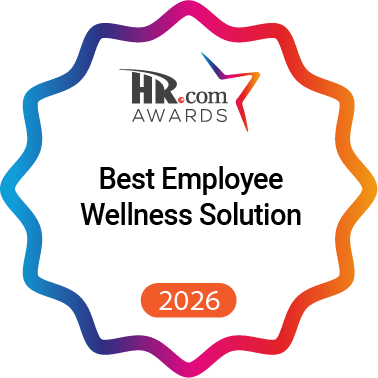
HR.com Best Employee Wellness Solution Award 2026 badge
Quick answer: Avidon Health has won the 2026 HR.com Best Employee Wellness Solution Award — independent recognition from the largest network of HR professionals in the world. The award validates Avidon's behavior change platform as the top-rated employee wellness solution for employers of any size, with particular recognition for making enterprise-grade wellness accessible to small and midsized businesses.

Avidon Health has been named the winner of the Best Employee Wellness Solution Award by HR.com, the largest network of HR professionals in the world, with over two million members. The award was announced May 12, 2026, as part of HR.com's annual Employee Well-being Awards program.

For HR and benefits leaders, this award provides third-party validation when evaluating employee wellness solutions. It reflects independent recognition from the community of HR professionals you work alongside every day.

What This Award Recognizes.

HR.com's evaluation focused on three areas that matter most to HR buyers: innovation, accessibility, and measurable outcomes. Avidon Health was recognized for its rebuilt behavior change platform, which delivers personalized, science-backed wellness journeys covering stress, sleep, movement, and nutrition without requiring IT support or a dedicated wellness coordinator.

The platform was specifically cited for democratizing workplace wellness, making enterprise-grade health coaching accessible to organizations of any size, including the small and midsized employers that have historically been underserved by the wellness industry.

2M+
HR professionals in HR.com's network who rely on the platform for career development, compliance, and solution evaluation.

"HR and benefits leaders put their credibility on the line every time they recommend a solution to leadership. This award is our commitment to them that their trust is well placed, and that we will keep earning it every day."

— Clark Lagemann, CEO, Avidon Health

Why This Matters to HR and Benefits Leaders.

Selecting an employee wellness solution is one of the highest-stakes decisions an HR leader makes. The wrong choice means low participation, wasted budget, and a program your employees ignore. The right choice builds a healthier, more engaged workforce and gives you the data to prove it to leadership.

According to the CDC, productivity losses related to employee health problems cost U.S. employers an average of $1,685 per employee per year. Effective wellness programs address that cost directly. But program effectiveness depends entirely on engagement, and engagement is where most platforms fail.

$1,685
Average annual cost per employee from health-related productivity losses, according to the CDC. Effective wellness programs reduce this directly.

Avidon's platform is built around cognitive behavioral science, the same evidence base used in clinical settings, applied to the everyday challenges your employees face. The result is a program that drives sustained behavior change, not just short-term participation spikes.

When HR.com recognized Avidon as the best employee wellness solution, it was recognizing a platform designed to solve the engagement problem that has plagued workplace wellness for decades.

Built for Small and Midsized Employers.

Most wellness platforms are built for large enterprises with dedicated HR teams, wellness coordinators, and IT infrastructure. Small and midsized employers have been left choosing between expensive enterprise tools they cannot support and low-quality consumer apps that do not move the needle.

Avidon was designed from the ground up to close that gap. Our wellness programs for small businesses deploy without IT support, launch in days rather than months, and are priced for organizations that need ROI, not just a wellness checkbox.

Avidon Health named winner of the HR.com Best Employee Wellness Solution Award 2026

"We built Avidon for the companies that enterprise wellness vendors overlook. Small and midsized employers deserve the same science-backed tools as the Fortune 500. This award validates that approach, and it motivates us to keep raising the bar."

— Tim Aumueller, CRO, Avidon Health

How Avidon Compares to Traditional Wellness Solutions.

HR leaders evaluating employee wellness solutions today face a crowded market with significant variation in quality, approach, and total cost. Here is how Avidon Health stands apart from the typical alternatives.

FactorAvidon HealthTypical Alternatives
Deployment timeDays, no IT requiredWeeks to months, IT involvement often required
Behavior change methodologyCognitive behavioral sciencePoints-based incentives, general content libraries
Company size fit10 to 25,000+ employeesOften enterprise-only or consumer-grade
Content personalizationIndividual care paths across 4 health domainsGeneric one-size programs
Third-party recognitionHR.com Best Employee Wellness Solution 2026Varies

About the HR.com Employee Well-being Awards.

HR.com is the largest network of HR professionals, with over two million members relying on the platform for career development, compliance resources, and solution evaluation. The annual Employee Well-being Awards recognize organizations making measurable contributions to how employers support the physical, mental, and behavioral health of their workforce.

Winners are selected based on innovation in program design, accessibility, and evidence of measurable outcomes. Being recognized by HR.com carries weight with HR and benefits buyers because it reflects the judgment of the professional community, not a vendor-sponsored ranking.

View the official HR.com award announcement

Common Questions About Avidon Health and This Award.

What is the HR.com Best Employee Wellness Solution Award? +

The HR.com Best Employee Wellness Solution Award recognizes the top workplace wellness platform of the year, as evaluated by HR.com, the largest network of HR professionals with over two million members. Winners are selected based on innovation, accessibility, and measurable employee outcomes. It is one of the most credible third-party endorsements in the HR technology space.

What types of companies is Avidon Health designed for? +

Avidon Health is built for employers of any size, with particular strength in small and midsized businesses that have been underserved by traditional wellness vendors. The platform deploys without IT support, requires no dedicated wellness coordinator, and scales from 25 to 25,000+ employees on the same platform.

How is Avidon different from other employee wellness solutions? +

Most wellness platforms rely on points-based incentives and general content libraries. Avidon Health is grounded in cognitive behavioral science, delivering personalized care paths across stress, sleep, movement, and nutrition. The result is sustained behavior change rather than short-term participation spikes. The platform also deploys in days, not months.

What topics does the Avidon wellness platform cover? +

Avidon Health's platform covers four core health domains: stress management, sleep improvement, physical movement, and nutrition. Each employee receives a personalized wellness journey based on their individual goals, delivered through courses, challenges, and coaching interactions all grounded in behavioral science methodology.

How quickly can we launch an Avidon wellness program? +

Most employers launch a fully configured Avidon wellness program within days. The platform is designed for instant deployment with no IT support required. If you have an HR contact and an employee roster, you have everything you need to get started.

Is Avidon Health a good fit for wellness programs for small businesses? +

Yes. Avidon Health was specifically built to make enterprise-quality wellness accessible to small businesses. It is priced for organizations that need real ROI, not just a wellness checkbox, and it requires no dedicated wellness coordinator or IT resources to run.

Ready to See What Award-Winning Wellness Looks Like?

Join the employers building healthier, more engaged teams with Avidon Health. No IT team needed. No wellness coordinator required. Launch in days.

Categories
Employers & HR Leaders

The Best Corporate Wellness Platform for Employee Engagement

Corporate Wellness Programs

Best Corporate Wellness Programs for Employee Engagement in 2026

The best corporate wellness programs for engagement combine behavior change science, low-friction participation, and personalized content delivery. Programs built on evidence-based methodologies consistently outperform activity trackers and generic health challenges, achieving participation rates 40–67% higher than traditional approaches.

Corporate wellness program engagement dashboard showing participation rates and behavior change metrics
Quick answer: The best corporate wellness programs for engagement are built on behavior change science, not activity incentives. Programs using cognitive behavioral training and similar evidence-based frameworks sustain participation rates 40–67% higher than points-and-rewards-only platforms. The programs ranked here are evaluated on methodology, real-world outcomes, and fit across organization sizes.

According to Gallup's 2025 State of the Global Workplace report, global employee engagement fell to 21% in 2024, and poor well-being is one of the top drivers of disengagement. The right wellness program doesn't just check a compliance box; it changes the conditions that create disengagement in the first place.

What Makes a Corporate Wellness Program Drive Engagement, Not Just Participation.

Participation and engagement are not the same thing. Participation means someone logged in. Engagement means they came back, changed a habit, and felt the program was worth their time.

According to a RAND Corporation study, wellness programs that rely solely on biometric screenings and fitness incentives see participation rates plateau at 20–30% after year one. Programs built around behavior change science sustain 60–70% ongoing engagement.

The difference comes down to four factors:

  • Behavior change methodology: Is the program built on proven frameworks like cognitive behavioral training (CBT) or acceptance and commitment therapy (ACT)?
  • Low time commitment: Employees won't engage with programs that feel like a second job. The best programs deliver value in 2–5 minutes per day.
  • Personalization: One-size wellness doesn't fit all. Programs that adapt to individual goals see 3x higher completion rates.
  • Psychological safety: Employees engage more when wellness content is confidential, judgment-free, and HIPAA-compliant.
21%
Global employee engagement in 2024, down from 23% the prior year — Gallup State of the Global Workplace 2025

The 7 Best Corporate Wellness Programs for Engagement.

1. Avidon Health — Best for Behavior Change-Driven Engagement

Avidon Health is the only corporate wellness platform built on a proprietary behavior change methodology that combines 14 evidence-based principles, including cognitive behavioral training, habit science, and motivational interviewing.

In a 7-day wellness challenge, Avidon clients achieved high engagement with just 2 minutes of daily participation, with health coaching expenses cut by 30% while participation increased by 67%. A municipal employer using Avidon's platform resolved a $32,000 wellness program challenge during a workforce crisis by shifting from traditional wellness incentives to behavior-focused programming.

HR.com recognized Avidon Health as the Best Employee Wellness Solution in 2026, citing its ability to make evidence-based coaching accessible to organizations of any size and drive lasting behavior change across stress, sleep, movement, and nutrition.

67% Increase in participation in a 7-day wellness challenge with just 2 minutes of daily activity
30% Reduction in health coaching expenses while engagement increased
91% Course completion rate, versus an industry average of 15%
88% Of participants achieved their health goals in outcome studies across thousands of users

Best for: Employers of any size who want measurable behavior change, not just participation metrics.
Key differentiator: The only platform with a published coaching efficacy report showing real-world client outcomes.

2. Wellable — Best for Broad Activity Tracking

Wellable is a points-based wellness platform that aggregates data from wearables, apps, and manual entries to reward healthy behaviors. It's a strong option for organizations that want a simple, incentive-driven wellness program with broad device compatibility. Companies using the platform report average participation rates of 50–60% during active challenge periods, though engagement tends to drop between challenge cycles without sustained programming.

Best for: Large employers looking for a straightforward incentives and activity tracking solution.
Limitation: Points-based models can drive short-term participation without producing lasting behavior change.

3. Personify Health — Best for Large Enterprise

Personify Health (formerly Virgin Pulse + HealthComp) is a comprehensive enterprise wellness and benefits navigation platform. It combines well-being programming, health plan data, and rewards into a unified employee experience. Its scale makes it well-suited for employers with 5,000 or more employees.

Best for: Enterprise employers who need wellness integrated with benefits administration.
Limitation: Implementation complexity and cost can be prohibitive for mid-market and small employers.

4. WellRight — Best for Customizable Challenges

WellRight offers a highly configurable challenge and points platform with strong customer support ratings. Employers can build custom wellness challenges around any health topic, with flexible team or individual formats. According to WellRight's 2024 outcomes data, employers using team-based challenges see 35% higher completion rates than individual challenges, a finding consistent with broader social accountability research in behavior change science.

Best for: HR teams that want creative control over their wellness challenge design.
Limitation: Content library depth is more limited than behavior change-focused platforms.

5. Limeade — Best for Culture-Focused Well-Being

Limeade (now part of WebMD Health Services) focuses on employee well-being through the lens of organizational culture. Its programming emphasizes belonging, purpose, and manager involvement alongside physical health. Research from Limeade's Institute found that employees who feel their company cares about their well-being are 38% more engaged and 18% more likely to go above and beyond at work.

Best for: Organizations with a strategic focus on culture transformation alongside well-being metrics.

6. Sprout at Work — Best for Data-Driven HR Teams

Sprout at Work is a wellness platform with strong reporting and analytics capabilities. HR teams can track program ROI, participation trends, and well-being metrics in real time, making it easier to justify wellness program spend to leadership. According to the International Foundation of Employee Benefit Plans, only 39% of organizations formally measure wellness program ROI. Platforms with built-in reporting help bridge this gap.

Best for: Data-driven HR teams who need to report program impact to leadership.

How to Choose the Right Corporate Wellness Program for Your Organization.

The right platform depends on three factors: your workforce size, your primary goal, and your internal capacity to manage programming.

GoalBest Fit
Drive lasting behavior changeAvidon Health
Simple activity tracking + rewardsWellable
Enterprise benefits integrationPersonify Health
Highly customizable challengesWellRight
Culture + well-being alignmentLimeade
ROI reporting + analyticsSprout at Work

For a full side-by-side breakdown of pricing, setup time, and ROI across these platforms, see our corporate wellness platform comparison.

According to the CDC Workplace Health Resource Center, the most effective wellness programs share three traits: leadership support, employee input in program design, and integration with existing HR systems. The platform you choose should enable all three, not create friction around them.

For small and mid-size employers specifically, the competitive window is real. According to SHRM's 2025 Employee Benefits Survey, only 39% of employers now offer structured wellness programs, down from 53% in 2021. For employers willing to invest, that gap is a meaningful competitive advantage in recruiting and retention.

How Avidon Health Approaches Corporate Wellness Engagement.

Avidon Health's approach is rooted in a simple premise: most wellness programs fail because they treat engagement as a participation problem when it's actually a behavior change problem.

Avidon's behavior-change methodology is built on 14 behavioral science principles, including cognitive behavioral training, values clarification, and habit stacking, that are designed to address the psychological barriers that prevent employees from sustaining healthy behaviors.

Rather than rewarding employees for checking boxes, Avidon builds intrinsic motivation. Clients have reported 67% increases in participation, 30% reductions in health coaching costs, and measurable improvements in stress, sleep, movement, and nutrition across industries ranging from municipal government to healthcare.

For employers who've tried generic wellness platforms and seen engagement plateau, Avidon's behavior-first design is a fundamentally different approach.

Common Questions About Corporate Wellness Programs.

What HR leaders ask most before evaluating platforms.

What is the most effective corporate wellness program for employee engagement?+
The most effective corporate wellness programs for engagement are built on behavior change science, not just activity incentives. Programs using evidence-based methodologies like cognitive behavioral training sustain participation rates 40–67% higher than points-and-rewards-only platforms. Avidon Health, Wellable, and WellRight consistently rank as top performers in HR buyer reviews for engagement-focused outcomes.
How much do corporate wellness programs cost?+
Corporate wellness programs typically range from $2–$15 per employee per month for digital-only platforms, up to $50–$150 per employee per month for comprehensive coaching and benefits integration. Small business-focused platforms like Avidon Health offer scalable pricing designed for organizations under 500 employees. According to SHRM, the average U.S. employer spends $742 per employee annually on wellness benefits.
What features drive the highest employee wellness program participation?+
The features most correlated with high participation are: short daily interactions (2–5 minutes), personalized content that adapts to individual goals, team-based social challenges, and mobile-first design. According to Avidon Health's published efficacy data, wellness challenges that take just 2 minutes per day can achieve the same engagement outcomes as longer-format programs, with significantly lower drop-off rates.
How do I measure corporate wellness program ROI?+
Measure wellness program ROI by tracking: participation rate, program completion rate, absenteeism reduction, healthcare utilization changes, and employee retention. A RAND Corporation study found that every $1 invested in workplace wellness programs returns $1.50 in reduced absenteeism and $3.27 in lower healthcare costs. Use platforms with built-in reporting dashboards to automate this tracking.
What is the difference between a wellness program and a wellness platform?+
A wellness program is the structured set of activities, challenges, and content that employees engage with. A wellness platform is the software that delivers, manages, and measures that program. The best corporate wellness outcomes come from platforms that also provide evidence-based programming, not just the infrastructure to run it.
Are corporate wellness programs worth it for small businesses?+
Yes. According to SHRM's 2025 Employee Benefits Survey, only 39% of employers offer structured wellness programs today, down from 53% in 2021. Platforms designed for smaller organizations, like Avidon Health, make it possible to launch a comprehensive wellness program without a dedicated HR team or large budget. The key is choosing a platform built for your scale, not an enterprise tool retrofitted downward.

Most Wellness Programs Generate Reports. Avidon Generates Results.

Most corporate wellness programs generate reports, not results. Avidon Health is built differently, grounded in behavior change science and recognized by HR.com as the Best Employee Wellness Solution of 2026.

Categories
Employers & HR Leaders

How Much Does a Wellness Program Cost Per Employee?

Employee Wellness Program Costs

How Much Does a Wellness Program Cost Per Employee?

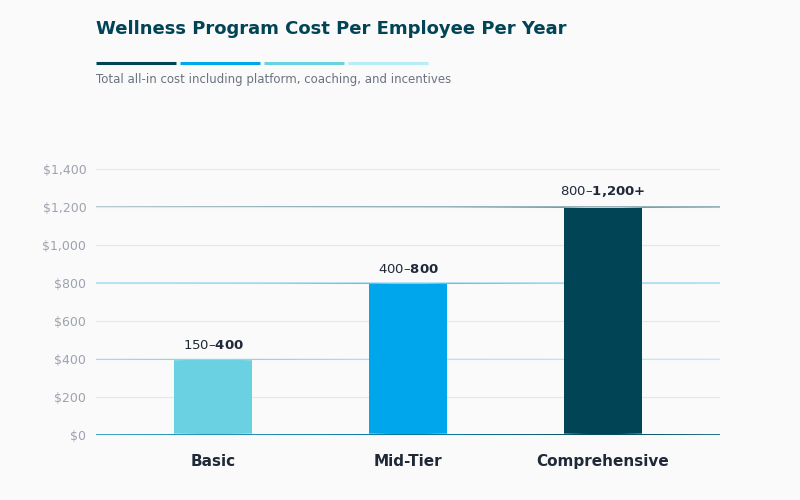
A workplace wellness program typically costs between $150 and $1,200 per employee per year. Most small and mid-size companies find a functional program in the $300–$500 range. The more important number: the cost of doing nothing.

Wellness program cost per employee benchmark chart showing cost tiers from basic to comprehensive
Quick answer: Workplace wellness programs cost between $150 and $1,200 per employee per year. Most small and mid-size companies land in the $300–$500 range once platform fees, coaching, and incentives are factored in. The industry average spend in 2024 was approximately $275 per employee, according to Shortlister's 2025 Workplace Wellness Trends Report. But the most important cost benchmark isn't the program fee. It's the $1,685 per employee per year that absenteeism alone costs U.S. employers, according to the CDC Foundation.

If you're an HR director at a 50–500 person company trying to build a business case, this guide gives you the real benchmarks, the honest ROI data, and a clear-eyed look at where wellness spending actually moves the needle.

Before we get to benchmarks: "doing nothing" has a price too. For a 200-person company running at 15% annual turnover, the conservative floor on inaction runs to $1.5 million per year in absenteeism and replacement costs combined. A mid-tier wellness program for those 200 employees at $500 per employee per year costs $100,000. The benchmarks below are worth knowing. But that ratio is the number that matters.

The Real Cost Breakdown: What You're Actually Paying For.

Most vendors quote a platform fee. That's not your total cost. A complete wellness program includes several layers:

Platform or software license: Basic digital wellness platforms run $2–$5 per employee per month ($24–$60 per year). Mid-tier platforms with AI personalization, analytics, and integrations typically run $5–$10 per employee per month.

Health coaching access: Adding 1:1 or group coaching can bring costs to $58–$100+ per employee per month for premium tiers. For most small and mid-size businesses, this is the line item that makes or breaks a program budget.

Incentives: Many employers offer $100–$300 per employee per year in wellness incentives: premium discounts, gift cards, or HSA contributions. This often exceeds the platform fee itself.

Biometric screenings: Typically $45–$75 per employee per event, conducted annually.

EAP (Employee Assistance Program): Standard EAPs cost $0.75–$4 per employee per month. High-touch mental health platforms with psychiatry networks run $10–$14 per employee per month.

When you add it up, here's how the tiers shake out:

Wellness Program Cost Tiers (Total Per Employee Per Year, All-In)

Program TierCost Per Employee Per YearWhat's Typically Included
Basic / Digital$150–$400Digital platform, wellness challenges, step tracking, basic content library
Mid-Tier$400–$800Above + health coaching, incentive programs, biometric screening, EAP or mental health integration
Comprehensive$800–$1,200+Above + 1:1 coaching, disease management, financial wellness, advanced analytics

Sources: HubEngage, WellSteps, CoreHealth. The industry average spend in 2024 was approximately $275 per employee, according to Shortlister's 2025 Workplace Wellness Trends Report. In practice, effective programs cluster between $300 and $600 once incentives and add-ons are factored in.

Wellness program cost tiers chart comparing basic, mid-tier, and comprehensive program pricing per employee per year

Why Smaller Companies Pay More Per Person.

If you run a 100-person company, you're likely paying a premium compared to a 5,000-person enterprise for the same platform. A 50-employee company may pay $400 per person per year for a program that costs a large employer $200, according to industry cost analysis.

The reasons are straightforward: fixed implementation and management costs are divided across fewer employees, small employers have less negotiating leverage with vendors, and most enterprise wellness platforms were built for large buyers and are only recently offering pricing that works for smaller organizations.

According to KFF's 2025 Employer Health Benefits Survey, 83% of large employers offer wellness programs versus 56% of firms with 10–199 workers. The market gap is real, and it's partly a pricing problem. For employers in that 56% who don't yet offer a program, that gap is a measurable competitive disadvantage in recruiting and retention.

The good news: digital-first platforms built specifically for smaller organizations have closed this gap significantly over the last few years. A well-structured program at $350–$500 per employee per year is achievable for most companies in the 50–500 employee range.

$1,685
Per employee per year in absenteeism costs to U.S. employers — CDC Foundation

What the ROI Research Actually Says.

This is where buyers need to slow down, because the evidence is more nuanced than most vendor one-pagers suggest.

The headline numbers

A landmark meta-analysis published in Health Affairs by researchers Katherine Baicker, David Cutler, and Zirui Song at Harvard found that medical costs fall $3.27 for every dollar spent on wellness programs, and absenteeism costs fall $2.73 per dollar. These are the most-cited figures in the field, drawn from 36 peer-reviewed studies.

The RAND Corporation's 10-year analysis of nearly 600,000 employees found an overall ROI of $1.50 per dollar invested, which is more modest but still positive.

The critical distinction most vendors skip

RAND's study separated two program types, and the difference is stark:

$3.80 Return per dollar invested in disease management programs (coaching, chronic condition support, health risk assessments) — RAND
$0.50 Return per dollar invested in lifestyle management programs (step challenges, gym discounts, general content) — RAND

Disease management programs also drove 86% of measurable healthcare savings. That's not a rounding error. A step-challenge app and a behavior-change coaching program are not the same investment. If your goal is healthcare cost reduction, the research points clearly toward programs with individual coaching, health risk assessments, and chronic condition support.

What this means for your business case

For companies under 500 employees, healthcare claims data is rarely statistically significant enough to measure. You won't have the sample size to detect changes in premiums or claims within one or two years.

A more defensible business case at smaller scale focuses on absenteeism and turnover, where the costs are visible and the returns are measurable faster. For a 200-person company with 15% annual turnover, the conservative math on replacement costs alone reaches $1.2 million annually. A mid-tier wellness program for 200 employees at $500 per employee per year costs $100,000. Even a modest reduction in turnover generates positive ROI.

Wondering what this looks like for your headcount?

Avidon's True Cost of Unhealthy Habits calculator estimates your workforce's exposure across the eight most common modifiable risks. No form. No sales call. Just the numbers.

The Hidden Cost of Doing Nothing.

Most HR directors evaluating wellness programs are comparing the program cost to zero. But "doing nothing" is not free.

Here's what the research says those costs look like for a 200-person company:

Cost of InactionAnnual Estimate (200 employees)
Absenteeism ($1,685/employee — CDC Foundation)$337,000
Turnover (15% rate, $40K avg replacement cost)$1,200,000
Rising healthcare premiums (KFF: 6% increase in 2025)Employer-specific
Total floor$1.5M+
Mid-tier wellness program at $500 per employee per year$100,000

According to Gallup, workers with poor mental health miss nearly 12 days per year compared to 2.5 days for healthier employees. Approximately one million workers miss work every single day due to stress-related illness. SHRM's 2025 Employee Benefits Survey found that structured wellness programs are now offered by only 39% of employers, down from 53% in 2021. For employers willing to invest, that gap is a real competitive advantage in recruiting and retention.

Mental Health: The Fastest-Growing Wellness Budget Item.

Mental health has become the dominant driver of wellness investment decisions. A large majority of HR managers increased their mental health budgets in 2025 versus 2024, yet traditional EAP programs average only 4% utilization, according to SHRM. That's a cost-per-engaged-employee problem, not a bargain.

Modern mental health platforms with better engagement design see utilization rates of 20–42%, according to recent industry research. A 2024 Cigna Healthcare integration study found $193 per member per year in medical cost savings when behavioral health is integrated with medical and pharmacy benefits.

How Avidon Health Approaches Wellness Program Cost.

Avidon Health is built for companies between 50 and 500 employees that need a real program at a price that makes sense for their size.

On cost: Avidon sits at the lower end of the basic-to-mid-tier range covered in this guide. The platform replaces the patchwork of separate vendors most employers cobble together for challenges, coaching, content, and reporting. One platform covers what the RAND research identifies as the components that actually move health outcomes: behavior change courses grounded in cognitive behavioral training, health risk identification, and coaching accountability.

On participation: engagement is the variable that determines whether any program generates ROI. Avidon's course completion rate is 91%, against an industry average of 15%. In a study of 300 participants, adding Avidon's platform to live coaching increased program completion by 112% compared to no coaching. In outcome studies across thousands of participants, 88% achieved their health goals and 91% said Avidon was essential to their success.

On admin burden: most employers launch within a week. Pre-built courses and monthly challenges deploy automatically with no content creation or IT integration required. No wellness coordinator needed.

For HR teams who have been through a failed wellness launch before, that last point matters as much as the first two. A program that runs itself is the only program that actually runs.

See how Avidon works for employers

Common Questions About Wellness Program Costs.

Answers to what HR directors ask most before building a business case.

How much does a corporate wellness program cost per employee?+
Most companies spend between $150 and $1,200 per employee per year on wellness programs, depending on program depth. A functional mid-tier program for a small or mid-size company typically runs $300–$500 per employee per year when platform fees, coaching, and incentives are included. The industry average spend in 2024 was approximately $275 per employee.
We tried an employee wellness program before and nobody used it. What makes this different?+
The RAND Corporation's 10-year analysis found that lifestyle management programs (step challenges, gym discounts, basic content) returned just $0.50 for every dollar invested. Disease management and behavior change programs returned $3.80 per dollar. If your previous program was in the first category, that's not a participation problem. It's a methodology problem. Programs built on cognitive behavioral training show meaningfully different outcomes. In studies across thousands of Avidon participants, 91% completed their courses (against an industry average of 15%), 88% achieved their health goals, and 91% said the program was essential to their success. The difference between a program people use and one they ignore is usually the science underneath it, not the incentive on top.
What is the ROI of an employee wellness program?+
Harvard researchers found that medical costs fall $3.27 for every dollar invested in wellness programs, and absenteeism costs fall $2.73 per dollar. RAND's 10-year analysis found an overall ROI of $1.50 per dollar. Returns are highest in programs that include health coaching and disease management, not just lifestyle challenges or step tracking.
Do small businesses pay more for wellness programs?+
Yes. A 50-employee company often pays up to 2x per employee compared to a 5,000-person enterprise for the same platform, due to lower negotiating leverage and fixed administrative costs spread across fewer people. Digital-first platforms built for smaller organizations have reduced this gap significantly.
How long does it take to see ROI from a wellness program?+
Disease management components can generate measurable healthcare savings within 12–24 months. Absenteeism and turnover reductions are typically visible within the first year. The Harvard meta-analysis figures ($3.27 per dollar) reflect mature programs with 3 or more years of sustained engagement. For companies under 500 employees, tracking turnover and absenteeism is a more reliable near-term ROI measure than claims data.
What drives wellness program cost the most?+
Program scope is the biggest variable. Adding health coaching, an incentive structure ($100–$300 per employee per year), and mental health or EAP integration can triple the base platform cost. The second-biggest driver is participation rate. A program that only 20% of employees use delivers a fraction of the value of one with 50%+ engagement.
Is a wellness program worth it for a 100-person company?+
Based on the available evidence, yes. If the program includes behavior change and coaching (not just lifestyle content), the math works. At 15% annual turnover (15 employees), replacement costs at a conservative $40,000 average could reach $600,000. A wellness program that reduces turnover by even 10–15% generates a return that exceeds the program's cost within the first year.

Ready to See What a Program Costs for Your Team?

Avidon Health publishes pricing for teams of every size. See what a behavior-change-driven program costs for yours.

Categories
Employers & HR Leaders

Best Wellness Platforms for Small Teams on a Budget (2026)

Buyer's Guide

Best Wellness Platforms for Small Teams on a Budget (2026)

Not every wellness platform was built for a 25-person team. This guide compares six options on price, setup time, admin overhead, and actual outcomes so you can decide with confidence.

HR manager reviewing wellness platform options for a small business team
The right wellness platform for a small team is affordable, launches fast, requires no dedicated wellness coordinator, and actually gets used. According to a 2025 HR.com survey of 215 HR professionals, budget constraints are the single biggest reason small businesses have not launched a wellness program. This guide compares six platforms on the dimensions that matter most for lean teams: price per employee, setup time, admin overhead, program depth, and evidence of real outcomes.

Why Small Teams Need a Different Kind of Wellness Platform

Most wellness platforms were designed for companies with 1,000 or more employees, a dedicated HR team, and a wellness coordinator on staff. For a business with 15 to 150 employees, those platforms create more work than they solve.

According to HR.com's 2025 Future of Employee Well-being Survey, only 41% of organizations rate their wellness programs as highly effective. The most common failure mode is a mismatch between program design and what employees actually need, a problem that compounds when enterprise tools are shoehorned into small-team environments.

Small teams need four specific things:

Budget
Affordability
The market standard for small business wellness is $1 to $5 per employee per month. Total annual investment should stay well under $10,000 for most teams under 150 employees.
Speed
Fast Setup
Platforms that can launch in minutes, not months, are the practical filter for this buyer. No IT involvement, no complex implementation.
Operations
Low Admin Lift
If running the program requires ongoing management from someone already wearing five hats, participation will collapse. Automation is not a nice-to-have; it is a requirement.
Access
Digital-First
Remote and hybrid teams are the norm for small businesses. A platform that requires employees to be in one building is a non-starter.

What Actually Drives Participation (and Why It Matters More Than Features)

The average corporate wellness program sees 40 to 50% participation. Poorly designed programs fall well below that. High participation is not a product of perks or rewards. It is a product of program design.

The research on this is clear. According to Wellhub's 2025 Return on Wellbeing data, companies offering four or more wellness dimensions, including fitness, mental health, nutrition, and financial, are 24% more likely to achieve 150% or higher ROI, compared to less than 50% returns for one- or two-feature programs.

The reason most platforms underperform is that they stack features without addressing the underlying behavioral barriers to sustained engagement. A steps challenge with a leaderboard is easy to build. A program that produces lasting habit change requires a fundamentally different design approach.

Real-world results bear this out. One small employer running Avidon's 7-Day Wellness Quiz Challenge, a micro-engagement format requiring just 2 minutes of daily participation, saw consistent daily completion throughout the entire challenge period with zero administrative input from HR. A separate employer came to Avidon with wellness participation sitting below 20%. After Avidon identified the root causes, including platform underutilization, no supervisor buy-in, and employees who found the program intimidating, and addressed each one directly, that organization reached 100% employee engagement. The participation problem is solvable. The design of the solution is what determines whether it gets solved.

Avidon's cognitive behavioral training methodology addresses why people start programs and stop, which is why our completion and outcome data look different from the industry average. As CEO Clark Lagemann said at the launch of our small business platform: "For too long, the best tools were priced out of reach for smaller companies. We rebuilt everything to serve the teams who need it most."

96%
of Avidon participants recommend the programs to others, based on 7,000+ exit surveys

The Business Case: What Small Businesses Actually Get Back

Budget anxiety is the primary reason small businesses do not launch wellness programs. The data says that anxiety is costing them more than the programs would.

Harvard research estimated that for every $1 invested in wellness programs, medical costs fall by approximately $3.27 and absenteeism costs drop by about $2.73. Wellhub's 2025 CEO survey found that 78% of small business CEOs reported returns of 50% or more on their wellness investments, with 30% seeing over 100% ROI.

The urgency is increasing. Small business healthcare costs are projected to rise 11% in 2026, according to Wellhub's small business wellness guide. Every month without a prevention-focused program is a month of avoidable cost accumulating.

For retention, the numbers are equally direct. Bank of America research found that 39% of employees cite strong benefits as the primary reason they stay. For a 25-person company, losing two people to a competitor with better benefits is not an abstract concern. It is a six-figure replacement cost.

$3.27 Medical cost reduction for every $1 invested in wellness (Harvard research)
78% of small business CEOs report 50%+ ROI on wellness investments (Wellhub 2025)
11% Projected rise in small business healthcare costs in 2026
39% of employees cite strong benefits as the primary reason they stay (Bank of America)

6 Wellness Platforms Worth Considering for Small Teams

The platforms below are evaluated on the criteria small teams actually use to make decisions: price, minimum team size, setup time, admin requirements, program depth, and whether there is published evidence of outcomes.

PlatformPrice (PEPM)Min. EmployeesSetup TimeAdmin BurdenProgram DepthOutcome Data
Avidon HealthStarting under $310+MinutesVery low (automated)Full (CBT-based, multi-dimensional)Yes (96% rec. rate, 38.1% tobacco quit rate)
YuMuuv~$2-310+1-2 hoursLowChallenges + activity trackingLimited public data
Sprout at Work~$3-525+1-2 daysModerateMulti-dimensionalModerate (vendor-reported)
Wellable~$3-525+1-2 daysModerateMulti-dimensionalModerate
Burnalong~$5-825+2-5 daysModerateFitness + classes focusedLimited SMB data
Virgin PulseCustom (typically $8+)200+WeeksHigh (coordinator recommended)Enterprise-gradeYes (large employer)
A note on pricing: most platforms list base rates that do not include add-ons, incentives administration, or implementation fees. Total cost of ownership often exceeds the headline per-employee-per-month rate. When evaluating any platform, ask for an all-in number for your specific team size.

How to Choose: A Checklist for Small Teams

Use this checklist before committing to any platform. The questions are ordered by the priorities that matter most for teams under 150 employees.

Infographic showing wellness platform selection criteria for small teams

Budget

  • Is the all-in cost under $5 per employee per month?
  • Are there setup fees, minimum contracts, or add-on charges?
  • Is there a free trial or pilot option?

Setup and Admin

  • Can the program launch without a wellness coordinator?
  • How much ongoing admin time is required weekly?
  • Is employee onboarding automated?

Employee Experience

  • Does the platform work for remote and hybrid employees?
  • Is the mobile experience strong enough for non-desk workers?
  • Does the content address multiple wellness dimensions (physical, mental, nutritional, financial)?

Evidence of Outcomes

  • Does the vendor publish completion rates and goal achievement data?
  • Is the program design grounded in behavior change research?
  • Are there case studies from companies similar in size to yours?

How Avidon Health Is Built for This Buyer

Avidon Health is not a downmarket version of an enterprise platform. It was rebuilt in 2025 specifically for businesses that do not have a wellness coordinator, IT support, or a large HR team, and the outcome data reflects that design intent.

The platform's foundation is cognitive behavioral training. Rather than relying on rewards and leaderboards to drive short-term engagement, CBT-based design addresses the cognitive and behavioral barriers that cause people to start programs and then stop. That difference shows up in the numbers: 96% of participants recommend Avidon's programs (based on 7,000+ exit surveys), and a San Diego State University controlled study documented a 38.1% tobacco quit rate among participants. For context, industry-average wellness program participation sits at 40 to 50%. Avidon's outcomes reflect a different design philosophy, not incremental improvements on the same approach.

For teams that have been through a wellness program that nobody used, that distinction matters more than any feature comparison.

For small teams, the practical advantages are equally significant:

  • Launch time: The platform can be set up in minutes. No IT involvement, no implementation timeline, no waiting.
  • Zero coordinator required: Challenges, nudges, health risk identification, and reporting are fully automated through Challenges Autopilot. One small business ran a 7-day wellness challenge requiring just 2 minutes of daily participation from employees and zero minutes of management from HR.
  • Content that covers every employee: 40+ courses, 700+ resources, monthly challenges, trackers, and optional coaching across physical, mental health, nutritional, and financial wellness. Something for every employee, regardless of where they are or what they need.
  • HIPAA compliance: Built in, not an add-on.
  • Pricing: Plans starting under $3 per employee per month, with no enterprise minimums. See Avidon Health pricing for details.

What to Avoid When Evaluating Wellness Platforms

Some features are standard in enterprise platforms but create unnecessary overhead for small teams. Watch for these during your evaluation:

  • Biometric screening coordination. Requires on-site logistical support that most small businesses do not have.
  • Rewards marketplace administration. Points systems and merchandise catalogs create ongoing management work that compounds over time.
  • Complex HRIS integrations. Setting up payroll or benefits system integrations often costs more time than it saves at under-150-employee scale.
  • Custom app development or white-labeling. Relevant for companies with large employer brands; irrelevant for most small teams.

If a vendor is leading with any of these in their pitch to a small business, that is a signal the platform was not designed with your team size in mind.

For more ideas on what a program could include, see 26 best wellness ideas for small businesses and employee wellness programs for small businesses.

Frequently Asked Questions

Common questions from HR leaders and business owners evaluating wellness platforms.

How much does a wellness platform cost for a small business? +
Most wellness platforms designed for small businesses cost between $1 and $5 per employee per month. At 50 employees, that is $600 to $3,000 per year before any add-ons. Enterprise platforms with coordinator support typically run $8 or more per employee per month and often require minimum employee counts of 200 or higher. Always ask for the all-in annual cost, not just the base rate.
Do I need a wellness coordinator to run a wellness program? +
No, if you choose the right platform. Platforms built for small businesses automate challenge delivery, employee nudges, progress tracking, and reporting. Avidon Health, for example, is designed to run without any dedicated wellness staff. Platforms built for large employers often assume a coordinator will manage logistics, which is a meaningful hidden cost for small teams.
What is a realistic participation rate for a small business wellness program? +
Industry-wide, corporate wellness programs average 40 to 50% participation. Programs with strong behavior change foundations and automated engagement consistently outperform that benchmark. Avidon's CBT-based approach has achieved 100% employee engagement in documented turnaround cases, starting from organizations where participation was below 20%. The design of the program matters far more than incentive budgets for driving sustained participation.
How long does it take to launch a wellness program for a small team? +
It depends on the platform. Enterprise platforms typically require weeks of implementation, IT coordination, and onboarding. Platforms purpose-built for small businesses can launch in minutes to a few hours. Setup time is one of the most meaningful differentiators for resource-constrained HR teams, and it is worth asking vendors for a concrete answer rather than accepting a vague "easy onboarding" claim.
What kind of ROI can a small business expect from a wellness program? +
According to Wellhub's 2025 Return on Wellbeing survey, 78% of small business CEOs reported returns of 50% or more on their wellness investments. Harvard research estimated that for every $1 spent on wellness, medical costs fall by approximately $3.27 and absenteeism costs drop by about $2.73. ROI varies significantly based on program quality and employee participation, which is why choosing a platform with published outcome data matters.
Does my business need a minimum number of employees to use a wellness platform? +
Minimums vary by platform. Enterprise platforms like Virgin Pulse typically require 200 or more employees. Mid-market platforms often have minimums of 25 to 50. Avidon Health is designed for teams starting at 10 employees, with no enterprise minimum. If your team is under 25 employees, confirm the minimum directly with any vendor before starting an evaluation.
What wellness dimensions should a small business program cover? +
According to Wellhub's 2025 research, companies offering four or more wellness dimensions, physical, mental health, nutritional, and financial, are 24% more likely to achieve 150% or higher ROI than programs covering only one or two areas. For small teams, a platform that covers all four in a single product is more practical and cost-effective than assembling multiple point solutions.
How do I know if a wellness platform will actually work for my employees? +
Look for platforms that publish first-party outcome data: course completion rates, goal achievement rates, and health metric improvements among participants. Generic claims about engagement are not the same as published numbers. Avidon Health publishes outcome data from its own participant base, including a 96% recommendation rate across 7,000+ exit surveys. For any platform you evaluate, ask: "Can you share completion rates and goal achievement data from companies similar in size to ours?"

Ready to See What This Looks Like for Your Team?

Avidon Health was built specifically for businesses that need real results without the enterprise overhead. Most teams are up and running in under 10 minutes.

Categories
Employers & HR Leaders

Virtual Health Coach Uses for Company Wellness Goals

Workplace wellness has come a long way in recent years. What started as step challenges and occasional lunch and learn talks has shifted into something more connected to daily work life. More HR teams are looking for support tools that do not pile on admin work or require every employee to approach wellness the same way.

A virtual health coach can help meet those needs. It offers flexibility, personal guidance, and steady support to employees, no matter their schedule or location. When done right, it does not just offer information. It helps people follow through on real behavior change. Let’s walk through how companies are leaning on virtual coaching to drive everyday wellness across their teams.

Building Better Daily Habits at Scale

Small habits create big change, but staying consistent without support is tough. A virtual health coach adds the kind of nudge people need to follow through without pressure. Better yet, it works for many people at once while still feeling personal.

We have seen how helpful it is when employees can pick small lifestyle goals like:

  • Drinking an extra glass of water each day
  • Getting out for a 10 minute walk between meetings
  • Turning off screens earlier to improve sleep

A virtual coach can send simple reminders or set quick check-ins to help those habits stick. These moments might seem small, but when they show up inside the tools people already use, on their phone, through email, or linked to their calendar, they become part of the everyday rhythm.

Helpful prompts or words of encouragement make a big difference, especially when the message feels personal. Over time, consistent guidance like this helps shift culture. Wellness becomes something your team lives out in small ways each day, not just a once a quarter campaign.

Avidon Health’s virtual health coach solution includes real-time habit tracking, personalized reminders, automated wellness content, and scalable coaching delivered via mobile, desktop, or chat. This approach supports each team member while reducing the administrative lift for HR.

Supporting Mental Health Without Stigma

It is not always easy to talk about stress or burnout at work. Many employees still hesitate to bring up mental health needs, especially in fast moving or remote work settings. This is where a virtual health coach can offer real support without pressure.

By offering judgment free, private spaces to reflect and ask questions, virtual coaching opens doors for more honest conversations. Employees can look for help managing overwhelm or lack of energy without having to schedule something formal. They may choose to message a coach late at night or book a flexible session before the workday starts.

When support meets employees where they are, it grows trust. Small shifts in how someone views rest, movement, or work boundaries can lead to better energy and focus over time. And when those shifts come through gentle, skilled interaction, not strict programs or lectures, they are more likely to last.

Offering More Personalization With Less Admin Work

Every employee’s wellness needs look different. Someone in sales might be burning out from travel. Someone else in operations might want help with low energy or movement. Trying to meet everyone’s needs can feel overwhelming, especially when HR teams already feel stretched.

One of the biggest benefits of a virtual health coach is how easily it can adjust based on who is using it. Employees can set their priorities and move at their own pace, whether they want to focus on eating habits, mindfulness, or energy. Behind the scenes, the system adapts based on what is working, all without needing customized materials for each role.

This kind of automation takes the pressure off of HR. Personalized support still gets delivered, but we are not creating individual plans or scheduling reminders ourselves. It is one less batch of tasks to manage, making wellness more scalable without losing the human touch.

In addition, our programs use analytics dashboards that let HR measure engagement and wellness results without having to pull manual reports. This gives instant feedback on what is helping most, all while keeping employee information private and secure.

Boosting Program Engagement and Follow-Through

Launching a wellness program is one thing. Keeping people involved after the first few weeks is another. A virtual health coach helps bridge that gap by staying in touch in ways that feel natural, not forced.

It might show up as:

  • A well timed reminder for a walking break
  • A midweek message asking how the week is going
  • A quick prompt to check progress on a set goal

These touchpoints are not meant to nag. Instead, they create structure and show employees that their goals matter, even when work kicks up. And when the system tracks progress over time in a simple, visual format, it adds encouragement. That feeling of momentum helps people stick with their wellness efforts longer than a one time challenge ever could.

The more connected employees feel to the process, the more they bring that motivation into other parts of their week.

Turning Coaching Data Into Real Insights

Wellness wins are harder to track than most numbers at work. Still, it helps to see where things are moving in a good direction, and where support could be adjusted. A virtual health coach makes that part easier too.

The coaching platform can gather feedback and usage data without focusing on individual behavior. Instead, the information builds trends across departments or job types. HR leaders can spot where engagement is strong or where stress seems to be building up.

The key is that this data does not add another report to pull. Overview dashboards give us just enough insight to act without drowning in details. And since it is coming through a tool already in use, there is no need for extra surveys or follow ups.

Smart data does not replace conversation, but it does help kickstart the right ones.

Making Wellness Feel Easy (And Real)

The best part of using a virtual health coach is that it adapts to real life. It supports people in different jobs, with different energy levels, without needing everyone to join a call or fill out a worksheet. It helps us make wellness practical, not polished.

Whether someone wants to walk more, breathe easier after meetings, or simply have a place to check in when things feel heavy, virtual coaching gives them that outlet. And for HR leaders, it offers a way to bring wellness into the daily flow without extra meetings, reports, or micromanaging.

When health support feels like a useful tool instead of another task, people are more likely to use it. Quiet progress shows up in better energy, stronger habits, and a steadier team, one small step at a time.

Adding more structure and support to your wellness initiatives does not have to be overwhelming. A tool like a virtual health coach empowers your team to make meaningful behavior changes while fitting effortlessly into their daily routines, whether they are in the field, at a desk, or working from home. At Avidon Health, we focus on making wellness simple and achievable. Connect with us to learn how this solution can benefit your organization.

Categories
Health Coaches

Health Coaching Platforms: What to Look For (and What to Avoid)

Health Coaches

Health Coaching Platforms: What to Look For (and What to Avoid)

Not all health coaching platforms are built for real coaching work. Here's what coaches and HR teams should evaluate before committing to one.

Health coach working with a client on a digital wellness platform
The best health coaching platform lets coaches deliver personalized, scalable programs without being buried in admin work. Look for built-in behavior change tools, HIPAA-compliant data handling, automated client communication, and reporting that shows real outcomes. Choosing the wrong platform costs more than money. It costs engagement.

According to McKinsey, 50% of consumers now use AI-powered search as their primary way to find health information, which means the platform coaches use to deliver programs needs to meet clients where they already are. Here is what coaches and HR teams need to know before committing to one.

What Makes a Health Coaching Platform Worth Using?

A good health coaching platform does three things well: it structures the coaching program, automates the operational overhead, and proves the results. Everything else is a nice-to-have.

The core features that separate effective platforms from glorified scheduling tools are:

Core Feature
Behavior Change Course Delivery
The ability to create and assign structured programs, not just send reminders. This is what turns a scheduling tool into a coaching platform.
Core Feature
Challenge and Tracker Management
Tools that drive daily habit formation between sessions. Coaching happens in the session; behavior change happens between them.
Core Feature
Automated Member Communication
Nudges, check-ins, and milestone messages that run without manual effort. If you're writing every message yourself, the platform is not doing its job.
Core Feature
HIPAA-Compliant Data Storage
Non-negotiable for any platform handling health information. This is a legal requirement, not a feature tier.
Core Feature
Reporting and ROI Dashboards
Coaches and employers both need to see what is working. Without outcome data, the program cannot improve and the budget cannot be justified.

According to a 2024 RAND Corporation study, structured wellness programs that include behavior change curricula reduce employee absenteeism by up to 25% compared to programs offering only access to fitness resources.

HIPAA Compliance: Why It Matters More Than Most Platforms Admit

A health coaching platform handles sensitive personal health information. That makes HIPAA compliance a legal requirement, not a feature.

Many platforms market themselves as "health-focused" without meeting the technical standards that HIPAA actually requires: encrypted data transmission, Business Associate Agreements (BAAs), audit logging, and access controls. Coaches who use non-compliant platforms expose themselves and their clients to significant liability.

Before signing with any platform, ask three direct questions: Do you offer a signed BAA? Is PHI (protected health information) encrypted at rest and in transit? Who within the platform's organization has access to client data?

Avidon Health is built to HIPAA standards, with full BAA availability and enterprise-grade security. You can review the technical specs on the security and compliance page.

Virtual Health Coaching vs. In-Person: Does the Platform Matter?

Yes. The platform is the difference between virtual coaching that works and virtual coaching that feels like a substitute for the real thing.

In-person coaching benefits from real-time body language, environmental cues, and the psychological weight of a scheduled room. A virtual health coach needs the platform to carry some of that structure. The best platforms compensate through daily micro-engagements: short check-ins, habit trackers, automated encouragement tied to specific program milestones, and community features that create accountability between sessions.

3x
Higher engagement rates for digital coaching programs that include daily touchpoints versus session-only models, according to the American Journal of Health Promotion.

The platform has to do the work between sessions. If it cannot, coaches will spend all their time chasing clients instead of coaching them.

What Health Coaches Should Evaluate Before Choosing a Platform

The best way to evaluate a health coaching platform is to run a test program on it before committing. Short of that, here is the framework to use:

Evaluation AreaWhat to Look ForRed Flag
OnboardingWhite-label setup, custom brandingForces you to use their brand
Content ToolsCourse builder, challenge templatesPDF uploads only
Client CommunicationAutomated nudges, segmented messagingManual email only
ReportingPer-client and aggregate dashboardsNo outcome data
ComplianceSigned BAA, HIPAA documentation"We take privacy seriously" with no specifics
SupportDedicated onboarding, live supportFAQ-only help center
PricingTransparent, scales with membersHidden fees, per-seat pricing at small scale

Platforms that score poorly on compliance and reporting are worth skipping regardless of how good the content tools look. Those two areas are where coaches and employers most commonly get burned.

How Avidon Health Approaches the Health Coaching Platform Problem

Avidon was built specifically for coaches and employers who need to deliver structured, behavior-change-based programs at scale. The platform is not a generic wellness app repurposed for coaching. It is purpose-built for the use case.

The core of Avidon's approach is cognitive behavioral training (CBT), applied through digital courses, habit trackers, and wellness challenges that coaches can customize for any population. Coaches can create their own content, use Avidon's pre-built library, or combine both. Everything runs inside a white-labeled environment, so clients experience the coach's brand, not Avidon's.

60-70% Average participation rates reported by employers using Avidon Health
20-30% Industry average participation for traditional wellness programs

That gap comes from the behavioral architecture underneath the platform, not just the technology. You can explore the platform features or register for a free demo to see how it works in practice.

Common Questions About Health Coaching Platforms.

Everything coaches and HR teams ask before choosing a platform.

What is a health coaching platform? +

A health coaching platform is software that lets coaches or employers design, deliver, and track personalized wellness programs for clients or employees. The best platforms include tools for behavior change courses, habit tracking, automated messaging, HIPAA-compliant data handling, and ROI reporting. They are distinct from fitness apps or general wellness portals, which lack the structured coaching infrastructure.

Do health coaching platforms need to be HIPAA compliant? +

Yes, if the platform stores or transmits any protected health information (PHI). This includes health assessments, biometric data, coaching notes, and any personally identifiable information connected to a health record. Coaches and employers should require a signed Business Associate Agreement (BAA) from any platform vendor before collecting client data.

What is the difference between a health coaching platform and a wellness app? +

A wellness app is typically consumer-facing and self-guided, think step counters or meditation timers. A health coaching platform is designed for practitioners: it includes program-building tools, client management, communication automation, and outcome reporting. The distinction matters when evaluating whether a platform can actually support a coaching practice or a corporate wellness program.

How much does a health coaching platform cost? +

Pricing varies significantly. Consumer apps often charge $10-30 per user per month. Enterprise-grade coaching platforms typically price by program size, active members, or organizational headcount and usually range from a few hundred to several thousand dollars per month depending on features and scale. Avidon Health offers transparent pricing for coaches and employers.

Can small businesses use a health coaching platform? +

Yes. Purpose-built platforms like Avidon are designed to scale both up and down. Small employers with 20 employees and large companies with 10,000 employees can use the same platform infrastructure. The key is finding a platform that does not penalize small programs with minimum seat requirements or high per-user costs at low volume.

See the Platform for Yourself.

Find out if Avidon is the right fit for your practice or organization. No commitment, no sales pitch.

Categories
Individuals

What to Expect from Your First Virtual Health Coaching Session

New to Coaching?

What to Expect from Your First Virtual Health Coaching Session

Starting something new always brings a mix of curiosity and nerves. If you have signed up for virtual health coaching and are not sure what actually happens in that first session, this is your straightforward guide to what it looks like, how to show up, and what you will walk away with.

Person having a virtual health coaching session on a laptop
Your first virtual health coaching session is a conversation, not a test. Your coach will ask about your current habits, help you clarify what you want to change, and work with you to create a simple, realistic starting point. You do not need to prepare extensively or have your goals figured out ahead of time.

It's a Conversation, Not a Performance

The most important thing to know going in: your first session is not a test. You do not need to have everything figured out or show up with a perfect health history and a five-year plan.

Your coach's job in that first meeting is mostly to listen. They want to understand where you are starting from — what has been working, what has not, and what matters most to you right now. You talk, they ask questions, and together you start to figure out what a realistic path forward looks like for your life specifically.

A lot of people leave the first session surprised by how much it just felt like a good conversation.

What Actually Happens

You'll Cover the Basics of Where You Are Now

Your coach will ask about your current habits including how you are eating, how much you are moving, how you are sleeping, and what your stress levels look like. This is not an interrogation. It is just context so they can actually help you instead of giving you generic advice that does not fit your life.

You do not need to have exact numbers or detailed logs. Honest and approximate is fine.

You'll Talk About What You Actually Want

This part matters more than people expect. Your coach will help you get specific about what you are hoping to change and why it matters to you. Not just "I want to be healthier" but what that actually looks like in your day-to-day life.

Getting clear on this early makes everything that follows more focused and more useful.

You'll Leave With a Starting Point, Not a Rigid Plan

By the end of the session, you will have a simple, realistic action plan with a few things to focus on before the next check-in. It is not a full overhaul. It is a starting point that is built around your schedule, your habits, and what you are actually willing to try.

The goal is something doable, not something impressive on paper that falls apart in week two.

A Few Things That Help Before You Show Up

You do not need to prepare extensively, but it helps to spend a few minutes thinking about:

  • What has been your biggest obstacle to making changes before?
  • Is there one area of your health you most want to address right now?
  • What does a realistic week look like for you in terms of schedule, energy, and obligations?

You will not be quizzed on any of this. It just helps you get more out of the conversation.

What Makes Virtual Coaching Work

The virtual format is genuinely convenient. No commute, you can join from wherever you are, and scheduling tends to be more flexible than in-person options. But the thing that makes it actually work is consistency.

One session will not change much on its own. The value builds over time through follow-up check-ins, adjustments when something is not working, and having someone in your corner who knows your situation and can help you course-correct when life gets complicated. That is how lasting habits form through repetition and support, not a single conversation.

Most people find that the accountability piece knowing someone will ask how things went is what finally makes the difference.

Common Questions About Your First Session.

Everything you want to know before you start.

Do I need to do anything to prepare for my first session? +
No major prep required. It helps to have a rough sense of what you want to work on, but your coach will guide the conversation. Just show up and be honest about where things are.
How long does the first session usually take? +
Most first sessions run 45 to 60 minutes since there's more ground to cover upfront. Follow-up sessions are often shorter once the relationship and goals are established.
What if I don't know what my goals are yet? +
That's completely normal. A big part of the first session is helping you get clear on what you actually want. You don't need to walk in with a goal already figured out.
Will my coach tell me exactly what to eat and how to exercise? +
Not exactly. Coaches help you build habits and make decisions that work for your life — they're not prescribing meal plans or handing you a rigid workout schedule. It's more collaborative than that.
What happens between sessions? +
You'll have a simple action plan to work on, and most coaches offer some form of check-in support between sessions. The follow-up session is where you review what happened, what worked, and what to adjust.
Is virtual coaching as effective as in-person? +
Research consistently supports virtual coaching as equally effective for most people. A published PubMed study found that virtual one-on-one coaching produced meaningful improvements in well-being, self-efficacy, and stress reduction. The convenience often leads to better consistency, which matters more than the format.

Ready to See What Coaching Can Do?

Explore Avidon Health and find out what a first session could look like for you.

Categories
Employers & HR Leaders

Health Coach App Features HR Should Look For

Supporting employee wellness shouldn’t feel like adding more to the to-do list. Many HR leaders are looking for ways to bring structure and support to wellness without overcomplicating what’s already a busy day. A smart health coach app can do a lot of the heavy lifting, especially when it’s easy to use and fits how people already work.

We’ve pulled together features that can make a real difference so you know what to look for. The goal is simple: help your team feel supported, no matter where they’re working from, without piling on extra tasks or guesswork. Whether your company runs remote, hybrid, or fully in-person, the right app should offer steady support without making wellness feel like another job.

Easy Onboarding and User-Friendly Design

Even the best wellness ideas will fall flat if the tech feels confusing or clunky. That’s why one of the most important places to start is how the app looks and feels when someone first logs in. A good health coach app should welcome users in, not push them away with long setup steps or confusing buttons.

  • Look for an app that’s simple to navigate, no tutorials needed
  • A clean dashboard makes the experience feel calm and clear
  • Mobile-friendly design matters for people on the go
  • Easy login and setup can help increase early adoption

When onboarding feels smooth, employees are more likely to stick with the app and explore how it supports their goals. That first impression sets the tone

Real Coaching Support That Fits Any Schedule

Everyone’s schedule looks a little different. Some people have time mid-morning, others don’t get a break until later in the day. That’s why flexibility matters so much when it comes to coaching. Support should be there when someone needs it, not just when there’s a time slot available.

  • Find apps that let users book time or send questions without waiting for a response
  • Asynchronous messaging gives people space to think while still feeling supported
  • Some want video calls, others just want messaging, it helps to offer both

A strong health coach app combines human support with smart tech, creating helpful touchpoints that aren’t tied to one format. That kind of flexibility builds trust while keeping things low-pressure.

Avidon Health’s health coach app includes on-demand virtual coaching, individualized support, and automated behavior tracking, making it possible for employees to reach goals at their own pace from any device.

Personalized Goals and Behavior Tracking

Wellness is personal. That means any real support tool needs to flex to the goals of the person using it. Some people want to improve sleep, others want to walk more, and some may just want help managing stress. A generic list of to-dos won’t cut it.

  • Choose an app that learns what each person values over time
  • Progress tracking should highlight wins while keeping things simple
  • Small nudges or reminders can help move goals forward organically

Well-being doesn’t happen overnight. It builds slowly, habits layered into daily life. When an app supports that process in a way that feels encouraging rather than demanding, employees are more likely to stay engaged.

Our solution offers customizable goal setting, daily nudges, and progress insights for both employees and HR. The built-in dashboard shows clear trends and wins to help teams stay on track without manual oversight.

Integration With Everyday Tools

People already use tools to help them stay connected and organized: calendars, email, Slack, wearables. A wellness app that fits into that same rhythm is easier for your team to remember and use. When everything is in one flow, it doesn’t feel like another item on the plate.

  • Look for apps that can sync with common scheduling and messaging tools
  • Integration with wearables helps track movement, sleep, or water without manual input
  • Notifications through tools people already use can boost participation

When an app feels like a natural part of the workday, it sticks. It’s less of a task and more of a gentle check-in, which leads to better outcomes and less resistance.

Clear Metrics for HR Without Micromanaging

As HR leaders, we want to know that wellness efforts are actually helping. But the last thing we need is more tracking or reports to chase down. The best wellness platforms quietly gather what matters and show patterns over time without requiring daily oversight.

  • Pick tools with basic dashboards that give useful snapshots, not dozens of charts
  • Look for trends instead of individual behavior, this keeps things respectful and effective
  • Use the built-in data to track engagement, spot burnout risks, or share high-level ROI

We don’t need to see every click or comment. What we need is confidence that the health coach app is delivering steady support and that the people using it are seeing value.

Make Wellness Work Without the Hassle

Real wellness doesn’t have to be complicated or time-consuming. The right app helps create healthier workdays by fitting into how people actually operate. It supports without crowding. It guides without pushing.

When we choose tools that offer strong coaching support, simple goal tracking, and real insights, without asking for schedule swaps or extra logins, we give our teams something they can actually use. And when people feel cared for without being micromanaged, they’re more likely to care back.

A smart health coach app should feel more like a helping hand than a checklist. That’s what makes the difference between just offering wellness and actually building it into how our teams thrive.

Exploring how a strong health coach app can simplify wellness for your team makes all the difference. At Avidon Health, we focus on practical solutions that support better results without adding to your workload. Ready to see how easy it can be to reach your goals? Contact us to get started.

Categories
Employers & HR Leaders

Wellness Program Incentives in 2026: Legal Risks and What Actually Works

Compliance & Program Design

Wellness Program Incentives in 2026: Legal Risks and What Actually Works

Wellness program incentive rules are in a genuine legal grey zone in 2026. There is no current federal cap on incentive amounts, and programs tied to GLP-1 drug access face new compliance exposure most employers have not caught yet. At the same time, the behavioral science is clear: cash rewards drive short-term participation but rarely produce lasting health change.

Wellness incentive compliance checklist for HR managers in 2026
The short answer: Wellness program incentive rules are in a genuine legal grey zone in 2026. There is no current federal cap on incentive amounts, and programs tied to GLP-1 drug access face new compliance exposure most employers have not caught yet. The employers getting the best results are redesigning incentives around behavior triggers, personal choice, and intrinsic motivation, not bigger checks.

Something unusual happened to wellness program incentive law in 2018: the rules disappeared. The EEOC's incentive limit provisions, which had allowed employers to offer incentives worth up to 30% of self-only coverage, were vacated by a federal court and never replaced. Since then, employers have been operating in a regulatory void, making their own judgment calls about how much is too much.

That void still exists today. And it's now more complicated, because GLP-1 medications like Ozempic and Wegovy have created a new category of incentive exposure that most employers, and many of their vendors, have not recognized yet.

Meanwhile, a separate trend is reshaping the incentive conversation from the bottom up. According to WTW's 2025 analysis, only 48% of employers now offer well-being financial incentives, down 10 points in two years, and employees rate employer wellness programs with a Net Promoter Score of -20. The era of paying people to participate is quietly ending.

Here's what HR managers and benefits professionals need to know heading into their next program renewal.

The EEOC Rule Void: Where Incentive Law Actually Stands.

The legal situation for wellness program incentives is genuinely unusual, and it's worth understanding the timeline before making any decisions about your program structure.

YearWhat Happened
2016EEOC issued final rules allowing incentives up to 30% of self-only coverage cost for programs involving medical inquiries (HRAs, biometric screenings).
2018A federal court vacated the incentive limit provisions. The EEOC removed them from the rules, effective January 1, 2019.
2021EEOC proposed new rules suggesting "de minimis only" incentives (a water bottle, a modest gift card) for programs involving disability-related inquiries. Those rules were later withdrawn.
TodayNo maximum is defined. The legal standard is effectively: "Would a reasonable person feel they had no real choice but to participate?" A subjective test with real litigation exposure.

The practical implication: programs requiring medical inquiries, health risk assessments (HRAs), biometric screenings, carry meaningful ADA risk if they're attached to large financial incentives. The ADA's voluntary participation requirement is the live wire here. Programs that don't require medical inquiries (step challenges, coaching engagement, participation-based activities) face considerably less exposure.

The absence of a clear rule is not a green light. It's a litigation grey zone. Any incentive tied to an HRA or biometric screening could be challenged under the ADA's voluntariness standard, and there's no bright-line defense available.

The GLP-1 Compliance Trap Most Employers Are Missing.

This is the newest and least understood compliance risk in wellness program design. As employers increasingly offer GLP-1 medications like semaglutide as part of their benefits, a new category of legal exposure has emerged at the intersection of drug access and wellness program participation.

The "Subsidized Medication as Incentive" Problem

When employers condition access to GLP-1 coverage on participating in a wellness program, the medication itself can function as the incentive, potentially triggering HIPAA's health-contingent wellness program rules even when no explicit cash reward is offered. Most vendors building these programs do not flag this risk.

Per compliance analyses from NFP and Trucker Huss, the issue is straightforward: HIPAA's wellness program rules apply whenever a reward is tied to a health standard or program participation. A subsidized medication with significant cost value meets that threshold. If your GLP-1 program was designed primarily by your PBM or carrier without a dedicated compliance review, this is worth examining before your next renewal.

The ADA and Obesity Question

Most federal circuit courts have held that obesity alone is not a disability under the ADA. However, when obesity results from an underlying condition, such as diabetes, metabolic syndrome, or hypothyroidism, it likely is covered. Courts are currently considering whether excluding GLP-1 coverage for weight loss constitutes disability discrimination, though no final rulings have been issued as of early 2026.

Guidance from Morgan Lewis (January 2026) recommends that employers apply GLP-1 plan rules consistently, document their clinical rationale for coverage decisions, and ensure coverage terms do not explicitly limit access based on disability status. Employers offering GLP-1s as a wellness reward should get a dedicated compliance review before their next plan year.

For a deeper look at GLP-1 coverage and ADA obligations, see our guide: GLP-1 Coverage and the ADA: What Every Employer Needs to Know Before Open Enrollment.

2026 Compliance Checklist: Seven Questions Before Your Next Renewal.

Run through these before finalizing your incentive program structure for the upcoming plan year. Programs that have not been reviewed since the EEOC rules were vacated in 2019 are the most exposed heading into renewal.

  • Does your program require medical exams or disability-related inquiries (HRA, biometrics)? If yes, significant cash incentives carry ADA voluntary participation risk.
  • Are incentives tied to health outcomes, such as achieving a BMI, cholesterol level, or other clinical metric? These trigger HIPAA's health-contingent rules: maximum 30% of self-only coverage, reasonable alternatives required.
  • Do you offer GLP-1 coverage tied to wellness program participation? Get a compliance review. The medication may itself constitute the incentive under HIPAA.
  • Are your incentive amounts consistent across your employee population regardless of disability status? Disparate impact creates ADA exposure.
  • Have you provided employees the required ADA written notice explaining what health data is collected, how it is used, and who receives it?
  • Is your program reasonably designed to promote health, not primarily to shift costs to employees? Cost-shifting design intent is a compliance vulnerability on its own.
  • Are you applying eligibility rules consistently regardless of whether an employee has a disability? Inconsistent application across a protected class is a litigation risk.

Not sure how your current program structure maps to these? A wellness specialist can walk through it with you. Talk to a wellness specialist.

Employee wellness program engagement team participating in group challenge

Why Cash Rewards Are Losing Ground, and What the Research Actually Says.

Financial incentives are declining not just because of legal risk, but because a growing body of evidence shows they underperform as a long-term engagement strategy. Understanding why matters for designing something better.

The Participation vs. Change Problem

Financial incentives are good at one thing: getting people to show up. They work reliably for first actions, such as scheduling a biometric screening, completing an HRA, or signing up for a challenge. The problem is what happens next.

-20
Net Promoter Score employees give employer wellness programs, according to WTW's 2024 Global Benefit Attitudes Survey.

A 2025 research synthesis published in Annual Reviews found that financial incentives rarely lead to sustained behavior change after payments stop. Participants tend to return to baseline behaviors once the reward is removed. The four constructs with the strongest evidence for sustaining change are habit formation, social norms, motivation quality, and reinforcing feedback loops.

Self-Determination Theory (SDT), the dominant framework in health behavior research, explains the mechanism. When people experience a behavior as externally controlled ("I'm doing this for the reward"), it produces the least durable form of motivation. When a behavior is internalized and connected to personal values, identity, and genuine goals, it is significantly more likely to persist. For more on why financial rewards undermine long-term wellness, see our deeper behavioral science breakdown.

Consider what this looks like in practice. A 200-person financial services company drops its HRA-linked incentive and replaces it with monthly team challenges and a library of self-directed courses. Participation does not crater. It increases, because employees are choosing activities that matter to them rather than completing a checklist to protect a premium discount. That shift in design logic is what the research is pointing toward.

When Financial Incentives Do Work

The evidence does not say financial incentives are always harmful or useless. The nuance matters, particularly for program designers.

A 2019 randomized controlled trial (N=153) found that small financial incentives designed around behavioral economics principles actually increased both intrinsic and extrinsic motivation for weight management. Critically, weight regain trajectories did not significantly differ between the incentivized and non-incentivized groups after payments stopped. Design matters enormously.

The Incentive Research Foundation's analysis identifies conditions under which financial incentives work well: when the target behavior has low baseline participation, when the incentive type matches the audience, when the incentive is paired with meaningful program content that builds habits, and when employee choice is preserved.

The key distinction: incentives work best as triggers, a well-timed push that gets someone started. They fail when they become the entire architecture of a program. See also: why GLP-1 programs need behavioral coaching to produce lasting outcomes beyond the medication itself.

What to Use Instead: Six Behavioral Levers That Outlast Cash.

WTW's HR Executive analysis (November 2025) offers an evidence-based framework for employers scaling back financial incentives without sacrificing engagement. These six behavioral science principles are supported by the same research base that underpins effective behavior-change programs.

Principle 1
Loss Aversion
Pair any incentive reduction with a perceived gain, such as a new program feature, a new benefit, or expanded content. People feel losses roughly twice as intensely as equivalent gains. Frame the change as an upgrade, not a cutback.
Principle 2
Present Bias
Communicate program changes well in advance of implementation. Changes that feel distant are processed differently than imminent ones. Early communication reduces resistance and gives employees time to adjust expectations.
Principle 3
Autonomy and Choice
Let employees choose their wellness activities from a menu rather than completing a prescribed checklist to earn a reward. Choice increases both engagement and the sense that the behavior is self-directed.
Principle 4
Social Proof
Team-based challenges, group goals, and ERG-integrated wellness consistently outperform individual incentive structures for sustained engagement. Social accountability is more durable than financial reward.
Principle 5
Purpose Alignment
Connect wellness activities to personal goals and organizational values. "Because it's good for you" is weaker motivation than "because it connects to what you're trying to build in your life."
Principle 6
Habit Formation
Reward consistency, such as streaks, daily habits, and completion patterns, rather than one-time actions. Habitual behavior is self-sustaining in a way that episodic, incentive-triggered behavior is not.

According to SHRM's 2025 Benefits Survey, programs that integrate physical, emotional, and financial well-being with genuine employee choice are driving higher engagement and retention than traditional points-for-rewards models. The one-size-fits-all incentive era is ending, and the employers making the transition proactively are better positioned than those waiting for their participation numbers to drop first.

How Avidon Health Approaches Incentive-Driven Wellness.

Avidon's behavior-change methodology is built on the same frameworks the research identifies as most effective: cognitive behavioral training, Self-Determination Theory, and habit formation, not transactional reward structures.

The platform gives employees genuine choice: 40+ courses, 700+ resources, monthly challenges, trackers, and coaching pathways. Employees engage with what's relevant to them, not a compliance checklist designed to hit a participation metric. That's the difference between a program people do because they want to, and one they do to avoid losing a premium discount.

For HR managers concerned about the compliance landscape, Avidon's participatory structure, challenges, coaching engagement, and habit tracking, operates largely outside the zone of ADA risk that applies to programs tied to medical inquiries. Participation-based incentives carry meaningfully less exposure than outcome-based or HRA-linked programs.

Challenges Autopilot launches monthly wellness challenges automatically, with no HR administration required. Social leaderboards, team goals, and streaks build the habit formation and social accountability that the research identifies as the most durable engagement drivers, without requiring a financial reward to keep the engine running.

96% of Avidon participants recommend the program to a colleague
40+ courses employees can choose from, covering physical, emotional, and financial well-being
700+ resources, challenges, and trackers available on the platform
Zero HR administration required. Challenges Autopilot runs monthly programs automatically

Common Questions About Wellness Program Incentives.

Compliance answers for HR managers and benefits professionals heading into 2026 renewals.

Are wellness program incentives legal under the ADA in 2026? +
There is no current federal rule defining a maximum wellness incentive amount. The 2016 EEOC rule allowing up to 30% of self-only coverage was vacated in 2018 and has not been replaced. The operative standard today is whether a reasonable person would feel they had no real choice but to participate, a subjective test that creates litigation exposure, particularly for programs tied to HRAs and biometric screenings.
What is the maximum incentive allowed for employee wellness programs? +
There is no defined maximum as of 2026. The EEOC's incentive cap rule was vacated by a federal court in 2018 and withdrawn in 2019. For programs involving disability-related inquiries, the prevailing guidance suggests "de minimis" incentives only, but this has not been codified into enforceable rules. Employers should consult benefits counsel before tying large financial incentives to HRAs or biometric screenings.
Can GLP-1 drug coverage be tied to wellness program participation? +
Yes, but it carries compliance risk most employers have not recognized. When GLP-1 access is conditioned on wellness program participation, the medication may function as the incentive under HIPAA's health-contingent wellness rules, even if no explicit cash reward is offered. The ADA also raises questions when GLP-1 access is tied to conditions related to underlying disabilities. Employers should get a dedicated compliance review before structuring programs this way.
Do financial incentives actually improve employee health outcomes? +
Financial incentives are effective at initiating participation, such as getting employees to complete an HRA, attend a screening, or join a challenge. They are significantly less effective at producing lasting behavior change. Research consistently shows participants revert to baseline behaviors after payments stop. Small incentives paired with behavior-change programs that build habits and intrinsic motivation show better sustained outcomes than large cash rewards alone.
What is intrinsic motivation, and why does it matter for wellness programs? +
Intrinsic motivation refers to engaging in a behavior because it aligns with personal values, identity, or goals, not because of an external reward. Self-Determination Theory identifies it as the most durable form of motivation for health behavior change. Wellness programs that help employees connect healthy habits to what they genuinely care about, such as energy, longevity, family, and performance, produce more sustained engagement than programs that pay people to check boxes.
How should I redesign my wellness incentive program in 2026? +
Start with a compliance audit: identify whether your current program ties incentives to medical inquiries, health outcomes, or GLP-1 coverage access. Then evaluate whether your incentive structure is driving genuine engagement or just compliance. Shift toward choice-based program designs that use behavioral triggers, such as habit streaks, social challenges, and goal alignment, as your primary engagement engine, with financial incentives as initiators rather than the entire architecture.

Ready to build a wellness program that does not depend on bigger checks?

Avidon's behavior-change platform gives employees a reason to participate that lasts beyond the next reward cycle, and it's built to keep your program on the right side of the compliance line.

Categories
Employers & HR Leaders

The Manager’s Role in Employee Mental Health: A Practical Guide for HR Leaders

Workplace Well-Being

The Manager's Role in Employee Mental Health: A Practical Guide for HR Leaders

Managers are the most under-leveraged mental health resource in any workplace. 69% of employees say their manager impacts their mental health as much as a spouse or partner. Here is what HR leaders at small and mid-size organizations can do right now, without an enterprise EAP budget.

A manager having a supportive one-on-one conversation with an employee about mental health and well-being in the workplace.
Quick Answer: Managers are a first-line mental health intervention whether organizations intend it or not. Research shows 69% of employees rate their manager's impact on mental health on par with a spouse, yet 1 in 3 managers receives no training on the topic. The most effective approach pairs trained managers with a structured behavioral coaching platform, so employees have support that extends beyond any single one-on-one conversation.

Managers are the most under-leveraged mental health resource in any workplace, and most organizations have no idea. According to a global study by the Workforce Institute at UKG, 69% of employees say their manager impacts their mental health as much as their spouse or partner, outranking both doctors and therapists. Yet 1 in 3 managers reports receiving no organizational training on this topic at all.

This guide explains what the research actually says about manager influence, what psychological safety means in practice, and what HR leaders at small and mid-size organizations can do right now, without an enterprise EAP budget. For benefits brokers, this is also the research brief your clients are asking about: psychological safety and manager training are becoming standard topics in 2026 benefits conversations.

Why Managers Have More Influence Than You Think.

The short answer: proximity. Employees spend more waking hours with their direct manager than with any healthcare provider. That daily exposure makes the manager the first person likely to notice a behavioral shift, normalize a difficult conversation, or connect someone to support at the right moment.

According to the Workforce Institute at UKG's 2023 global study of 3,400 employees across 10 countries, 60% of respondents identified their job as the single biggest factor influencing their mental health overall, and the manager was identified as the primary mechanism through which that experience is shaped.

69%
of employees say their manager impacts their mental health as much as their spouse or partner, outranking doctors and therapists.
Workforce Institute at UKG, 2023

Mental Health America's "Mind the Workplace" research program, which has collected more than 75,000 workplace surveys over nearly a decade, consistently identifies trust and supportive relationships with managers as top contributors to employee mental health. The data across independent studies points to the same conclusion: the manager is a first-line mental health intervention whether the organization intends it or not.

The Training Gap Is Larger Than Most HR Leaders Realize.

Most managers want to help. Most are not equipped to.

According to WorldatWork, citing 2026 TELUS Health data, only 56% of managers feel prepared to support an employee experiencing a mental health issue. That means nearly half do not. And the gap between perceived readiness and actual readiness is significant: while 78% of managers in the 2025 NAMI Workplace Mental Health Poll said they feel prepared, only 32% strongly agreed.

1 in 3 managers says their organization provided no training on supporting employee mental health (WorldatWork/TELUS, 2026)
20% of employees receive any mental health education through their employer (NAMI, 2025)
42% of burned-out workers who told their manager about burnout say their manager took no action (Eagle Hill Consulting, 2025)
7+ pts higher on the TELUS Mental Health Index for workers whose managers communicate clearly about available resources (WorldatWork/TELUS, 2026)

The communication gap compounds the training gap. WorldatWork/TELUS data from 2026 found that nearly half of employees say their manager has never communicated about the availability of mental health support. Workers whose managers do communicate clearly about resources score more than seven points higher on the TELUS Mental Health Index, meaning that communication alone, even before formal training, produces measurable well-being improvement.

Burnout Is the Urgent Business Context.

U.S. employee burnout reached 66% in 2025, according to multiple corroborating sources, with the Eagle Hill Consulting national survey (n=1,400+) finding that 55% of the workforce reported active burnout symptoms. That is not a wellness trend. That is an operational risk, and for many teams, workplace anxiety is rising alongside it.

The manager layer is disproportionately affected. Managers are 36% more likely to report burnout than their direct reports, and 24% more likely to be considering leaving within six months. A burned-out manager is not a manager who can notice, communicate, or act on their team's mental health needs.

According to McKinsey research, employees experiencing mental health challenges are four times more likely to want to leave their organization. For SMBs without deep talent pipelines, that is a significant retention and recruitment cost. Research on evidence-based mental health interventions consistently finds a net economic benefit of approximately $3.70 per $1 invested, through reductions in presenteeism, absenteeism, and turnover.

What Psychological Safety Actually Means in Practice.

"Psychological safety" has become an HR buzzword, but the concept has rigorous academic roots. Harvard Business School professor Amy Edmondson coined the term in her landmark 1999 paper in Administrative Science Quarterly, defining it as a shared belief that the team is safe for interpersonal risk taking.

Critically, psychological safety is not about comfort or lowering standards. It is about whether employees believe they can raise a concern, admit a mistake, or ask for help without fear of embarrassment or retaliation. In a 2023 synthesis of 185 research papers, Edmondson and doctoral researcher Derrick Bransby confirmed that psychological safety drives team learning, better decisions, innovation, and retention.

A 2023 McKinsey survey found 89% of employees consider psychological safety essential to workplace effectiveness. Google's Project Aristotle research identified it as the single most important factor in high-performing teams, ranking above individual skill, tenure, or team cohesion.

The practical connection to mental health is direct: employees in psychologically safe environments seek help earlier, are less likely to mask distress, and are more likely to use available mental health resources.

Three Behaviors Managers Can Start This Week

Edmondson identifies three foundational leader behaviors that build psychological safety. They cost nothing and require no formal training to begin:

  1. Frame work as a learning opportunity, not a performance test. When challenges arise, the language managers use signals whether mistakes are acceptable or punishable. "What did we learn?" vs. "What went wrong?" changes the team's risk calculus.
  2. Explicitly invite participation and dissent. Asking "What am I missing?" or "Does anyone see this differently?" signals that disagreement is welcome, not dangerous.
  3. Respond to feedback and mistakes with curiosity, not judgment. How a manager reacts the first time someone admits a problem determines whether anyone will ever admit a problem again.

The Evidence for Manager Training: What the Research Actually Shows.

A visual overview of manager mental health training frameworks and evidence-based approaches for building psychological safety at work.

The strongest academic evidence comes from Gayed et al. (2018), a peer-reviewed systematic review and meta-analysis covering 10 controlled trials of manager-focused workplace mental health interventions. It found that manager training produced significant improvements in knowledge, attitudes toward mental health, and supportive behavior, with effects that held at six-month follow-up. A 2025 systematic review in the Scandinavian Journal of Work, Environment and Health reinforced those findings.

One important nuance: the research most clearly supports improvements in manager knowledge, attitudes, and behavior. Evidence for downstream improvements in employee psychological distress, while promising, is still developing. The field's consensus is that the goal should be framed as building manager capability, not promising clinical outcomes.

What the research does consistently support about effective training design:

  • Focus on observable behaviors, not amateur therapy
  • Use scenario-based, interactive formats rather than passive awareness content
  • Reinforce training over time rather than a single session
  • Tier the content: managers need different competencies than frontline employees

Five Conversation Frameworks Managers Can Use Today.

HR leaders often ask what "manager mental health training" actually looks like in practice. These frameworks are grounded in behavioral science and designed for managers, not therapists.

Framework 1
The Check-In Question
Replace "How are you?" (which invites one-word answers) with something that opens a door without demanding disclosure.
"On a scale of 1 to 10, how are you doing this week, and what would make it a 10?"
Framework 2
The Observation, Not Diagnosis
Managers should never attempt to diagnose or interpret. Separate observation from assumption and invite without pressuring.
"I've noticed you seem quieter than usual this week. I just want to check in. Is everything okay?"
Framework 3
The Resource Bridge
Managers do not need to solve the problem. They need to know what resources exist and how to point toward them. According to WorldatWork/TELUS data, simply communicating about available support produces measurable well-being improvement.
"I don't have all the answers, but I want to make sure you know what's available."
Framework 4
The Workload Conversation
Burnout is often workload-driven. This conversation normalizes capacity discussions and catches early warning signs before they escalate.
"I want to do a quick check on your workload. What's feeling most heavy right now, and is there anything we can adjust?"
Framework 5
The Follow-Up
One check-in is not enough. Following up signals that the conversation mattered. According to Eagle Hill Consulting, 42% of managers take no action after an employee discloses burnout. Following up is itself an intervention.
"I wanted to follow up on our conversation last week. How are things going?"

How to Train Managers at Scale Without a Large Budget.

For SMBs, the good news is that high-impact manager mental health training is available at low or no cost. Mental Health America notes that mental health promotion is infrequently adopted by smaller employers, not because the need is less acute, but because they assume enterprise-level investment is required. It is not.

Low-cost and no-cost options include:

  • NAMI Workplace Mental Health resources: Free frameworks, guides, and manager education tools designed specifically for workplace contexts
  • Mental Health First Aid (MHFA) certification: An evidence-based, one-day training that certifies managers to recognize and respond to mental health challenges. Available in-person and online
  • Internal lunch-and-learns: Using the frameworks above, HR can facilitate 30-minute sessions that equip managers with language and practice without external spend
  • Behavioral coaching platforms: Digital platforms that give employees direct access to structured support, reducing the burden on managers to be the sole source of help

The research on what makes training last is consistent: organizations with strong executive commitment to manager mental health training achieve 40 to 60% higher training participation rates than those where training is delegated to HR alone (Workplace Mental Health Institute, 2026). Leadership buy-in is the primary driver of whether training takes root.

Why Behavioral Coaching Platforms Support What Managers Cannot Do Alone.

Managers are not therapists, and they should not be. The most effective approach creates two parallel systems: a trained manager who can notice, communicate, and refer, and a structured support resource employees can access on their own terms.

This is where behavioral coaching platforms play a critical role. Cognitive behavioral training (CBT)-based digital coaching gives employees a private, low-barrier path to the kind of structured support that builds resilience and coping skills over time. For many employees, especially those who would never seek formal therapy, a behavioral coaching platform is the most accessible entry point.

The connection to manager training is direct: a manager who says "here's a resource you can access anytime" is doing exactly what the research calls for. They are not diagnosing, they are not counseling; they are creating a bridge. The platform handles the ongoing reinforcement that a one-time training conversation cannot.

Your managers cannot do this alone, and they should not have to. Avidon's behavioral coaching platform is built on this model, giving HR leaders a scalable way to extend mental health support beyond what any manager can provide in a weekly one-on-one. See how Avidon Health supports employee well-being at scale.

Frequently Asked Questions.

Common questions from HR leaders about manager mental health training and psychological safety.

What is psychological safety in the workplace? +
Psychological safety is the shared belief among team members that it's safe to speak up, take risks, and admit mistakes without fear of punishment or embarrassment. Coined by Harvard professor Amy Edmondson in 1999, it's been identified by Google's Project Aristotle research and a 2023 McKinsey survey as the single most important factor in high-performing teams.
How much do managers actually affect employee mental health? +
More than most organizations realize. A 2023 global study by the Workforce Institute at UKG, covering 3,400 employees across 10 countries, found that 69% of employees rate their manager's impact on their mental health on par with a spouse or partner, higher than doctors or therapists. The same study found 60% of employees identify their job as the biggest factor in their overall mental health.
What should manager mental health training cover? +
Effective training focuses on three areas: recognizing early signs of distress without diagnosing, having non-clinical, supportive conversations using structured frameworks, and knowing what resources to point employees toward. Research from Gayed et al. (2018) confirms that manager training significantly improves knowledge, non-stigmatizing attitudes, and supportive behavior, with effects persisting at six-month follow-up.
How can small businesses train managers on mental health without a large budget? +
Several high-impact options are available at low or no cost, including free NAMI workplace resources, Mental Health First Aid certification, and internal facilitated sessions using publicly available frameworks. According to Mental Health America, the need for mental health support at SMBs is just as acute as at enterprise organizations, and most of the evidence-based interventions don't require enterprise budgets to implement.
What is the ROI of investing in employee mental health? +
Research on evidence-based mental health interventions finds a net economic benefit of approximately $3.70 per $1 invested through reduced presenteeism, absenteeism, and turnover. McKinsey data shows employees experiencing mental health challenges are four times more likely to want to leave their organization, making the cost of inaction significant for SMBs without deep talent pipelines.
How do I get managers to actually participate in mental health training? +
Leadership commitment is the primary driver of participation. According to the Workplace Mental Health Institute, organizations where senior leaders visibly support and participate in manager training achieve 40 to 60% higher participation rates than those where training is delegated to HR. Framing training as a management capability issue rather than a wellness initiative also increases uptake among skeptical managers.

Give Your Managers the Support System They Need.

Avidon's behavioral coaching platform extends mental health support beyond what any manager can provide alone, giving every employee a private, structured path to building resilience.

Looking to join our team? Click here for an important message