

Workforce Well-Being

Financial Stress at Work: An HR Guide for 2026

59% of employees are financially stressed right now. Learn what that costs your business and what HR leaders can do to build resilience before it becomes a crisis.

HR leader reviewing employee wellness data and financial stress metrics
The short answer: Financial stress is now one of the leading drivers of lost workplace productivity. According to PwC, 59% of employees are stressed about their finances right now, and 56% say that stress has directly harmed their performance at work. For HR leaders at small and midsize companies, it's already inside your organization. This guide covers what the research says, what it is costing employers, and what interventions actually work.

Why Financial Stress Has Gotten Worse in 2026.

Economic uncertainty has compounded financial anxiety in ways that go beyond normal cost-of-living pressure. According to the American Psychological Association's 2025 Work in America Survey, 54% of U.S. workers say job insecurity is significantly impacting their stress levels at work, up sharply from prior years.

The drivers are structural. Trade policy uncertainty has hit small and midsize businesses especially hard. The Federal Reserve Bank of Boston tracked SMB decision-makers across three survey waves in late 2024 and early 2025 and found that tariff uncertainty rose markedly across all firm sizes, with that uncertainty closely tied to decisions about headcount. When business owners are unsure about their cost structures, employees feel it.

The APA survey found that 65% of employed adults say their organization has already been affected by recent government policy changes. Workers in heavily affected companies are 70% more likely to cite job insecurity as a major stressor than workers in less affected organizations.

"When people feel their jobs are at risk, it creates a sense of uncertainty that can affect every aspect of their lives." — Arthur C. Evans Jr., PhD, CEO, American Psychological Association

The Financial Layer Underneath the Job Anxiety.

Job insecurity and financial stress are not separate problems. They compound each other.

PwC's 2026 survey of approximately 3,500 employed adults found that 53% have less than $5,000 saved for emergencies, and 30% have less than $1,000. Nearly half of workers say their compensation is not keeping pace with costs. More than half say they do not feel capable of planning for long-term financial goals.

53% of employees have less than $5,000 saved for emergencies (PwC 2026)
30% have less than $1,000 in emergency savings (PwC 2026)
54% of U.S. workers say job insecurity is significantly impacting their stress (APA 2025)
65% of employed adults say their organization has been affected by recent government policy changes (APA 2025)

An employee worried about a potential layoff who also has no financial cushion is not experiencing additive stress. The two anxieties amplify each other in a cycle that researchers have specifically documented. A 2025 peer-reviewed paper in the Human Resource Management Review describes "financial security spirals," in which financial insecurity becomes self-reinforcing and current organizational approaches are, in the authors' words, "inadequate" at interrupting it.

This cycle helps explain why standard wellness approaches keep falling short.

What It Is Costing Your Business.

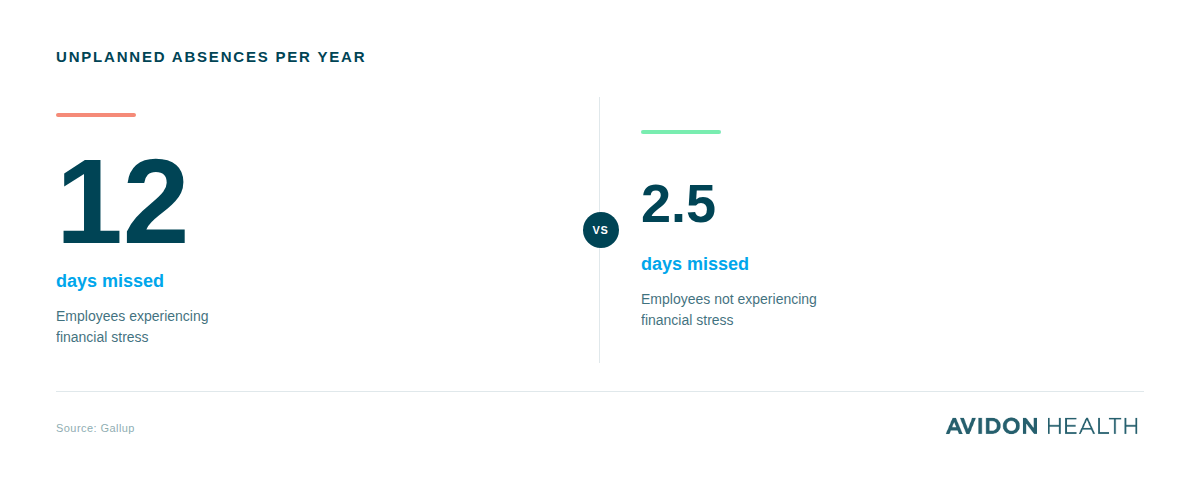
The productivity cost of poor employee mental health is not abstract. Gallup research found that workers with fair or poor mental health report nearly 12 unplanned absences per year, compared to 2.5 for peers with good mental health.
$47.6B
Estimated annual cost to U.S. employers from stress-driven absenteeism and lost productivity, per Gallup research
Gallup data comparing unplanned absences between financially stressed and healthy employees

At the individual employer level, the math is direct. Each missed workday costs approximately $340 for a full-time employee. For an SMB with 50 employees, even a modest uptick in stress-driven absenteeism adds up to tens of thousands of dollars in direct costs annually, before accounting for presenteeism, errors, or turnover.

The Hartford's 2025 workplace research found that nearly three-quarters of U.S. workers report financial stress, with 56% saying it has negatively affected their productivity. That is not a fringe population. It is most of your workforce.

For a broader look at how unhealthy habits translate into employer costs, see the true cost of unhealthy habits at work.

Why EAP Programs Are Not Enough.

The most common employer response to employee mental health challenges is the Employee Assistance Program. According to HR.com's Future of Employee Well-being 2025 report, 88% of organizations offer one.

EAPs are valuable as a crisis resource. But they are reactive, not proactive, and the evidence on utilization is consistent: single-digit participation rates, access barriers, and persistent stigma mean that most employees never engage with them until they are already in crisis.

The HR.com report specifically notes that small employers may need to engage in more creative, low-cost interventions that can still drive meaningful impact. Proactive, behavior-change-based programs that build coping skills before crisis hits represent exactly that category.

What Actually Works: The Case for Behavior Change Coaching.

A 2025 peer-reviewed randomized controlled trial published in the International Journal of Business Management tested an 8-session coaching intervention with employees facing organizational uncertainty. Researchers found statistically significant improvements in adaptability, motivation, and performance, with large effect sizes across both post-intervention and one-month follow-up assessments. The researchers specifically noted that coaching builds "introspection, behavioral change, goal alignment, and self-regulation competencies" for operating in volatile and uncertain environments.

Those are exactly the conditions U.S. workers are navigating in 2026. A meta-analysis of psychologically informed coaching approaches, covering 20 studies and 957 participants, confirmed significant effect sizes on goal attainment and self-efficacy, with cognitive-behavioral frameworks shown to be particularly effective.

Financial behavior change follows the same pattern. PwC found that 48% of employees are highly motivated to learn financial coping skills including budgeting, debt management, and savings behaviors. Among younger workers whose employers offered financial wellness support, Gen Z (83%) and Millennials (79%) actively used those programs when they were available.

The gap is not employee motivation. The gap is employer provision.

What HR Leaders Can Do Right Now.

You do not need a large budget or a lengthy procurement cycle to begin building employee resilience. The evidence points to a few high-leverage starting points.

Action 1
Address financial wellness directly.
Employees want it. Programs that offer judgment-free coaching on budgeting, debt, and savings behaviors see high engagement when they are accessible and stigma-free. This does not require a comprehensive benefits overhaul.
Action 2
Prioritize proactive access over reactive resources.
EAPs are a floor, not a ceiling. Supplementing them with programs that employees engage with before a crisis is where the productivity return lives.
Action 3
Train managers on psychological safety.
The APA research found that transparent, supportive communication from leadership is one of the most consistent buffers against stress amplification. This is low-cost and high-impact.
Action 4
Use behavior change frameworks, not wellness perks.
Step challenges and meditation apps show weak evidence for reducing financial or job-related stress. Programs grounded in cognitive behavioral approaches show strong evidence. The distinction matters when you are trying to demonstrate ROI.

How Avidon Health Approaches Economic Anxiety.

Avidon's methodology is built on cognitive behavioral training, the same evidence base the coaching research above draws from. Our programs are designed specifically for the SMB environment: scalable, accessible, and built to engage employees who would not self-identify as needing mental health support.

Where EAPs wait for employees to seek help, Avidon's approach builds coping capacity proactively through habit-based coaching that addresses both financial wellness behaviors and broader stress resilience. Employees develop practical skills they apply immediately, not just awareness of resources that exist if things get worse.

For HR leaders working with limited budgets and no dedicated wellness staff, that distinction is what makes a program usable. Avidon is built to run with minimal administration: monthly wellness challenges launch automatically, and most employers are up and running within a day of getting started. You can see outcome data from real client programs in the Avidon Health Coaching Efficacy Report.

Common Questions About Financial Stress at Work.

Research-backed answers for HR leaders navigating economic uncertainty.

How does financial stress affect employee productivity? +

According to PwC's 2026 Employee Financial Wellness Survey, 56% of financially stressed workers say their financial health has negatively affected their workplace productivity. Gallup research links poor mental health broadly to nearly 12 unplanned absences per year per affected worker, compared to 2.5 for healthier peers, a gap that costs U.S. employers an estimated $47.6 billion annually.

What is the difference between financial wellness programs and EAPs? +

EAPs are reactive resources: employees access them when they are already in distress. Financial wellness programs are proactive: they build skills like budgeting, savings behaviors, and debt management before a crisis hits. EAP utilization rates are typically in the single digits. When employers offer financial wellness programs, Gen Z and Millennial employees use them at rates above 79%, according to PwC.

Are small businesses more affected by employee financial stress than large companies? +

Yes, in meaningful ways. SMB employees generally have fewer organizational buffers: less HR support, less organizational communication during uncertainty, and often thinner personal financial reserves. The Federal Reserve Bank of Boston found that trade policy uncertainty among SMBs was directly linked to headcount decision uncertainty, meaning SMB employees are more likely to feel the economic stress their employers are experiencing.

What does behavior change coaching have to do with economic anxiety? +

Economic anxiety affects behavior: employees disengage, avoid difficult decisions, and stop making the healthy choices that would actually help their situation. Behavior change coaching, particularly approaches grounded in cognitive behavioral frameworks, interrupts this cycle at the cognitive level by building coping skills, self-regulation, and tolerance for uncertainty. A 2025 RCT found statistically significant improvements in employee adaptability and performance after 8 coaching sessions in an organizational uncertainty context.

How much does employee financial stress cost a small business? +

The costs are direct and indirect. Each unplanned absence costs an employer approximately $340 for a full-time employee (Gallup). For a 50-person company where even a modest number of employees are experiencing significant financial stress, the annual absenteeism cost alone can reach five figures, before accounting for presenteeism, errors, and turnover. Turnover costs for a single mid-level employee typically range from 50% to 200% of annual salary.

What should HR leaders do first if they want to address economic anxiety? +

Start with access and stigma. Most employees who are financially stressed do not seek help because they do not know what is available or feel embarrassed. A low-barrier, judgment-free program that addresses financial coping skills directly, communicated clearly by leadership, is the highest-leverage starting point. Manager training on psychological safety and transparent communication is a parallel step that costs almost nothing and has strong evidence behind it.

Build Financial Resilience Across Your Team.

Avidon Health gives small and midsize employers a proactive, behavior-change approach to employee well-being that runs with minimal HR overhead.

Author

  • The Avidon Health logo.

    Avidon Health is transforming how organizations promote healthier lifestyles through behavior change science and technology-driven coaching. Our mission is to empower individuals to achieve better health outcomes while driving measurable business success for our clients.

    With over 20 years of expertise in health coaching and cognitive behavioral training, we’ve built a platform that delivers personalized, 1-to-1 well-being experiences at scale.

    Today, organizations use Avidon to reimagine engagement, enhance health, and create lasting behavior change—making wellness more accessible, impactful, and results-driven.

Looking to join our team? Click here for an important message