
Healthy Habits

Decluttering Can Be Neat!

Clutter, as defined by Dr. Joseph Ferrari and Dr. Catherine Roster, is "an overabundance of possessions that create chaotic and disorderly living spaces."

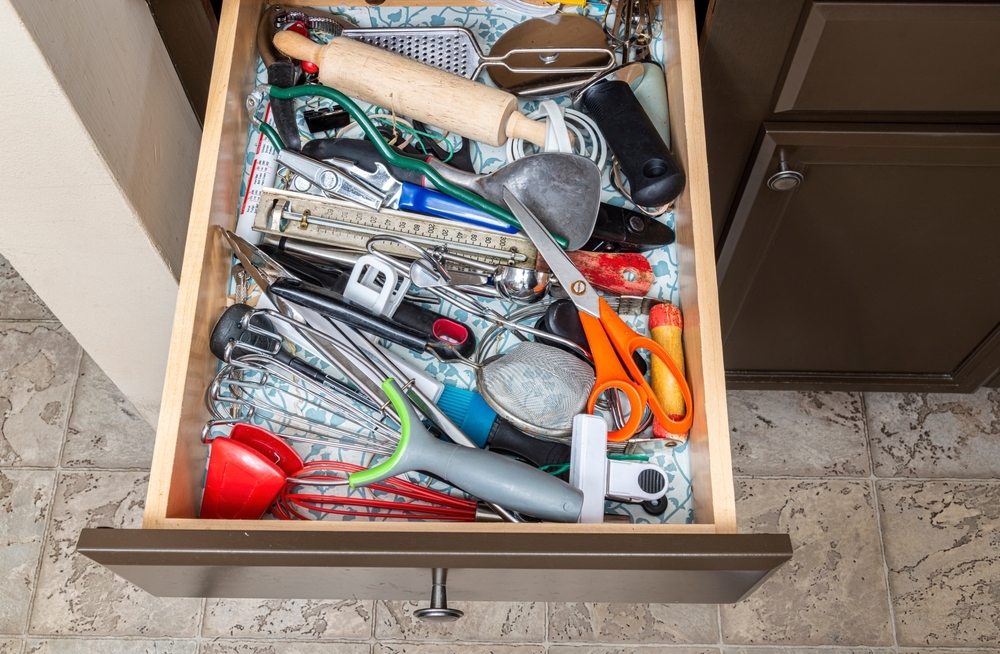
Overstuffed kitchen drawer crammed with utensils including a rolling pin, grater, scissors, ladles and spatulas
If you've been struggling with clutter or finding it hard to let go, remember: your memories, your worth, and your life are bigger than any object.

Their study of nearly 1,400 adults found the same pattern again and again: the more clutter people lived with, the less satisfied they were with their homes and with life in general.

Writing in Psychology Today, neuropsychologist Diane Roberts Stoler, Ed.D., pulls together the research connecting disorganization and clutter to mental health conditions, including depression, anxiety, and stress. Messy environments can cause frustration, helplessness, and feeling overwhelmed. The feelings can spiral, making it difficult to find the motivation to address the clutter.

Why decluttering is worth the effort

There are many positive reasons to declutter. Decluttering increases self-worth, creates healthy habits, and boosts productivity. People often find that a clean and tidy home helps them sleep better, lifts their mood, and makes it easier to relax. It cuts down on dust, and on the piles that give pests somewhere to hide. Socially, you'll be more willing to invite friends and family over with an inviting space. Having less "stuff" can help you pare back on shopping, which saves money now and keeps items out of a landfill later.

4.9 lbs
The EPA puts American municipal solid waste at 4.9 pounds per person per day, and about half of it goes straight to a landfill.

First, ask yourself why you keep things

So how do you get started? First, take an honest look at why you keep things.....is it guilt, lack of decision making, a sense of identity, laziness? This may help you let go of some items sooner.

Don't be afraid to enlist the help of a counselor to dig deep into why you keep things. If decluttering is not your strength, consider hiring an organizational consultant.

How to start decluttering: 7 methods that work

When you are ready to get started....start small. Here are some practical strategies that may help you declutter.

The 4 box method

To help with decision making, try sorting items into 4 categories. Items to 1) keep, 2) donate, 3) recycle, and 4) throw away. Then deal with each box appropriately.

The 5 second rule

You have 5 seconds to remember the last time you used the item. If you can't remember, let it go.

The rule of 5 years

If you haven't used the item in 5 years, let it go. Clothing can be cut back to 2-3 years.

Tackle it by space or category

Start small.....just one spot, one chair or one drawer at a time. Ask yourself: what would you keep if you lived in a tiny house?

One in, one out

This is a way to maintain balance in your house. If you bring home something new, like a shirt or shoes, you must then divest an older similar item like an old shirt or old pair of shoes. It helps prevent accumulating massive piles again once you've decluttered.

Clean as you go

Take care of the task right away. Hang clothes up or put them in the hamper, not on the floor. Sort mail as soon as you come in the door. Wash dishes or put them in the dishwasher, not the sink. Teach children to put a toy away before they take out the next one.

Set a timer for 15 minutes

So you're ready to declutter. Set a timer for a short amount of time, say 15 minutes, and pick just one space to start, like a chair filled with clothes or a drawer. You'll find that once you start, it's easier to keep going.

Decluttering makes room for more than space

Decluttering isn't just about creating more space in your home. It's about making room for a life that feels lighter, freer, and more intentional, and for joy, peace, and new experiences. And sometimes, releasing the past is the best way to step fully into the present.

Frequently asked questions

How do I start decluttering when I feel overwhelmed?+
Shrink the job until it stops being scary. Set a timer for 15 minutes and pick one drawer, one chair, or one shelf. Not the garage. The point of the first session isn't the drawer, it's proving to yourself that starting is survivable.
What is the 4 box method?+
You label four boxes keep, donate, recycle, and throw away, then handle one item at a time and put it in a box. It works because it takes the hardest part off your plate: instead of deciding what to do with a thing, you only have to decide which box it goes in. Then you deal with each box.
How do I keep the clutter from coming back?+
Two habits do most of the work. One in, one out means a new shirt costs you an old shirt. Clean as you go means the task gets done now rather than becoming a pile later. Decluttering is an event; these are the maintenance.
Does decluttering actually improve your mental health?+
The research shows a consistent link between clutter and lower well-being, including higher stress, anxiety, and depressed mood. What the studies can't tell us is which direction it runs, because a hard stretch mentally makes it much harder to keep a house in order. That's worth knowing rather than glossing over. What people do report reliably is that the act of clearing a space feels good, and that's a fine enough reason to start.

Want help building the habit?

Clearing the chair is the easy part. Keeping it clear is a habit, and habits are easier with something nudging you along. Avidon has 20+ habit builders, 40+ coaching courses, and 1,000+ resources on iOS, Android, and web. It's $9 a month, or $7.20 with the promo code HABITS. A year is $90, or $72 with the code, which works out to $6 a month.

Curious what that looks like for people who stuck with it? Member stories and results collects their outcomes in their own words.

Author

  • Avidon Health team member professional headshot

    Pam Faccone is the Health Coach Team Lead at Avidon Health, where she has dedicated the past 5 years to empowering employees on their health journeys, working on-site with a leading healthcare system.

    Prior to joining Avidon, Pam played a vital role in enhancing employee well-being at a leading financial institution. As a key member of their internal wellness program, she was responsible for a wide range of initiatives, including on-site fitness centers, ergonomics programs, community outreach, and support services for employees with childcare and eldercare responsibilities.

    Pam holds an M.S. in Exercise Science and is a Certified Exercise Physiologist and National Board Certified Wellness Coach.

    A dedicated member of her community, Pam volunteers her time with her local Zoning Board and Boy Scout troop.

    Outside of work, Pam enjoys an active lifestyle. She is an avid cyclist, having completed a ten-year journey across the United States. She is also a dedicated yogi and enjoys exploring nature with her 7-year-old Labrador Retriever.

Looking to join our team? Click here for an important message