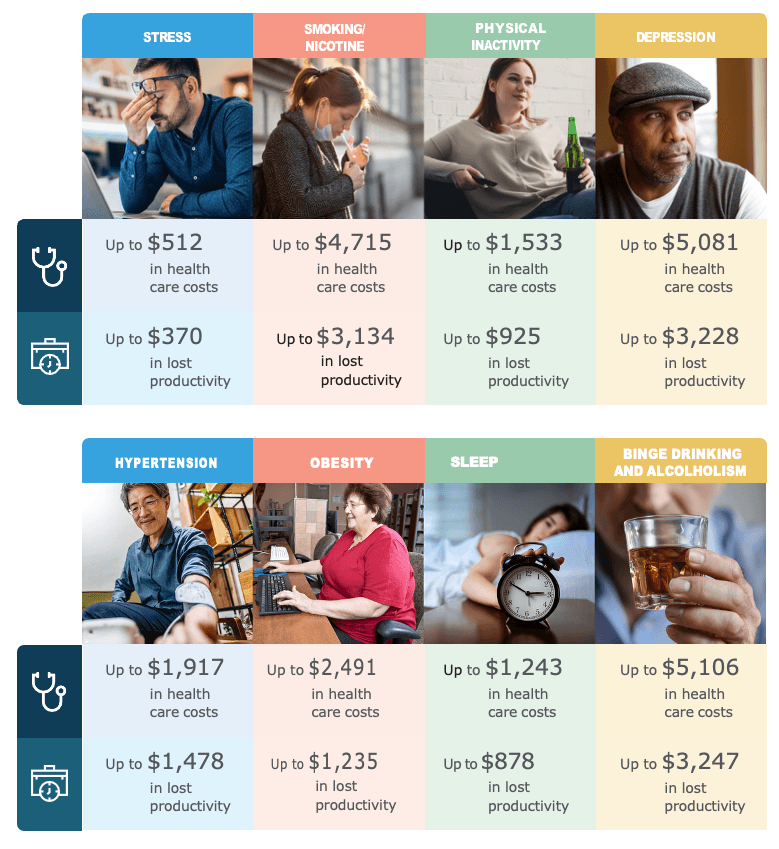
Unhealthy habits quietly cost employers thousands of dollars per employee each year. This page summarizes the latest research on healthcare spend and productivity loss tied to the most common modifiable unhealthy habits.
This analysis focuses on common, modifiable lifestyle risks that drive the majority of chronic disease costs for employers. These behaviors account for roughly 80% of total costs associated with chronic conditions, showing up as higher healthcare claims, absenteeism, and presenteeism.
Productivity loss includes missed workdays, reduced performance, errors and accidents, and slower recovery. As hybrid and remote work reduce access to traditional on-site programs, these real-time costs persist and impact employers regardless of benefits design.
Most wellness content focuses on participation and satisfaction.
This page focuses on where employers actually lose money, using published prevalence and cost data.
Last updated: January 2026
See where costs may concentrate across the most common modifiable risks.
We estimate affected employees using prevalence, then apply per-capita costs.
$0
0 employees.
As work has shifted toward hybrid and remote models, many traditional on-site wellness programs have disappeared. At the same time, lifestyle-driven risks such as inactivity, stress, poor sleep, and substance use have increased, quietly driving healthcare claims and productivity loss. [1]
This estimate highlights where those costs typically concentrate across a workforce and is designed to help employers identify their largest sources of exposure and focus efforts where intervention can have the greatest financial and human impact.
| Habit | Prevalence | Per-capita total | Estimated exposure |
|---|
A one-page snapshot of healthcare costs vs. productivity loss across the most common modifiable risks. Ideal for internal sharing, decks, and employer education.
Job-related stress continues to drive absenteeism in the workplace. As of 2023, the American Institute of Stress estimates that stress-related issues cost U.S. employers over $300 billion each year, with missed workdays being a major factor. [2-4]
Stress is one of the fastest ways productivity leaks out of an organization. These costs often appear immediately through missed workdays, presenteeism, errors, and slower recovery, before claims data ever flags a problem.
Nicotine use, including cigarettes, vapes, and pouches, contributes significantly to absenteeism, lower productivity, and excess healthcare costs. Smoking-related illness is estimated to cost U.S. employers over $300 billion annually, with $7,849 in excess annual cost per nicotine-using employee. [5]
Nicotine use drives both high medical claims and sustained productivity loss. Employers often underestimate its impact because costs are spread across absenteeism, chronic illness, and higher utilization over time making it a persistent, compounding expense.
Physical inactivity is a silent cost driver. Although guidelines recommend 150 minutes of movement weekly, about 80% of adults fall short, and 1 in 4 do no physical activity at all. These employees are at higher risk for chronic disease, slower recovery, and more sick days. The annual burden associated with physical inactivity exceeds $117 billion. Highlighting the urgent need for solutions that truly get people moving. [6-7]
Physical inactivity quietly increases risk across multiple chronic conditions at once. While the per-capita cost may appear moderate, its high prevalence makes it a widespread exposure that compounds healthcare spend, slows recovery, and increases future claims risk.
Depression is one of the most common and costly mental health conditions affecting the workplace. An estimated 13% of U.S. adults experience depressive symptoms that interfere with daily functioning. Costs associated with depression include absenteeism, reduced productivity, and increased healthcare utilization, contributing to a large annual economic burden. [8-9]
Depression is one of the most expensive conditions for employers because it directly impairs daily functioning. Costs accumulate through absenteeism, presenteeism, and higher healthcare utilization, making early identification and support critical to limiting long-term exposure.
High blood pressure often goes undetected, but it’s a costly problem. About 1 in 2 workers has hypertension, contributing to significant annual excess spending through lost productivity and elevated healthcare claims. [10]
Left unmanaged, it increases the likelihood of costly cardiovascular events, higher claims severity, and productivity loss turning a silent risk into a major financial driver.
Obesity is a major driver of healthcare spending and reduced workplace productivity. As of 2023, 42% of U.S. adults are classified as having obesity. Beyond raising risk for diabetes, cardiovascular disease, and certain cancers, obesity is associated with substantial indirect costs such as disability claims, higher workers’ compensation expenses, absenteeism, and presenteeism. These factors contribute to a large annual employer burden per affected employee. [11]
Obesity amplifies risk across nearly every major chronic condition. Its impact extends beyond medical claims into disability, workers’ compensation, and absenteeism, making it one of the largest and most interconnected sources of employer cost exposure.
Sleep deprivation remains a critical workplace issue, reducing employee alertness, increasing accident rates, and driving healthcare spending. The CDC estimates that one in three adults regularly gets insufficient sleep, and major economic analyses place the annual cost to U.S. employers at roughly hundreds of billions of dollars. [12-13]
Sleep deprivation directly affects alertness, safety, and performance. Employers absorb these costs through accidents, errors, missed workdays, and increased healthcare utilization often without recognizing sleep as the underlying driver.
Excessive alcohol use remains a costly and often overlooked workplace issue. Based on CDC-supported data, approximately 1 in 9 workers engages in risky or excessive drinking. Alcohol misuse contributes to absenteeism, lower job performance, higher accident rates, and long-term health issues. National productivity losses exceed $249 billion annually. [14-15]
Alcohol misuse creates disproportionate cost relative to its prevalence. Productivity loss, safety incidents, and long-term health consequences combine to make it a high-severity risk that can materially impact both performance and claims experience.
This section explains the data sources, assumptions, and calculation methods used throughout this page. Estimates are directional benchmarks based on peer-reviewed research and national datasets, and may vary by workforce demographics, industry, and geography. Data and assumptions are reviewed and updated annually as new studies become available.
This page consolidates peer-reviewed research and national datasets annually.
You’ve seen where lifestyle risk is driving cost. Avidon helps employers reduce exposure with programs built for modern, distributed workforces.