
According to the American Psychological Association, 92% of workers say how they feel at work affects how they feel at home, yet most wellness programs still default to fitness perks that only 20% of employees actually use. The good news: there are dozens of evidence-backed, affordable ways to build a wellness culture that employees actually engage with, whether your team is in-office, remote, or hybrid.
Why Gym Memberships Alone Don't Work.
Gym membership benefits have low participation rates because they only address physical fitness for people who already want to exercise. The reality is that most employees face a wider range of well-being challenges.
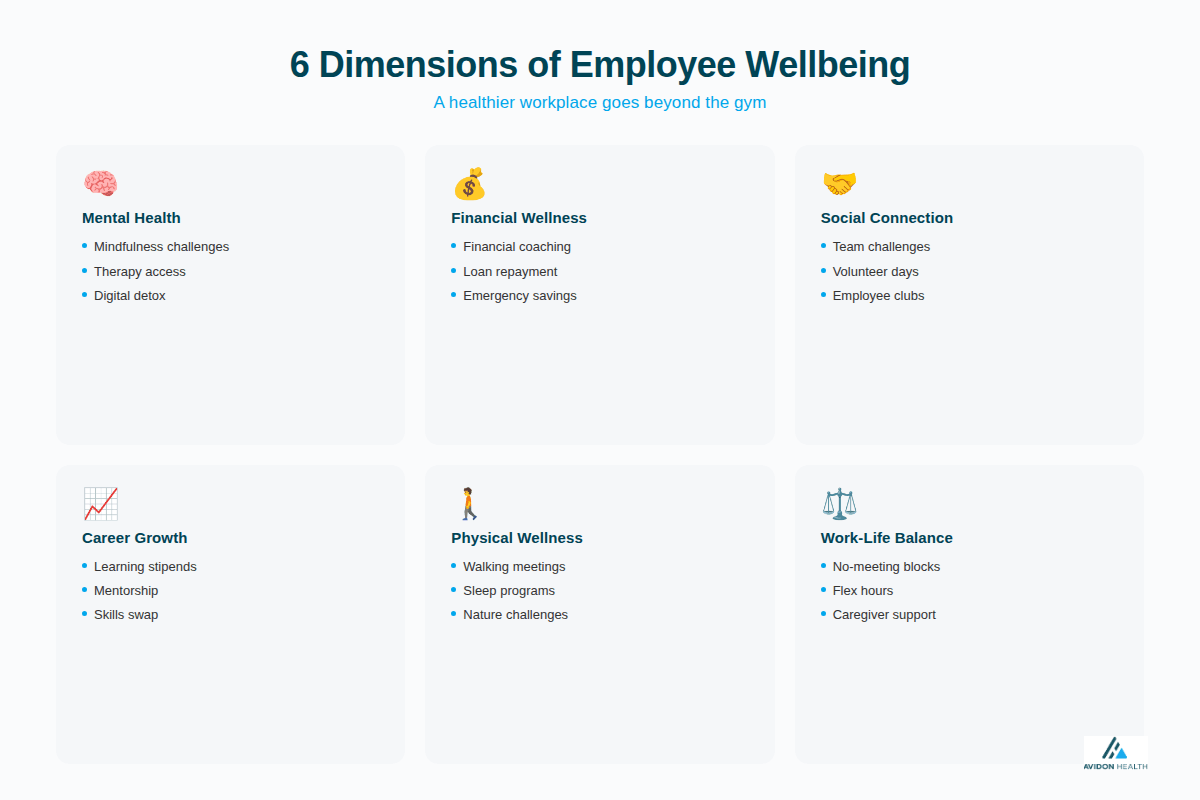
According to Gallup's 2024 State of the Global Workplace report, 44% of employees experience significant daily stress, and physical fitness perks do little to address that. True employee well-being spans five dimensions: physical, mental, financial, social, and career health.
25 Creative Employee Wellness Program Ideas.
Mental Health & Stress Management
Idea 01
Mindfulness and Meditation Challenges
Run a structured 21-day or 30-day mindfulness challenge with daily prompts, guided audio sessions, and peer check-ins. Apps like Headspace or Calm can be integrated at the company level. According to the Journal of Occupational Health Psychology, mindfulness programs reduce workplace stress by up to 28%.
Idea 02
Mental Health Days (No Questions Asked)
Designate 2–4 additional paid days per year specifically for mental health. Unlike general PTO, naming the days reduces stigma and signals organizational commitment. Companies that offer mental health days report a 25% reduction in burnout-related turnover, according to the Society for Human Resource Management, 2024.
Idea 03
Digital Detox Challenges
Challenge employees to reduce screen time outside of work hours for 14 or 21 days. Provide a tracking template and team check-ins. Reduced digital overload is directly linked to lower anxiety and better sleep quality.
Idea 04
Stress Management Workshops
Bring in a certified health coach to run 60-minute workshops on cognitive reframing, boundary-setting, and breathing techniques. These are especially effective when paired with follow-up one-on-one coaching. Avidon Health's behavior change coaching platform supports exactly this model, connecting group education to individual accountability.
Idea 05
Therapy and Counseling Access
Partner with a mental health service to offer subsidized therapy sessions. According to the National Alliance on Mental Illness, employees with untreated mental health conditions cost employers an average of $1,685 more per year in lost productivity.
Financial Wellness
Idea 06
Financial Literacy Workshops
Host monthly 30-minute lunch-and-learns on budgeting, debt reduction, retirement planning, and building an emergency fund. Financial stress is the number one source of anxiety for U.S. workers, according to PwC's Employee Financial Wellness Survey.
Idea 07
Student Loan Repayment Assistance
Offer even a modest monthly contribution ($50–$100) toward employee student loans. Under the SECURE 2.0 Act, employers can now match employee student loan payments with 401(k) contributions, a meaningful benefit for younger employees.
Idea 08
Emergency Savings Fund Matching
Help employees build a financial safety net by matching contributions to a dedicated emergency savings account. According to the Federal Reserve, 37% of Americans can't cover a $400 emergency expense, and that financial fragility shows up at work as distraction and presenteeism.
Idea 09
1-on-1 Financial Coaching
Give employees access to a certified financial counselor for personalized goal-setting. Even one or two sessions can significantly reduce financial anxiety and improve focus. This is a high-impact, relatively low-cost benefit.
Social Connection & Community
Idea 10
Wellness Challenges with Team Accountability
Run team-based wellness challenges around steps, hydration, sleep, or habit streaks, where small groups compete or collaborate together. According to the American Journal of Health Promotion, social accountability increases wellness challenge completion rates by up to 40%. Avidon Health's platform is built around exactly this model, with configurable team challenges and real-time leaderboards.
Idea 11
Volunteer Days and Community Service
Organize quarterly team volunteer events: food banks, habitat builds, mentorship programs. According to Deloitte, employees who volunteer are twice as likely to rate their corporate culture as positive and 27% more likely to feel optimistic about their career.
Idea 12
Interest-Based Employee Clubs
Fund and support employee-run clubs around shared interests: book clubs, running clubs, cooking groups, gaming leagues, language learning circles. These build cross-departmental relationships and give employees a reason to connect beyond their immediate team.
Idea 13
Buddy Programs for Remote Workers
Pair remote employees with an in-person or other remote colleague for a 30-day connection challenge. Weekly virtual coffee chats, shared goal-setting, and a simple check-in structure can dramatically reduce remote worker isolation.
Career Growth & Purpose
Idea 14
Learning Stipends
Provide $500–$1,500 annually per employee for professional development: online courses, certifications, conferences, or books. According to LinkedIn's 2024 Workplace Learning Report, 94% of employees say they would stay at a company longer if it invested in their career development.
Idea 15
Internal Mentorship Programs
Match junior employees with senior leaders for structured 6-month mentoring relationships. Mentorship programs increase retention by 50% among mentees and 69% among mentors, according to the Association for Talent Development, 2024.
Idea 16
Passion Project Time
Give employees 2–4 hours per month of dedicated time to explore ideas outside their core job function. Companies like Google and 3M pioneered this model, and it's strongly correlated with innovation and job satisfaction.
Idea 17
Skills Swap Sessions
Invite employees to teach each other skills: presentation tips, Excel tricks, cooking, photography, or a second language. Peer-learning creates connection, surfaces hidden talent, and costs nothing to run.
Physical Wellness (Beyond the Gym)
Idea 18
Walking Meeting Culture
Establish a walking meetings norm for one-on-one check-ins and small brainstorms. Research from Stanford University found that walking increases creative output by 81%, and it integrates movement into the workday without requiring gym access.
Idea 19
Ergonomics Stipends
Offer $200–$500 for home office ergonomic upgrades: standing desks, monitor risers, lumbar support chairs. Musculoskeletal disorders are the number one cause of worker disability and account for $20 billion in workers' compensation costs annually, according to the Bureau of Labor Statistics.
Idea 20
Nutrition and Cooking Challenges
Run a 4-week healthy cooking challenge: weekly recipe drops, photo shares in a Slack channel, and a simple points system for trying new meals. Nutrition directly impacts energy, focus, and chronic disease risk. No gym required.
Idea 21
Sleep Improvement Programs
Offer a structured sleep health program covering education on sleep hygiene, optional sleep tracking, and a coaching check-in. According to the CDC, 1 in 3 adults don't get enough sleep, and insufficient sleep costs U.S. employers $411 billion annually in lost productivity.
Idea 22
Outdoor and Nature Challenges
Challenge employees to log time outside: hiking, gardening, outdoor recreation, even a daily walk in a park. Research from the University of Michigan found that 20 minutes in nature reduces cortisol levels more effectively than many pharmaceutical interventions.
Work-Life Balance & Flexibility
Idea 23
No-Meeting Afternoons or Mornings
Designate 2–3 afternoons per week as meeting-free blocks for deep work. According to Microsoft's Work Trend Index, the average employee loses 57% of their day to meetings and interruptions. Protected focus time is a powerful and free wellness benefit.
Idea 24
Flex Fridays or Summer Hours
Offer reduced or flexible Friday hours during summer months. According to a survey by Wildgoose, 67% of employees said flexible working hours would meaningfully improve their well-being. This costs employers nothing except scheduling flexibility.
Idea 25
Caregiver Support Resources
Provide access to backup childcare, elder care resources, or a caregiver support stipend. Nearly 53 million Americans are unpaid caregivers, according to the National Alliance for Caregiving, and the inability to balance caregiving with work is a leading cause of turnover among high-performing employees.
How to Choose the Right Wellness Programs for Your Company.
Not every idea fits every organization. The best employee wellness programs start with listening. Here's a simple framework:
- Survey your employees.Ask what's causing them the most stress and what benefits would be most meaningful. A 5-question pulse survey takes 10 minutes to run.
- Identify your top three well-being gaps.Are employees burned out? Financially stressed? Feeling disconnected?
- Start with one or two initiatives.Pilot programs before committing to full rollout.
- Measure participation and outcomes.Track engagement rates, absenteeism, and employee satisfaction quarterly.
- Iterate based on data.Drop what isn't working. Double down on what is.
According to a study by Harvard Business School, companies with comprehensive, multi-dimensional wellness programs see a 6:1 return on investment through reduced healthcare costs, lower absenteeism, and improved productivity.
Free Download: The $0 Employee Wellness Toolkit
12 plug-and-play templates from Avidon's behavioral scientists: challenge ideas, journal prompts, Slack messages, monthly themes, and more. No budget or vendor contract needed.
How Avidon Health Supports Creative Employee Wellness.
Avidon Health provides a behavior change coaching platform built for employers who want to go beyond generic wellness perks. Our platform combines structured wellness challenges, one-on-one health coaching, and habit-building tools into a single, easy-to-launch experience.
Unlike traditional gym benefit programs, Avidon's approach is grounded in cognitive behavioral techniques, the same evidence-based methods used in clinical behavior change, applied to everyday workplace wellness. Our platform supports mental health, physical activity, nutrition, financial wellness, and social connection, all in one place.
Companies of all sizes use Avidon to run the types of creative employee wellness programs described in this article, with measurable engagement, real behavior change, and outcomes they can report to leadership. See how Avidon works for employers.