Categories
Employers & HR Leaders

26 Best Wellness Ideas for Small Businesses in 2026: The Complete Guide

Small Business Wellness Guide

26 Best Wellness Ideas for Small Businesses in 2026.

The best wellness ideas for small businesses combine zero-cost initiatives, affordable low-cost programs, and scalable digital support. Most successful programs are simple to launch, easy to join, and flexible enough to fit teams of almost any size.

Practical ideas for lean teams, growing companies, and budget-conscious HR leaders.

Inside this guide

💡 Zero-Cost Ideas
Walking meetings
Peer support
Meditation breaks
Volunteer days
💸 Low-Cost Programs
Lunch-and-learns
Gym stipends
Challenge apps
Flexible break policies
📈 Scalable Options
Digital coaching
Pulse surveys
Mental health resources
ROI and participation tracking
Quick Reference: All 26 wellness ideas
IdeaCategoryCostDifficultyBest For
1. Walking MeetingsZero-CostFreeEasyRemote-hybrid teams
2. Peer MentorshipZero-CostFreeEasyCulture, retention
3. Meditation FridaysZero-CostFreeMediumStress reduction
4. Wellness ChallengesZero-CostFreeEasyEngagement
5. Suggestion BoxZero-CostFreeEasyEmployee voice
6. Volunteer DayZero-CostFreeMediumPurpose, community
7. Lunch-and-LearnsLow-Cost$2/empMediumEducation
8. Gym MembershipsLow-Cost$4-6/empEasyPhysical health
9. Challenge AppLow-Cost$1-3/empEasyGamification
10. Standing DesksLow-Cost$3-5/empMediumEnergy, posture
11. Coffee/Tea SubscriptionLow-Cost$2/empEasyMorale
12. Flexible BreaksLow-CostFreeEasyWork-life balance
13. Mental Health DaysDigitalFreeEasyBurnout prevention
14. Pulse SurveysDigital$2-4/empMediumEarly intervention
15. Fitness ClassesDigital$3-5/empEasyFlexibility
16. Wellness DashboardDigital$5-8/empMediumROI tracking
17. Digital CoachingDigital$6-12/empHardMental health
18. Stress WorkshopsMental Health$3-6/empMediumResilience
19. Sleep ProgramMental Health$2-4/empMediumPreventive
20. Manager TrainingMental Health$500-2KMediumCulture change
21. EAPMental Health$2-4/empEasyCrisis support
22. Financial WorkshopsFinancial$1-2/empEasyStress reduction
23. Nutrition GuidesFinancial$1-2/empEasyPreventive
24. Time-Off PolicyFinancialFreeMediumBurnout prevention
25. AmbassadorsFinancialFree-$1KMediumPeer-led
26. Wellness StipendFinancial$50-100/empEasyAutonomy

Zero-Cost Wellness Ideas.

Your best wellness ideas do not need to cost anything except intention and consistency.

1. Walking Meetings.

Replace 30-minute desk meetings with 15-minute walks. Invite two to three people and talk as you move.

Why it works: Movement reduces stress, improves energy, and makes meetings feel more natural.

2. Peer Mentorship Circles.

Pair experienced employees with newer ones for informal biweekly check-ins that feel supportive, not evaluative.

Why it works: Mentorship reduces isolation and helps build stronger culture faster.

3. Meditation Moment Fridays.

Pick one time each week and pause for a short guided reset. Keep attendance optional.

Why it works: Even a brief pause can lower stress and reset the tone of the week.

4. Department Wellness Challenges.

Launch simple monthly challenges around steps, water, movement, or sleep and track them in a spreadsheet or app.

Why it works: Friendly competition adds accountability and makes participation more fun.

5. Wellness Suggestion Box.

Create a digital or physical place for employees to share wellness ideas anonymously.

Why it works: Better input usually leads to better adoption.

6. Volunteer Day.

Offer paid volunteer time each quarter for community organizations or local causes employees care about.

Why it works: Purpose-driven activity improves morale and strengthens connection.

Ready to Launch Your Wellness Program?

See how Avidon helps small businesses build practical programs that people actually use.

Try Free Demo

Low-Cost Wellness Ideas Under $5 Per Employee.

7. Monthly Wellness Lunch-and-Learns.

Host short sessions on sleep, stress, nutrition, posture, or financial health. Keep the format simple.

Why it works: Education helps people understand why a behavior matters, not just what to do.
Cost: Usually $1-3 per employee when lunch and speaker cost are spread across the team.

8. Subsidized Gym Memberships.

Offer a reimbursement or negotiate a discounted local gym rate. Let employees choose what fits.

Why it works: Reducing the cost barrier increases the odds that people participate.
Cost: Usually $30-50 per interested employee per month.

9. Wellness Challenge App.

Use a digital tool to track steps, sleep, hydration, or movement and reward consistency.

Why it works: Tracking makes progress visible and gives wellness more structure.
Cost: About $1-3 per employee monthly.

10. Standing Desk Stipends.

Offer support for ergonomic desks or workstation improvements for office or remote employees.

Why it works: Better workstations reduce discomfort and improve daily energy.
Cost: Often works out to $3-5 per employee monthly over time.

11. Coffee or Tea Subscription.

Stock the office with high-quality coffee or tea, or send small boxes to remote staff quarterly.

Why it works: Small rituals matter. They signal care and improve the day-to-day experience.
Cost: Around $2 per employee monthly.

12. Flexible Break Scheduling.

Let employees take breaks when they need them instead of forcing the same schedule on everyone.

Why it works: Autonomy lowers stress and helps employees recharge before burnout builds.
Cost: Free.

Digital and Tech-Enabled Wellness.

13. Mental Health Days Policy.

Formalize dedicated reset days or make it clear employees can take time to recover when needed.

Why it works: It reduces stigma and gives people permission to recover before things spiral.

14. Anonymous Wellness Check-In Tool.

Run pulse surveys to track stress, connection, workload, and overall sentiment across the team.

Why it works: Early signals let leadership address problems before turnover rises.

15. On-Demand Fitness Classes.

Offer access to yoga, recovery, strength, or movement classes employees can use on their own schedule.

Why it works: Convenience removes friction, especially for remote and hybrid teams.

16. Wellness Dashboard and Analytics.

Track participation, engagement, and trends so leadership can see what is working.

Why it works: If you cannot measure it, it is hard to improve or defend.

17. Digital Coaching.

Offer personalized coaching for stress, sleep, activity, nutrition, or behavior change.

Why it works: Coaching adds accountability and personalization that content alone cannot.

Mental Health and Resilience Programs.

18. Stress Management Workshop Series.

Run a focused series on resilience, burnout prevention, and emotional regulation.

Why it works: Stress management is a skill, not just a personality trait.

19. Sleep Wellness Program.

Offer sleep education, workshops, or light sleep coaching for employees who want more support.

Why it works: Better sleep improves mood, judgment, energy, and resilience.

20. Manager Mental Health Training.

Train managers to recognize burnout, respond with empathy, and point people toward support.

Why it works: Managers shape the employee experience more than most policies do.

21. Employee Assistance Program (EAP).

Offer confidential support for mental health, family, legal, or financial issues.

Why it works: Access to support matters, even when utilization is not perfect.

Financial and Holistic Wellness.

22. Financial Wellness Workshops.

Cover budgeting, debt, investing, and practical money habits that reduce everyday stress.

Why it works: Financial stress shows up at work whether leaders address it or not.

23. Nutrition Planning or Meal Prep Guides.

Provide simple meal guides, nutrition tips, or light coaching resources.

Why it works: Clear guidance removes friction and makes healthier choices easier.

24. Holistic Time-Off Policy.

Encourage real recovery with generous PTO or clear norms that time away is supported.

Why it works: Policies only matter when people feel safe actually using them.

25. Wellness Ambassador Program.

Recruit employees from different teams to champion wellness and keep participation moving.

Why it works: Peer-led programs usually feel more authentic than top-down reminders.

26. Wellness Stipend.

Give employees a fixed amount they can use on wellness in whatever way fits them best.

Why it works: Relevance improves when the benefit reflects real life, not just one idea of wellness.

Not Sure What Fits Your Team?

See examples by company size, and features.

See Pricing

Frequently Asked Questions About Small Business Wellness Programs.

How much does a wellness program cost for a small business?
Most small business wellness programs land around $3-8 per employee per month, though many can start with zero-cost ideas first.
What are the best free wellness ideas for small businesses?
Walking meetings, peer mentorship, meditation breaks, volunteer days, suggestion boxes, and simple team challenges are strong starting points.
How do I start a wellness program with no budget?
Start with two or three free ideas, communicate them clearly, and ask employees what they want next.
Do wellness programs actually work for small businesses?
They can, but only when they are relevant, easy to join, and consistently supported by leadership.
What wellness programs usually get the highest participation?
Programs with low friction tend to perform best, especially challenges, walking meetings, peer support, digital tools, and flexible options.

How to Launch a Wellness Program on a Small Business Budget.

You do not need to launch all 26 ideas at once. The smartest approach is to start small, build early wins, and expand based on what your employees actually use.

Step 1. Assess What Your Team Actually Needs.

Start with a quick employee pulse check. A short survey, suggestion box, or 10-minute team discussion is enough.

Ask questions like:
• What wellness topics matter most right now?
• What gets in the way of healthy habits?
• What kinds of support would people actually use?

Step 2. Start Small With 3 to 4 Ideas.

Pick a mix of zero-cost and low-cost ideas that fit your team size, culture, and budget. The goal is momentum, not perfection.

Simple examples:

$0 budget: walking meetings, meditation breaks, peer mentorship
$500/month: add lunch-and-learns and a gym reimbursement
$1,000/month: add a challenge app, stress workshop, or digital coaching pilot

Step 3. Build Consistency Before You Scale.

Launch one idea at a time, promote it clearly, and check what people are actually using after 30 days.

Best practice: double down on the ideas employees engage with, then add technology later to make communication, coaching, and reporting easier.

The real goal: create a program your team will actually participate in. Small businesses win when wellness feels easy to join, easy to understand, and worth coming back to.

Measuring Wellness Program ROI for Small Businesses.

If leadership is going to support wellness long term, you need to show what is working. Start with simple measures first. Participation usually moves before harder business outcomes do.

Metric 1

Participation Rate

Track how many employees use any part of the program. This is the first sign that your rollout is landing.

Metric 2

Engagement Depth

Look beyond one-time usage. Measure repeat activity, consistency, and how often employees come back.

Metric 3

Health and Sentiment Changes

Use simple pulse questions on stress, energy, sleep, or perceived support to see if conditions are improving.

Metric 4

Business Impact

Over time, track unplanned absences, retention, burnout-prone roles, and team engagement trends.

A simple way to think about ROI:

Leading indicators: participation, repeat engagement, survey response trends
Lagging indicators: lower absenteeism, better retention, stronger morale, fewer burnout signals

What to expect

Most small teams see participation signals first. Stronger business outcomes usually show up after the program has been visible, repeated, and supported for a few months.

Small Business Wellness

Not Sure Where to Start?
Talk to a Wellness Advisor.

We help small businesses launch wellness programs in days — not months. No dedicated HR team required. Book a free 20-minute call to find the right fit for your team and budget.

Book a Free Call Try Free Demo First

No sales pitch. Just helpful guidance.

Categories
Employers & HR Leaders

Best Employee Wellness Programs for Small Businesses (2026 Guide to Wellness Platforms)

Table of Contents

WHAT’S INSIDE THIS GUIDE

📊 Why wellness programs matter for smaller employers

Rising costs, burnout, and talent retention

🔍 Common program types compared

Digital platforms, coaching, incentives, culture-driven

⚖️ 5 vendors reviewed side-by-side

Strengths, considerations, and best-fit company size

💰 Typical costs and how to launch

$3–7 PEPM range, 5-step launch plan, choosing the right fit

If you’ve looked around the marketplace, it’s obvious most workplace wellness programs were built for large companies. They assume dedicated HR teams, significant benefits budgets, and the time to manage vendors, incentives, and reporting tools. For organizations with thousands of employees, that model is feasible.

For small and mid-size companies, the reality is very different.

HR may be one person, or an owner wearing multiple hats. Budgets are tighter, and anything that requires complicated setup or ongoing administration is unrealistic. Even when leadership wants to support employee wellbeing, the tools available often feel too complex or too expensive.

That’s why many smaller employers end up skipping wellness programs entirely. The market has largely been built around enterprise buyers, leaving small and mid-size companies to adapt tools that were never really designed for them.

The marketplace has started to shift, and quality wellness options for smaller organizations are becoming easier to find. Digital wellness platforms, coaching tools, and behavior-change programs are making it easier for smaller organizations to run meaningful wellness initiatives without a dedicated team managing them.

Below we’ll explore how employee wellness programs work for small businesses, typical costs, and which wellness companies are best suited for organizations that need practical, easy-to-implement solutions.


Key Takeaways for Small and Mid-Size Employers

  • You don’t need a large HR team to run an effective wellness program.
  • Digital wellness platforms are often the easiest solution for smaller companies.
  • Many wellness programs cost only a few dollars per employee per month.
  • The most successful programs focus on long-term behavior change rather than one-time incentives.

Why Wellness Programs Matter for Small and Mid-Size Companies

Smaller employers face the same health and wellness challenges as large companies, just on a reduced scale. Most employers are dealing with rising healthcare costs, increased burnout, and competition for talent.

For smaller companies, the goal usually isn’t building a complex benefits ecosystem. Instead, it’s finding practical tools that encourage healthier behaviors without creating extra work for already busy teams.

When done right, wellness programs help employers support healthier habits, reduce burnout, and create a happier, healthier workplace.

Benefits include:

  • Supporting healthier habits that reduce long-term healthcare costs
  • Improving employee engagement and morale
  • Reducing absenteeism and burnout
  • Helping attract and retain talent
Small business employees meeting in a collaborative office environment discussing workplace initiatives.

Why Many Wellness Programs Fail in Smaller Organizations


While the value of wellness programs is generally agreed upon, the implementation is where many smaller companies struggle and quit.

Products designed for enterprise use often have built-in assumptions. If you’re reading this guide, it’s safe to assume your team doesn’t have hours to spare on rollouts, marketing materials, and internal communications. Implementing an enterprise-level solution for a small or mid-size company is the classic round peg into a square hole scenario.

Common barriers include:

  • Administrative complexity that overwhelms small HR teams
  • Engagement models designed for very large employee populations
  • Cost structures built for enterprise budgets
  • Programs that require ongoing vendor management

In many cases, smaller employers are asked to adopt wellness systems designed for organizations ten times their size. That mismatch is one of the biggest reasons wellness programs struggle to gain traction in smaller workplaces.

Programs that work well for smaller organizations tend to prioritize simplicity, accessibility, and employee engagement rather than complex incentive structures.

Common Types of Employee Wellness Programs


The wellness landscape includes several different approaches. Understanding these options can help you identify which model fits your organization best.

Digital wellness platforms

Digital wellness platforms use apps or web platforms to deliver wellness challenges, educational content, health tracking, and habit-building programs.

These platforms often automate many administrative tasks, making them easier for smaller organizations to implement and track participation.

Health coaching programs

Some wellness providers emphasize one-on-one coaching or guided programs designed to support long-term behavior change.

While coaching can be highly effective, programs built heavily around coaching services may cost more than smaller employers expect.

Incentive-based wellness programs

Some organizations encourage participation through incentives such as gift cards, insurance discounts, or wellness rewards.

While incentives can increase engagement, they also create administrative complexity if not managed carefully. They can also lead employees to rush through tasks simply to check the box and claim the incentive rather than focus on the underlying wellness goals.

Culture-driven wellness initiatives

Other companies build wellness programs around team activities, mental health resources, or lifestyle education.

These initiatives work best when paired with a structured wellness platform that helps keep employees engaged over time.

Top Employee Wellness Companies for Small Businesses in 2026

Numerous wellness vendors offer platforms that small and mid-size organizations can select. While some providers focus primarily on enterprise clients, others offer solutions that can work well for smaller employers. It’s not a lack of choices. It’s choosing wisely.

Want a side-by-side comparison?

See how top wellness platforms stack up on features, pricing, and fit.

Compare Vendors →

VendorBest ForTypical Company Size Fit
WellableChallenge-based engagement and activity trackingSmall to mid-size employers
Personify Health (formerly Virgin Pulse)Large ecosystem of wellness servicesMid-size and enterprise
WebMD Health ServicesCoaching and health assessment programsMid-size employers
LimeadeCulture and engagement-focused wellbeingMid-market and enterprise
Avidon HealthLow-administration wellness programsSmall to mid-size employers

Wellable — Best for challenge-based engagement

Wellable provides a digital wellness platform focusing on activity challenges, health tracking, and employee engagement tools.

Strengths

  • Strong challenge-based engagement features
  • Flexible digital wellness platform
  • Easy activity tracking and wellness challenges

Considerations

  • Very strong on engagement and challenges, with less emphasis on behavior-change coaching.

Personify Health (formerly Virgin Pulse) — Best for larger mid-market employers

Personify Health is one of the largest wellness vendors in the industry and serves many enterprise organizations.

Strengths

  • Extensive wellness ecosystem
  • Large content library and engagement tools
  • Strong enterprise capabilities

Considerations

  • Programs may be more complex than smaller organizations need.

WebMD Health Services — Best for coaching and health assessments

WebMD Health Services focuses heavily on health education, assessments, and coaching programs.

Strengths

  • Clinical health education resources
  • Health risk assessments and coaching support
  • Strong healthcare credibility

Considerations

  • Excellent clinical depth and health assessments, with less emphasis on engagement-driven wellness tools.

Limeade — Best for culture-driven wellbeing programs

Limeade emphasizes employee engagement and organizational culture as part of workplace wellbeing.

Strengths

  • Strong employee engagement tools
  • Culture-focused wellness programs
  • Broad employee experience platform

Considerations

  • Strong focus on culture and shared employee experiences, with less emphasis on traditional wellness programming.

Avidon Health — Best for low-administration wellness programs
Avidon Health provides a digital wellness and behavior change platform designed to help organizations promote sustainable healthy habits through personalized programs, automated engagement tools, and optional health coaching.

The platform emphasizes evidence-based cognitive behavioral training and personalized wellness journeys that adapt to each participant’s health needs, goals, and readiness for change. With pre-built programs, automated challenges, and user-friendly reporting tools, Avidon is designed to help organizations launch and manage wellness initiatives without heavy HR involvement.

Strengths

  • Evidence-based behavior change programs rooted in cognitive behavioral training
  • Highly automated platform that reduces ongoing administration
  • Personalized wellness journeys based on health assessments and user data

Considerations

  • Designed for rapid implementation with a wide range of digital features. Organizations seeking onsite programming or clinical care services may require complementary solutions.
Hand checking a yes box on a checklist in a notebook

How Much Do Employee Wellness Programs Cost for Small Businesses?

Costs vary depending on the services included.

It is common for companies to offer different program tiers.

Most digital wellness platforms charge on a per employee per month (PEPM) basis. For smaller organizations, basic digital wellness programs range between $3 and $7 per employee per month.

Programs that include more extensive coaching services, biometric screenings, or clinical support are more expensive.

When evaluating cost, employers should consider factors such as:

  • Employee population size
  • Whether coaching, biometric screenings, or clinical services are included
  • Platform features such as challenges, education content, and reporting
  • How much internal administration the program requires

For smaller organizations, the most cost-effective programs are often those that automate engagement and require minimal ongoing management.

How to Launch a Wellness Program Without a Large HR Team

  1. Identify your primary goals.
    Start with one or two priorities such as stress management, physical activity, or general health education.
  2. Choose a platform designed for smaller organizations.
    Look for programs that automate onboarding, reminders, and reporting.
  3. Communicate the program clearly to employees.
    Explain what the program is, why the company is offering it, and how employees can participate. Many wellness vendors provide rollout materials that can simplify this step.
  4. Start small and build gradually.
    Launch a limited set of features or one wellness challenge and expand over time.
  5. Track participation and adjust the program.
    Monitor engagement and make adjustments based on employee feedback. Identify one or two employees who are excited to participate and ask them what’s working and what isn’t.

How to Choose the Right Wellness Platform

When evaluating wellness vendors, small businesses should focus on practical considerations rather than flashy features.

Questions to consider include:

  • How easy is the program to implement?
  • How much HR administration does it require?
  • Will employees actually engage with the platform?
  • Does the platform regularly add new challenges, courses, or content to keep employees engaged?
  • Is pricing transparent and scalable as the company grows?
  • Does the program support long-term behavior change?

The best wellness platforms for smaller organizations typically prioritize simplicity, accessibility, and engagement.

Related Resources

Organizations evaluating wellness platforms often benefit from reviewing program costs, engagement strategies, and behavior-change support.

FAQs

The best wellness programs for small businesses are typically digital platforms that are easy to implement and require minimal HR administration. Many organizations look for programs that combine engagement tools, habit-building programs, and optional coaching support.

Most digital wellness platforms charge on a per employee per month (PEPM) basis. Basic programs for small businesses typically range from about $3 to $7 per employee per month, with higher costs for programs that include coaching, biometric screenings, or clinical services.

Programs that combine digital engagement tools, simple wellness challenges, and behavior-change education tend to work best for smaller organizations because they are easier to implement and require less ongoing administration.

Incentives can increase participation, but they are not always necessary. Many successful programs focus on accessible challenges, helpful content, and habit-building tools that encourage employees to participate voluntarily.

Participation and engagement improvements can appear within the first few months. Health outcomes and healthcare cost improvements usually develop more gradually as employees adopt healthier habits over time.

Many wellness platforms can support organizations with as few as 10 employees. The more important question is whether the program is designed for small teams and is simple to launch and manage.

Categories
Employers & HR Leaders

Employee Wellness Program Cost in 2026 (Per-Employee Guide)

Table of Contents

How Much Does an Employee Wellness Program Cost?

Quick Answer: Employee wellness programs in 2026 cost $3–$100 per employee per month, depending on depth. Basic platforms with challenges and content start near $3/user/month. Full-service programs with coaching and health assessments start near $58. A 200-person company budgets roughly $5,000/year, with volume discounts typically kicking in above 500 employees.

If you’re pricing wellness because leadership gave you a budget number,this guide shows per-employee benchmarks, the three pricing models vendors actually use, and a framework for comparing vendors.

Compare top wellness vendors side-by-side →

Average Cost of Wellness Programs by Company Size

How much do corporate wellness programs cost on average? The answer depends on three factors: your company size, the scope of services you need, and whether you choose a digital-first platform or a full-service provider.

Here is what most organizations can expect to budget:

Cost of Corporate Wellness Programs by Tier

Basic Digital
$3 – $5
per employee / month
$36 – $60 annually
Health assessments, wellness portal, challenges, educational content
Mid-Range
$12 – $58
per employee / month
$150 – $700 annually
All basic features plus incentive programs, group coaching, analytics
Comprehensive
$58 – $100+
per employee / month
$700 – $1,200+ annually
Full suite: 1:1 coaching, biometrics, mental health, reporting, custom content

How Different Wellness Platforms Price Per Employee

Pricing models vary by vendor. Some charge a flat per-employee-per-month (PEPM) fee regardless of participation. Others use a per-active-user model where you only pay for employees who actually engage. A few use tiered pricing based on company size, where larger organizations get lower per-employee rates.

For small businesses with fewer than 100 employees, expect to pay at the higher end of per-employee rates because you lack the volume discount that larger organizations negotiate. The best value corporate wellness consulting packages for small businesses typically start at the Basic Digital tier ($3-$5/employee/month) and scale up as your program matures.

What Drives Cost Up

  • Human coaching: Live, 1:1 health coaching is the most expensive component, typically adding $20-$50/employee/month
  • Biometric screenings: On-site or lab-based screenings add $50-$150 per employee per event
  • Incentive programs: Gift cards, premium reductions, or HSA contributions can add $100-$500/employee/year
  • Custom content: Branded courses, challenges, and communications add development costs
  • Integration complexity: Connecting to your HRIS, benefits platforms, or claims data requires technical work

Free Resource

Not ready to invest? Start with our Zero-Cost Wellness Toolkit.

Dozens of proven, no-budget wellness strategies your team can launch this week. No vendor required.

Wellness Program ROI: Is the Investment Worth It?

Are employee wellness programs worth the investment? The research says yes, but with an important caveat: program design matters more than program spending.
$3.27
medical cost savings per $1 spent
Source: Harvard Meta-Analysis
$2.73
absenteeism cost savings per $1 spent
Source: Harvard Meta-Analysis
6:1
total return on investment
Combined medical + absenteeism
A Harvard meta-analysis estimated that for every $1 spent on wellness programs, medical costs fall by approximately $3.27 and absenteeism costs by about $2.73. For balance, a JAMA study of a large U.S. employer found more modest results, highlighting that program quality and design are the real drivers of effectiveness.ROI does not happen because a company throws money at a program. It is a by-product of an agile wellness offering that evolves over time, keeps employees engaged, and is actively supported by leadership. The organizations that see the strongest returns pair digital platforms with evidence-based coaching and build a culture where wellness is part of daily operations, not a once-a-year event.

See how Avidon delivers measurable ROI →

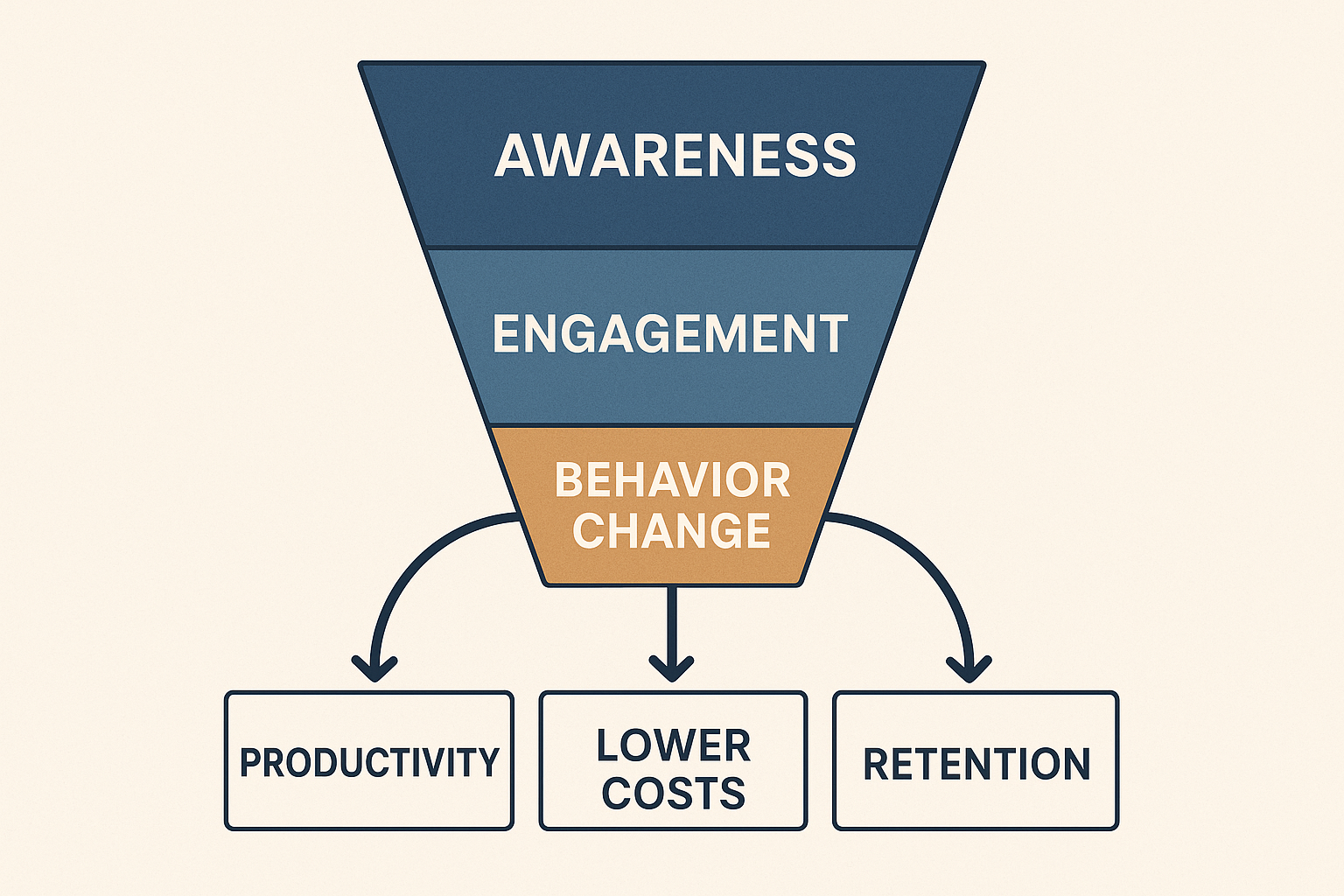
Visual funnel showing awareness, engagement, and behavior change leading to productivity, lower costs, and retention—illustrating employee wellness program ROI.

Hidden Costs of Employee Wellness Programs

The sticker price is only part of the employee wellness program cost. These are the hidden costs that quietly erode your budget and ROI:

  • Low participation: If only 10-15% of employees engage, your per-participant cost skyrockets. A $5/employee program with 10% participation effectively costs $50 per active user. Personalization and evidence-based engagement strategies are the fix.
  • Platform fragmentation: Stacking disconnected tools (one for challenges, another for coaching, another for reporting) creates admin overhead and confuses employees. A unified platform reduces both cost and friction.
  • Manual administration: If your HR team spends 5-10 hours per week coordinating wellness activities, that is a real labor cost that most budgets ignore.
  • One-size-fits-all content: Generic programs fail because they do not meet employees where they are. The most effective programs use behavioral science to personalize the experience. Burnout and grind culture cannot be solved with a step challenge.
  • Vendor switching costs: Choosing the wrong vendor means 6-12 months of sunk implementation time, lost employee trust, and the cost of starting over.
Key Takeaway: The cheapest program is rarely the most cost-effective. A $3/employee platform with 40% engagement delivers more value than a $1/employee platform nobody uses.

Key Features of Cost-Effective Wellness Platforms

The most cost-effective wellness solutions share these traits. Use this as a checklist when evaluating platforms:

  • Automation and personalization: Delivers support at scale without significant staffing. Look for platforms that use behavioral science to tailor content to each employee’s stage of change.
  • Multi-channel engagement: Mobile app, email, text, and wearable integration to meet employees wherever they are.
  • Real-time analytics: Enables timely adjustments and clear visibility into participation, outcomes, and program ROI.
  • Behavior change methodology: Programs grounded in cognitive behavioral training, not just gamification, produce lasting results. Evidence-based health coaching is the differentiator.
  • System integration: Reduces manual work by connecting to your HRIS, benefits admin, and claims data.
  • Scalable pricing: Grows with your organization so you are not overpaying at 50 employees or underpowered at 500.

How to Compare Corporate Wellness Program Vendors

Choosing the right wellness partner is not just about the lowest employee wellness program cost. It is about capabilities, scalability, and proven outcomes. Here is what to evaluate:

  • Engagement rates: Ask for average participation rates across their client base, not just cherry-picked case studies.
  • Outcome data: Do they have published research or third-party validation of health outcomes?
  • Pricing transparency: Can they give you a clear per-employee cost with no hidden fees for implementation, reporting, or content?
  • Content depth: How many programs, courses, and challenges are included? Are they evidence-based?
  • Technology: Is the platform mobile-first? Does it integrate with wearables and your existing HR systems?
  • Support model: Do you get a dedicated account manager or are you routed to a help desk?

Use our side-by-side vendor comparison tool to evaluate providers across these criteria. You can also see how Avidon compares to Noom and other popular platforms.

Not sure which vendor fits? Compare Wellness Vendors →

Free and Low-Cost Wellness Program Ideas That Work

Not every impactful initiative requires budget. Many organizations start with zero-cost wellness ideas and build from there. Here are proven strategies that drive engagement without spending a dollar:

  • Walking or hydration challenges: Simple, social, and effective for building team culture
  • Mental health days: Designate days off specifically for wellbeing
  • Peer-led fitness groups: Leverage employees who are already passionate about health
  • Healthy recipe exchanges: Build community around nutrition without preaching
  • Workspace ergonomics tips: Free content that reduces physical strain
  • Guided mindfulness sessions: 5-minute team breathing exercises cost nothing

For a comprehensive list of no-budget strategies, explore our complete guide to zero-cost wellness programs, which includes dozens of proven tactics your team can launch this week.

These free initiatives are also a smart way to build the business case for a funded program. Show leadership that employees want wellness support, then propose the budget for a scalable digital wellness platform that amplifies what you started for free.

Compliance and Legal Considerations

When budgeting for an employee wellness program, factor in compliance requirements that can affect program design and cost:

  • HIPAA: Protects the confidentiality of employee health information collected during screenings or assessments. Your vendor must be HIPAA-compliant and willing to sign a Business Associate Agreement.
  • GINA: Prevents the use of genetic information in making employment decisions. This affects how you structure health risk assessments.
  • ADA: Ensures wellness programs are inclusive and do not discriminate against employees with disabilities. Incentive structures must be reasonable.
  • EEOC Guidelines: Incentive-based programs must remain voluntary and non-coercive. The EEOC has placed limits on the size of incentives tied to health screenings.

Compliance expectations continue to evolve, especially around digital wellness platforms and data privacy. Choosing a vendor that stays current with legal standards, like one that maintains ISO 27001 certification, helps ensure your program remains compliant and trustworthy.

Making Your Wellness Investment Count

Understanding employee wellness program cost is not just about finding the cheapest option. It is about making a strategic investment that aligns with your organization’s goals, fits your budget, and actually moves the needle on employee health and engagement.The organizations that get the best return start with clear goals, choose a platform built on evidence-based behavior change (not just gamification), and commit to engagement over time. Whether you are investing in a full-scale digital coaching platform or starting with grassroots zero-cost initiatives, the key is building a program that adapts to your workforce and delivers measurable outcomes.

Ready to see what a wellness program would cost for your team?

Try Free Demo →   |   View Pricing Plans →

FAQs

Employee wellness program costs range from $3-$5 per employee per month for a digital platform to $150-$1,200 per employee annually for comprehensive programs that include biometric screenings, coaching, and incentives. The cost depends on program scope, vendor, company size, and level of personalization.
The average cost of a wellness program per employee is $150-$300 annually for small businesses (under 100 employees), $300-$700 for mid-size companies (100-999 employees), and $700-$1,200+ for large organizations (1,000+ employees). Digital-only platforms start as low as $3-$5 per employee per month.
Corporate wellness programs cost an average of $3-$5 per employee per month for basic digital platforms. Mid-range programs with incentives and group coaching run $12-$58 per employee monthly. Comprehensive programs with 1:1 coaching, biometrics, and analytics cost $58-$100+ per employee per month.
Yes. Research from Harvard shows well-designed wellness programs return $3.27 in reduced medical costs and $2.73 in reduced absenteeism for every $1 invested. Beyond financial returns, organizations report improvements in employee morale, retention, productivity, and employer brand reputation.
Absolutely. Many effective wellness strategies cost nothing, including walking challenges, mental health days, and peer-led fitness groups. When ready to invest, small businesses can start with a digital platform for as little as $3-$5 per employee per month, then scale up as budget and engagement grow.
Hidden costs include low participation (which inflates per-user costs), platform fragmentation from using multiple disconnected tools, manual HR administration time, vendor switching costs when the wrong partner is chosen, and one-size-fits-all content that fails to engage employees.
Start with zero-cost initiatives like walking challenges, guided mindfulness sessions, and healthy recipe exchanges to build a culture of wellness. Then layer in a scalable digital platform for $3-$5 per employee per month. Many vendors offer tiered pricing that grows with your organization.
Categories
Employers & HR Leaders

Corporate Wellness: How to Navigate the Future Worry-Free

Table of Contents

A successful corporate wellness program used to mean free fruit in the kitchen and a flu shot sign-up sheet. Not anymore. The last few years have redefined what employees expect from employers when it comes to wellbeing—and what companies must deliver to remain competitive. Wellness has evolved into a critical element of business strategy, influencing everything from productivity to retention to employer brand perception.

For HR leaders and business owners, the challenge isn’t deciding whether to invest in wellness—it’s understanding where to focus. Which trends matter most? How do you separate meaningful innovation from passing fads? And how do you scale efforts across diverse workforces, job functions, and health profiles?

According to McKinsey’s 2024 report on global wellness trends, 82% of U.S. consumers now place a high value on wellness, making wellness not just a workplace issue, but a cultural shift.

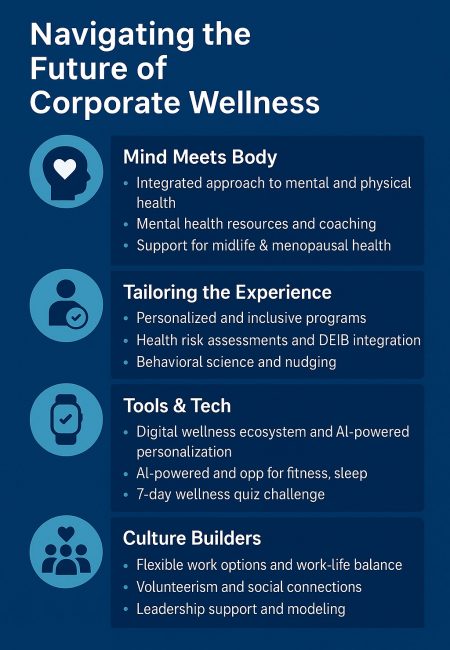
corporate wellness program diagram

We’ve outlined four key focus areas—each with practical takeaways you can apply today. From mental health to digital tools, these strategies are designed to help you meet evolving employee needs and drive measurable outcomes.

These four pillars reflect where modern wellness is headed—and where your organization can lead. Whether you’re updating a legacy program or starting fresh, the ideas ahead are designed to meet the moment.

If you’re an HR leader or business owner ready to future-proof your wellness strategy, read on.

1. Mind Meets Body: The Rise of Integrated Wellbeing

Case in Point: In one coaching outcomes study, 81% of participants reported increased confidence in achieving their health goals, while 88% credited coaching as a key contributor to success. Measurable improvements included a 70% increase in physical activity, a 20-point average reduction in blood pressure, and an 85% improvement in chronic care management. Wellness program completion rates more than doubled when coaching was paired with digital support—reinforcing that combining personal guidance with scalable technology drives lasting behavior change.

Wellness is no longer just about physical fitness. A holistic approach that integrates mental, emotional, and physical health is now the gold standard.

Key Focus Areas

Strategic capabilities to prioritize when evaluating corporate wellness platforms.

  • Mental Health Support: With burnout and stress still high post-pandemic, organizations are prioritizing tools like EAPs, virtual therapy access, and mental health manager training. According to SHRM’s 2024 Workplace Mental Health Report, 42% of HR professionals cited emotional wellbeing as the number one employee need. Health coaching programs that incorporate mental and emotional support can further boost results.
  • Sleep Health: Sleep directly impacts mood, productivity, and even chronic disease risk. Employers that provide sleep education and tracking tools often see measurable improvements in absenteeism and performance. A study from the RAND Corporation found that sleep-deprived workers cost U.S. companies $411 billion annually in lost productivity.
  • Addressing Loneliness: Social isolation is a hidden epidemic, especially in remote settings. Companies are responding with virtual social events, team challenges, and intentional community-building.

Tip: Layer these efforts together to support the whole person—not just their output.

2. Tailoring the Experience: Inclusivity, Flexibility & Personalization

Case in Point: A coaching outcomes report involving a multi-industry program showed that when participants were offered parallel wellness tracks based on preference and participation data, total engagement increased by more than 60%, and avoidable absenteeism dropped by 14%.

Employee participating in a wellness coaching program using light dumbbells

Program Examples

Real-world wellness initiatives aligned with engagement, retention, and ROI goals.

  • Flexible Work & Work-Life Balance: Remote options, compressed schedules, and manager training on setting boundaries are now considered foundational to well-being. The American Psychological Association links flexible scheduling to lower stress, higher retention, and better overall health.
  • Personalized Programs: Using health risk assessments (HRAs), feedback tools, and preference data to match employees with the right resources. Personalization increases program engagement rates by as much as 70%, according to a 2023 WellSteps employer study. Wellness coaching services, including virtual coaching, can also be customized to individual needs, offering scalable and relevant support. 
  • Inclusive Design: Ensuring programs are accessible across locations, abilities, and cultures—with DEIB principles woven throughout. Gartner reports that inclusive workplaces are 2.6 times more likely to engage and retain talent.
  • Support for Midlife & Menopausal Health: Employers are increasingly recognizing the importance of midlife health—especially for women navigating menopause. Offering educational resources, health coaching, and peer support signals that your organization supports employees at every stage of their journey.
  • Behavioral Nudges & Habit Science: More organizations are using behavioral science techniques—like nudging, goal priming, and habit stacking—to help employees follow through on wellness goals. These methods, when integrated into wellness platforms that combine behavior science with user-friendly design, make behavior change easier to start and stick with—especially when paired with small, achievable steps.

Tip: Form employee resource groups to co-create and vet new health and wellness programs.

3. Tools & Tech: Powering Digital Wellness

Illustration representing digital wellness platforms with coaching, learning tools, and employee engagement features.

Case in Point: A commercial employer recently ran a 7-Day Wellness Quiz Challenge where employees completed short interactive quizzes on sleep, stress, and nutrition. 77% of employees participated, and 79% completed the challenge. They reported increased motivation and practical takeaways. The approach reinforced the value of light-touch, digital-first strategies that engage users daily and spark meaningful conversations around health.

Technology is no longer a bonus—it’s the delivery mechanism for modern wellness. In 2025, the best programs will blend convenience with customization, and increasingly use data to anticipate and respond to individual needs.

Platform Capabilities

Features and tools that drive measurable outcomes and long-term value.

  • Wellness Portals & Apps: Centralized hubs that offer fitness challenges, health education, and tracking features are now expected. The most effective platforms also integrate with wearable devices and offer nudges to drive daily engagement. Modern wellness platforms are increasingly essential for supporting large and hybrid teams. 
  • Virtual Coaching & Support: Personalized coaching—delivered remotely—continues to grow in popularity, especially when paired with asynchronous support. Harvard Business Review notes that digital coaching improves behavior change outcomes by 3x over self-guided interventions. The best platforms also use AI-powered personalization to recommend timely, relevant next steps. Virtual coaching tools help scale these efforts while still keeping the experience personal.
  • Preventive Care & Screenings: Biometric screenings, health assessments, and on-demand education drive early intervention and reduce long-term healthcare costs. When paired with actionable follow-up support, preventive care can yield an ROI of up to 6:1, according to the American Journal of Health Promotion.

Tip: Choose tech that integrates with existing platforms and offers a seamless user experience. Evidence-based platforms that emphasize flexibility and user experience are increasingly being adopted to help scale workplace wellness efforts effectively—without sacrificing personalization.

4. Culture Builders: Belonging, Meaning & Social Impact

Wellness doesn’t live in a silo. It thrives when it’s woven into the fabric of a healthy company. Employees are more likely to engage with wellness programs when they see them reflected in company values and leadership behavior. Building a culture of well-being means fostering emotional safety, meaningful recognition, social connectedness, and a shared sense of purpose.

Hands joined in a circle symbolizing teamwork and support within employee wellness programs.

Engagement Strategies

Tactics designed to maximize participation and demonstrate program impact.

  • 🫱Community Engagement: Volunteering, corporate giving, and cause-based challenges support morale and loyalty. Companies that promote volunteerism report a 13% increase in employee satisfaction (Deloitte, 2023).
  • 💰Financial Wellness: Budgeting help, retirement education, and savings tools address one of the top drivers of employee stress. A PwC survey found that 57% of employees cite financial stress as their top distraction at work.
  • 🌿Environmental Wellness: Ergonomics, indoor air quality, natural light, and sustainability initiatives can dramatically improve workplace satisfaction.

Tip: Highlight these programs in your recruitment materials. They’re a competitive advantage.

Measuring What Matters: Data-Driven Wellness

Even the most thoughtful wellness initiatives can underperform if they aren’t measured, refined, and optimized. Data doesn’t just help justify budget—it shapes smarter decisions and keeps programs aligned with employee needs and business outcomes. Many HR leaders are moving beyond simple participation rates to more meaningful metrics that capture the full picture of engagement, behavior change, and culture impact.

Best practices:

  • Track participation, satisfaction, and health outcomes over time.
  • Gather both quantitative and qualitative feedback.
  • Measure both ROI (e.g., lower claims) and VOI (e.g., improved morale).
  • Use feedback loops to adjust offerings and invest where it matters most.

From Trends to Transformation

For a wellness strategy to truly transform your workplace, it must be both aspirational and actionable. This means tying wellness efforts directly to organizational KPIs such as employee engagement scores, talent retention, and productivity levels. It also means fostering internal alignment: from leadership setting the tone, to middle managers reinforcing participation, to employees feeling empowered to set and pursue goals that matter to them.

The future of corporate wellness lies in the intersection of culture, technology, and behavioral insight. As you evaluate your next steps, start by auditing your current program for gaps in personalization, inclusivity, and leadership support. Consider tools and partners that offer evidence-based approaches and scalable solutions—especially those designed with lasting behavior change in mind.

FAQs: Building a Future-Focused Corporate Wellness Program

Focus on low-cost wins: flexible scheduling, mindfulness resources, and peer-led initiatives. Corporate wellness starts with culture, not just cash.

Combine participation and feedback data with VOI metrics like productivity, morale, and satisfaction scores. Align results with platform insights, such as participation dashboards and learning feedback reports, to identify what's driving sustained engagement.

Listen first. Use surveys and employee resource groups to shape your offerings. Provide varied formats (virtual, in-person, mobile) and design with accessibility in mind. Inclusivity should also extend to life stages—like offering support for midlife and menopausal health.

Balance digital tools with personal touchpoints, like live coaching, group challenges, or peer support. Connection drives change.

Leadership buy-in is essential. When executives and managers actively participate in wellness programs, whether by joining challenges, sharing personal stories, or attending events—it signals that wellbeing is a company value, not just an HR initiative. This modeling behavior significantly increases employee engagement.

Categories
Employers & HR Leaders

How to Evaluate Corporate Wellness Programs | Avidon Health

Employers & HR Leaders

How to Evaluate Corporate Wellness Programs

Quick Answer: Evaluate your wellness program by measuring both leading indicators (participation, engagement, HRA completion) and lagging indicators (health outcomes, cost savings, absenteeism reduction). Analyze claims data and biometric trends, then segment results by risk level to identify what's working and what needs adjustment for maximum ROI.
Published January 15, 2024 | Updated March 27, 2026

Why Regular Wellness Program Evaluation Matters.

Many organizations launch wellness programs with genuine intent to improve employee health. But without regular evaluation, these programs become budget black holes that drain resources without delivering measurable returns. Evaluation isn't just about accountability—it's the engine that drives continuous improvement and ensures your wellness investment actually works.

When you systematically evaluate your wellness program, you align it with business objectives, identify which initiatives generate real health outcomes, and spot engagement gaps early enough to course-correct. This data-driven approach justifies ongoing investment to leadership and demonstrates your commitment to employee wellbeing.

Comprehensive wellness programs generate $1.50–$3 in savings for every dollar spent, according to research from Harvard and Johnson & Johnson. Organizations that don't measure results leave this ROI on the table.

Strategic alignment is critical. Your wellness program should directly address the health risks most prevalent in your workforce. For example, if cardiovascular disease and diabetes are driving your health costs, focus on programs that target those conditions through exercise, nutrition coaching, and preventive screenings. Evaluation data tells you whether your interventions are reducing these specific risks.

Key Insight: Companies that systematically evaluate wellness programs see participation rates increase by 20–30% in year two because they know what employees actually want and can deliver it consistently.

Core Metrics for Measuring Wellness Program Success.

Not all metrics are created equal. Wellness program evaluation requires tracking both leading indicators (activities that predict future health) and lagging indicators (actual health and financial outcomes). Leading indicators show engagement and effort; lagging indicators show whether engagement translates to real results.

Leading Indicators: Engagement & Participation

These metrics measure how actively employees engage with your program. They're easier to track in real-time and help you spot declining engagement before it becomes a long-term problem. Increasing engagement often requires removing friction points and making programs easier to access.

  • Participation Rate: Percentage of employees completing health risk assessments, biometric screenings, or program activities. Target: 50–60%.
  • Activity Engagement: Completion rates for challenges, coaching sessions, or online modules. Track which activities drive the highest engagement.
  • Platform Usage: Monthly active users, app downloads, website visits, or login frequency. Higher usage correlates with better outcomes.
  • Incentive Redemption: Percentage of offered incentives claimed. Strong uptake signals program relevance.

Lagging Indicators: Health Outcomes & Financial Impact

These metrics reveal actual health improvements and business impact. They often take 6–12 months to materialize but provide definitive proof that your program works.

  • Health Risk Score Improvement: Percentage of participants showing improved risk profiles. Compare baseline HRA scores to follow-up assessments.
  • Medical Cost Savings: Change in per-employee healthcare costs. Segment by program participants vs. non-participants to isolate program impact.
  • Absenteeism Reduction: Days missed per employee. According to the RAND Corporation, companies with effective wellness programs see 25% lower absenteeism.
  • Presenteeism Improvement: Reduced productivity loss while at work. Employees with better health miss fewer work hours due to illness.
  • Claim Frequency & Severity: Number and cost of insurance claims. Programs targeting specific conditions should reduce claims in those categories.

Comparison: Leading vs. Lagging Indicators

Indicator TypeExample MetricsTimeframeUse Case
LeadingParticipation, HRA completion, app usageReal-time to monthlyQuick program adjustments, engagement optimization
LaggingCost savings, absenteeism, health scores6–12 monthsROI justification, program success validation

The best evaluation strategy tracks leading indicators weekly or monthly to stay agile, and lagging indicators quarterly and annually to measure true impact. This dual approach prevents your program from becoming a one-time activity funnel while ensuring you see bottom-line business results.

The Step-by-Step Evaluation Framework.

A structured evaluation framework ensures you capture the right data at the right time. Follow this process to build a comprehensive view of your wellness program's effectiveness.

Step 1: Identify Your Baseline Health Risks

Before evaluating program impact, understand what you're working with. Conduct comprehensive health risk assessments (HRAs) to identify the prevalence of conditions, behaviors, and risks in your workforce. Choosing the right HRA format—web-based, mobile, or on-site—affects participation rates and data quality.

Look for trends: Which age groups carry the highest health risks? Are musculoskeletal conditions, mental health issues, or chronic diseases the primary cost drivers? Are certain departments or locations showing different risk profiles? This baseline becomes your benchmark for measuring improvement.

Step 2: Establish Clear Success Metrics & Targets

Define what success looks like before your program runs. Set specific, measurable targets aligned with your organization's health priorities. For example: "Reduce average BMI by 2% among overweight employees," or "Increase biometric screening participation from 30% to 60%," or "Achieve 15% medical cost reduction among high-risk participants."

Document baseline values for all metrics so you can measure progress accurately. Share these targets with program stakeholders so everyone understands success criteria.

Step 3: Collect Comprehensive Data Through Multiple Sources

Effective evaluation synthesizes data from multiple sources. Each provides a different lens on program impact. Start with health risk assessments to understand self-reported behaviors and health status. Add biometric data (blood pressure, cholesterol, BMI) from screening events for objective health measures. Layer in claims data to see actual healthcare utilization and costs.

The CDC reports that physical inactivity costs the U.S. healthcare system $117 billion annually—showing how critical fitness-focused interventions are for reducing costs.

Track program engagement metrics from your wellness platform: logins, activity completions, challenge participation, coaching utilization. Include HR data on absenteeism, turnover, and employee satisfaction. Finally, gather qualitative feedback through surveys and focus groups to understand employee perception of program value.

Step 4: Segment Results by Risk Level & Demographics

Don't just look at company-wide averages. Segment your results by health risk level (low, moderate, high risk), demographics (age, role, department), and program participation (participants vs. non-participants). This reveals where your program generates the most impact.

High-risk employees who engage with your program should show the steepest improvements in health scores and cost reduction. Low-risk employees benefit more from prevention activities. Understanding these patterns helps you optimize your program mix for maximum ROI.

Step 5: Calculate Financial Impact & ROI

Use this formula: (Total Benefits − Total Costs) ÷ Total Costs × 100 = ROI%

Benefits include: medical cost savings (claim reduction, ER visit decreases), absenteeism savings (days worked × average employee salary per day), productivity improvement (reduced presenteeism), reduced turnover, and engagement gains. Costs include platform licensing, incentives, health coaching, screenings, and administrative staff time.

Most organizations see measurable ROI within 12–24 months. According to research from Gallup, organizations with wellness programs report 11% higher revenue per employee compared to those without programs, a significant financial advantage that extends beyond direct health cost savings.

Turning Data Into Action.

Collecting data is only half the battle. The real value emerges when you act on what the data reveals. Use evaluation insights to continuously improve your program and demonstrate tangible ROI to leadership.

Risk Stratification: Focus Resources Where Impact Is Greatest

Segment your workforce into risk tiers based on HRA responses and biometric data. High-risk employees—those with multiple chronic conditions, high stress, obesity, or risky behaviors—generate the most healthcare costs and offer the highest ROI potential. Direct intensive interventions like one-on-one health coaching, disease management programs, or counseling toward this population.

Moderate-risk employees benefit from targeted group interventions addressing their specific concerns. Low-risk employees engage with prevention and wellness maintenance activities. This tiered approach maximizes resources and shows better outcomes because interventions match risk levels.

Personalized Interventions Based on Evaluation Insights

Use health risk assessment data to recommend personalized interventions. If an employee has high blood pressure and low physical activity, recommend cardio-focused fitness challenges or heart health coaching. If an employee reports high stress and poor sleep, offer mindfulness or sleep optimization programs. Personalized health coaching drives higher engagement and better health outcomes because recommendations feel relevant to individual needs.

Segment your communications and program offerings by interest and risk. Send targeted challenges to specific populations. Create small group coaching cohorts around shared health interests. This personalization dramatically increases engagement and improves outcomes.

Continuous Improvement Loop

Evaluation is not a once-a-year exercise. Build continuous feedback into your program. Track real-time engagement data and adjust on the fly. If a fitness challenge is underperforming, investigate why and pivot. If a health coaching program shows exceptional results, expand it. Share program results with employees quarterly so they see the impact of their participation.

Conduct formal program reviews at least annually. What activities drove the highest engagement and health improvement? Which demographics participated most? Where did you fall short on targets? Use these insights to redesign programs for the next year, doubling down on what works and eliminating what doesn't.

Benchmark for Growth: Most organizations increase their wellness program ROI by 20–40% in year two because evaluation data allows them to optimize offerings and improve targeting. Use your evaluation insights to achieve similar growth.

Common Mistakes That Undermine Wellness Programs.

Many organizations run wellness programs for years without seeing meaningful results because they commit fundamental evaluation and strategy mistakes. Learn from their missteps to avoid wasting resources.

Mistake 1: Launching Without Baseline Data

The Problem: Organizations sometimes skip comprehensive HRAs and jump straight into programs, then claim success based on anecdotal feedback. Without baseline health risk data, you can't measure improvement or calculate true ROI.

The Fix: Always conduct a comprehensive health risk assessment before launching major wellness initiatives. Document health prevalence, claims data, absenteeism rates, and participation in previous programs. This baseline lets you measure progress accurately 12 months later and isolate program impact from other factors.

Mistake 2: Ignoring Participation & Engagement Data

The Problem: Programs achieve great lagging metrics among participants but reach only 20% of your workforce, limiting total company impact. You're optimizing for the wrong audience.

The Fix: Monitor leading indicators closely. If participation drops below 50%, investigate barriers. Is the program hard to access? Employees don't understand benefits? Leadership isn't modeling participation? Engagement challenges need strategic design and leadership support to drive participation. Remove friction points, improve communication, and increase visibility.

Mistake 3: Measuring Everything Except What Matters

The Problem: Some organizations track dozens of metrics (number of emails sent, event attendance, incentives distributed) but ignore actual health outcomes or ROI. Vanity metrics feel good but don't justify continued investment.

The Fix: Focus on metrics that align with business objectives. For most organizations, this means health outcome improvements (risk score reduction, claim frequency decrease) and financial impact (cost savings, absenteeism reduction). Track 5–7 critical metrics religiously rather than 50 metrics that don't drive decisions.

Mistake 4: Not Segmenting Results

The Problem: Company-wide averages mask where your program actually works. You might have a breakout success reaching high-risk employees but completely miss low-engagement populations. Without segmentation, you can't optimize.

The Fix: Always analyze results by risk level, demographics, department, and participation status. This reveals patterns: Which populations show the best outcomes? Where is engagement lowest? Are certain activities resonating more than others? Use these insights to refine your program.

Ready to Transform Your Wellness Program?

Evaluating a wellness program requires infrastructure, expertise, and the right platform to synthesize data from multiple sources. Leading organizations use integrated platforms that combine HRAs, biometric tracking, coaching, and claims analysis to create actionable insights that drive real health improvement.

The key is starting with clear success metrics, collecting comprehensive data, and acting on insights immediately. Most organizations achieve positive ROI within 12 months when they follow this disciplined approach. Your evaluation should answer three critical questions:

  1. Are employees engaging with the program? (Leading indicators)
  2. Are their health risks improving? (Lagging indicators)
  3. Are we saving money? (Financial ROI)

If the answer to all three is yes, you have a program worth scaling. If any is no, evaluation data tells you exactly where to focus improvement efforts.

Frequently Asked Questions.

What are the most important metrics to track in a wellness program?

The most important metrics fall into two categories: leading indicators and lagging indicators. Leading indicators include participation rates, engagement with activities, health risk assessments completed, and biometric screening attendance. Lagging indicators measure actual health outcomes, including health cost savings, absenteeism reduction, claim frequency changes, and employee health score improvements. For comprehensive evaluation, track both categories alongside financial metrics and employee satisfaction surveys.

How do I calculate ROI for a wellness program?

Calculate wellness program ROI using this formula: (Total Benefits − Total Costs) ÷ Total Costs × 100. Benefits include medical cost savings, reduced absenteeism, improved productivity, and decreased presenteeism. Costs include platform fees, incentives, health coaching, and administrative staff time. Most organizations see returns within 12–24 months. Studies show comprehensive wellness programs generate $1.50–$3 in savings for every dollar spent, though results vary based on program design and employee engagement.

What data should I collect from a health risk assessment?

Effective health risk assessments gather data across multiple dimensions: demographic information, lifestyle behaviors (exercise, nutrition, sleep, stress), medical history, current health conditions, medication use, and biometric data where available (blood pressure, cholesterol, BMI). This data creates a comprehensive health profile that helps identify at-risk populations, segment employees for targeted interventions, and establish baseline metrics for measuring program effectiveness over time.

How often should I evaluate my wellness program?

Evaluate your wellness program at least quarterly to track progress against KPIs and identify trends early. Conduct comprehensive annual reviews that include ROI analysis, employee feedback, health outcome comparisons, and engagement metrics. However, set up real-time dashboards to monitor daily or weekly participation data so you can make quick adjustments if engagement drops. Continuous evaluation allows you to optimize programs throughout the year rather than waiting for annual results.

What benchmarks should I use to assess program success?

Benchmark your program against industry standards: target 50–60% participation rates (higher indicates stronger engagement), aim for 25% reduction in absenteeism, and expect 20–30% improvement in health risk scores among active participants. For ROI, comprehensive programs typically return $1.50–$3 per dollar invested. Compare yourself against peer organizations in your industry and size. However, focus primarily on your own baseline improvements year-over-year, as success depends on your unique workforce demographics and health risks.

How can I improve participation rates in my wellness program?

Increase participation by making wellness programs easy and accessible. Offer multiple engagement pathways: mobile-first experiences, on-site activities, virtual coaching, challenges, and incentives that drive behavior change. Ensure executive leadership visibly participates, which increases credibility and employee buy-in. Communicate program benefits clearly through multiple channels. Use segmentation to send personalized recommendations based on health risks and interests. Track which activities drive the highest engagement and double down on those programs. Regular feedback loops help you continuously improve offerings.

Ready to Energize Your Wellness Program?

See how the right evaluation framework transforms your program from a cost center into a health and business driver.

Related Resources From Avidon Health.

Case Study: Sparking Engagement in Just 2 Minutes a Day

Discover how one organization increased wellness program engagement by 40% through mobile-first design and personalized recommendations.

Read Case Study →

Corporate Wellness Coaching: Boost Employee Health

Learn how personalized health coaching drives better outcomes than one-size-fits-all programs and improves employee satisfaction.

Explore Coaching →

Employee Wellness Outcomes: A Detailed Analysis

See real-world data on how comprehensive evaluation leads to measurable health improvements and sustained ROI across diverse organizations.

View Results →
Categories
Employers & HR Leaders

Better Wellness Benefits Engagement: Energize Your Team

Maximizing the Impact of HR Wellness Benefits: Strategies to Drive Utilization and Employee Buy-In

wellness benefits

With over ten years of experience guiding organizations in the creation, implementation, and optimization of workplace wellness programs, one principle stands out unequivocally: there is no universal solution for maximizing the impact of employee wellness benefits. Throughout my career, I’ve witnessed companies flourish through internally developed initiatives, collaborations with esteemed national programs, and the crafting of highly personalized wellness strategies. The consistent factor across these successes is not the pursuit of the “perfect” program, but rather the dedication to discovering what best aligns with each organization’s unique culture and needs. Leveraging this deep expertise, here are some actionable strategies designed to help HR leaders enhance the effectiveness of their wellness benefits, ensuring greater utilization and stronger employee commitment.

The Critical Role of Wellness Programs

Employee wellness programs have transformed from optional perks to essential elements of a thriving workplace. These programs are pivotal in boosting employee health, reducing absenteeism, and enhancing overall productivity. By addressing various aspects of well-being—physical, mental, and emotional—wellness initiatives create an environment where employees can excel both personally and professionally. Furthermore, companies that prioritize comprehensive wellness programs often see increased job satisfaction and higher retention rates, making these programs integral to effective talent management.

The Challenge of Utilization

Despite the undeniable advantages, many organizations grapple with low participation rates in their wellness programs. Even the most thoughtfully designed initiatives can remain underutilized if employees are unaware of them, find them difficult to access, or don’t see them as relevant to their personal needs. Overcoming these barriers is crucial for HR leaders who aim to maximize the return on investment in wellness benefits and ensure these programs genuinely support their workforce.

1. Understanding the Barriers to Utilization

Common Obstacles

Several factors can hinder employee engagement with wellness programs:

  • Insufficient Awareness: The company might not have fully informed employees about the available wellness benefits or how to access them.
  • Time Constraints: Heavy workloads and busy schedules can lead employees to feel they lack the time to participate in wellness activities.
  • Cultural Barriers: If the organizational culture does not prioritize wellness, employees may be reluctant to engage or feel supported in their wellness efforts.
  • Privacy Concerns: Worries about the confidentiality of personal health information can deter employees from using certain wellness services.

Gathering Employee Feedback

To effectively tackle these barriers, it is essential to obtain direct input from employees. Utilizing surveys, focus groups, and individual interviews can uncover specific challenges and preferences within the organization. By understanding the unique needs and concerns of employees, HR leaders can tailor wellness benefits that resonate more deeply and remove obstacles to participation.

2. Strategies to Increase Awareness and Accessibility

Effective Communication Techniques

Enhancing awareness and encouraging participation in wellness programs hinges on clear and consistent communication:

  • Personalized Messaging: Customize communications to address the diverse interests and needs of different employee segments.
  • Regular Reminders: Implement periodic reminders to keep wellness benefits at the forefront of employees’ minds, preventing them from being overlooked.
  • Diverse Channels: Use various communication platforms, such as email newsletters, intranet portals, digital signage, and posters in common areas, to reach employees wherever they are.

Making Programs Easily Accessible

Simplifying access to wellness programs can significantly improve participation rates:

  • Integration with Existing Systems: Incorporate wellness resources into platforms employees already use, like HR portals or mobile applications.
  • Mobile Compatibility: Offer mobile-friendly wellness solutions to accommodate employees who prefer accessing resources via smartphones or tablets.
  • Streamlined Processes: Reduce administrative hurdles by simplifying the enrollment process and minimizing paperwork, making it easier for employees to sign up and engage with wellness activities.
3. Tailoring Wellness Programs to Employee Needs

Personalization and Customization

A one-size-fits-all approach may not effectively address the diverse needs of today’s workforce. Personalizing wellness initiatives can enhance their relevance and boost engagement:

  • Variety of Options: Offer a wide range of wellness activities and resources, including fitness classes, mental health support, nutritional guidance, and stress management workshops.
  • Flexible Participation: Allow employees to choose how and when they engage with wellness programs, accommodating different schedules and preferences.

Segmented Engagement

Segmenting employees based on demographics, job roles, or health risks enables the delivery of more targeted and effective wellness programs:

  • Demographic Segmentation: Customize programs for different age groups, genders, or life stages, recognizing that each group may have distinct wellness needs.
  • Role-Based Segmentation: Develop specific initiatives for various job roles, acknowledging that employees in different positions may face unique stressors and health challenges.
  • Health Risk Segmentation: Identify employees with specific health risks and provide tailored support to address their particular concerns.

4. Enhancing Employee Buy-In through Leadership and Culture 

Leadership’s Role

Leadership is instrumental in cultivating a culture of wellness within the organization:

  • Leading by Example: When leaders actively participate in wellness programs, it sends a strong message that wellness is valued and encouraged.
  • Promoting Wellness: Leaders should consistently communicate the importance of wellness and acknowledge employees’ efforts to engage in wellness activities.

wellness benefits

Fostering a Wellness-Oriented Culture

Integrating wellness into the company culture ensures it becomes a fundamental aspect of the organizational ethos:

  • Incorporating Wellness Goals: Embed wellness objectives into performance reviews and team goals, highlighting their importance alongside traditional performance metrics.
  • Organizing Team Activities: Facilitate team-based wellness challenges or group activities to build camaraderie and collective participation in wellness initiatives.
5. Leveraging Data and Technology

Data-Driven Decision Making

Effectively utilizing data can significantly enhance the impact of wellness programs:

  • Monitoring Effectiveness: Track participation rates, health outcomes, and employee feedback to evaluate the success of wellness initiatives.
  • Identifying Trends: Analyze data to uncover patterns and trends, enabling HR leaders to make informed decisions about program adjustments and improvements.
  • Implementing Data-Backed Adjustments: Use insights from data analysis to refine wellness programs, ensuring they remain relevant and effective in meeting employee needs.

Embracing Innovative Technology Solutions

Wellness Engagement

Technology can greatly facilitate engagement with wellness programs:

  • Digital Platforms: Deploy comprehensive digital wellness platforms that serve as centralized hubs for accessing wellness resources, tracking progress, and interacting with peers.
  • Mobile Applications: Offer mobile apps that enable employees to participate in wellness activities, set personal goals, and monitor their health on the go.
  • Wearable Devices: Promote the use of wearables to track physical activity, sleep patterns, and other health metrics, providing real-time feedback and motivation for employees.
Conclusion

The time to act is now. HR leaders must seize the opportunity to transform their wellness programs from underutilized benefits into essential drivers of organizational success. By prioritizing wellness, you are investing in the most valuable asset of your organization—your people. Lead the charge in creating a healthier, more motivated, and resilient workforce that will drive your company’s success now and in the future.

Categories
Employers & HR Leaders

What Is Grind Culture? Meaning, Signs & What HR Can Do About It

How to Survive the Grind

Frustrated remote worker gesturing in stress during a midday virtual meeting, surrounded by paperwork in her home kitchen — symbolizing modern grind culture

Grind culture has become a buzzword that signifies relentless work ethic and unwavering dedication. But what does this culture truly entail, and how does it impact employees across different generations? This article explores the facets of grind culture, its benefits, its drawbacks, and how it is perceived by different generational cohorts in the workplace.

What is Grind Culture?

Grind culture is the workplace belief that long hours and constant hustle equal productivity and success. In practice, it drives burnout, turnover, and absenteeism. Research from Stanford’s business school shows output drops sharply after 50 hours per week and nearly to zero after 55 hours.

The Pros

Increased Productivity

Grind culture often leads to higher productivity as employees push themselves to meet deadlines and exceed expectations. The constant drive to perform can lead to remarkable achievements and rapid career advancement.

Skill Development

The continuous effort to improve and excel helps individuals develop a robust skill set. Employees in grind culture environments often become highly proficient and capable, handling complex tasks with ease.

Career Growth

The dedication and hard work associated with grind culture can accelerate career progression. Employees who embody this culture are often viewed as highly committed, leading to more opportunities for promotions and leadership roles.

The Cons

Burnout

Extinguished candle releasing a thin trail of smoke, symbolizing burnout and mental exhaustion in the workplace

One of the most significant downsides of grind culture is burnout. The relentless pressure to work long hours without adequate rest can lead to physical and mental exhaustion. This can diminish overall productivity and affect long-term career sustainability.

Work-Life Imbalance

Grind culture often blurs the lines between work and personal life. Employees may find themselves constantly connected to their work, sacrificing personal relationships and leisure activities, which can lead to dissatisfaction and decreased morale.

Health Issues

Prolonged exposure to high-stress environments without sufficient downtime can lead to various health problems, including anxiety, depression, and other stress-related conditions.

Generational Perspectives on Grind Culture

Baby Boomers

Generally, baby boomers view grind culture with skepticism. Having grown up in a time where work-life balance was more achievable, they may see the relentless hustle as unnecessary and detrimental to long-term well-being.

Generation X

This generation often finds itself balancing the traditional work ethic with modern demands. While some embrace the grind, others strive for a more balanced approach, recognizing the importance of personal time and health.

Millennials and Generation Z

Younger generations are more likely to embrace grind culture, driven by the desire for rapid career advancement and success. However, they are also more vocal about the need for mental health support and flexible work arrangements to mitigate the negative effects.

The Impact on Organizational Health

Employee Turnover

High employee turnover rates can be a direct result of grind culture. When employees feel constantly overworked and undervalued, they are more likely to seek employment elsewhere, where work-life balance is prioritized.

Organizational Reputation

Companies known for promoting an unhealthy culture may develop a reputation for being high-pressure environments. While this might attract highly ambitious individuals, it can also deter talented professionals seeking a more balanced and sustainable work environment.

Long-Term Sustainability

Organizations that rely heavily on burning the candle at both ends may struggle with long-term sustainability. Burnout and high turnover rates can lead to a loss of institutional knowledge and a continuous cycle of hiring and training new employees.


If grind culture is burning out your team, you're not alone. See how employers are tackling burnout with zero-cost wellness programs that actually move the needle.

See how it works


Strategies to Mitigate the Negative Effects

Encouraging Work-Life Balance

Companies can implement policies that encourage work-life balance, such as flexible working hours, remote work options, and mandatory breaks. This helps employees’ recharge, avoid burnout and maintain their productivity over the long term.

Providing Mental Health Support

Offering mental health resources and support can help employees manage stress and prevent burnout. This includes providing access to counseling services, stress management workshops, and creating a workplace culture that prioritizes mental well-being.

Promoting a Healthy Work Environment

Creating a supportive and healthy work environment involves fostering open communication, recognizing employee achievements, and encouraging teamwork. Organizations can also make use of practical resources like this free wellness kit, a simple, zero‑cost way to support employees. Together, these efforts can help reduce workplace pressures and improve overall job satisfaction.

Practical Tips for Employees Navigating Grind Culture

Setting Boundaries

Employees should set clear boundaries between work and personal life. This can include designated work hours, unplugging from work-related communications outside those hours, and ensuring time for personal activities and rest.

Prioritizing Self-Care

Illustration of a woman watering a plant sprouting from her head, symbolizing growth through self-care and mental wellnessRegular self-care practices, such as exercise, hobbies, and relaxation techniques, are crucial for maintaining mental and physical health. Employees should prioritize these activities to prevent burnout.

Seeking Support

Employees should not hesitate to seek support from colleagues, managers, or mental health professionals when feeling overwhelmed. Open communication about workload and stress levels can lead to better support systems within the workplace.

The Future

Evolving Workplaces

The future workplace is likely to see a shift towards more flexible and balanced work environments. As awareness of the negative impacts of grind culture grows, companies may adopt more sustainable practices that prioritize employee well-being.

Role of Technology

Advancements in technology can also play a role in reducing the pressures of grind culture. Tools that streamline workflows, improve communication, and enable remote work can help create more efficient and less stressful work environments.

Generational Influence

As younger generations continue to enter the workforce, their emphasis on mental health and work-life balance may drive changes in workplace culture. Organizations that adapt to these values are likely to attract and retain top talent.

Conclusion

Grind culture, with its promise of success and productivity, is a double-edged sword. While it can lead to remarkable achievements, it also poses significant risks to personal well-being and work-life balance. Understanding the generational perspectives on grind culture can help organizations create a more balanced and sustainable work environment that promotes both productivity and employee well-being. This requires a commitment to a culture of support, providing accessible tools and resources that empower individuals to manage their stress, build resilience, and prioritize their health.

FAQs

Grind culture refers to a work ethic characterized by relentless hustle, long hours, and a focus on constant productivity, often at the expense of personal time and well-being.

The benefits include increased productivity, skill development, and accelerated career growth. Employees often achieve remarkable results and advance rapidly in their careers.

The drawbacks include burnout, work-life imbalance, and health issues such as anxiety and depression. Prolonged exposure to grind culture can lead to decreased overall productivity and job satisfaction.

Baby boomers tend to view grind culture skeptically, preferring work-life balance. Generation X balances traditional work ethics with modern demands. Millennials and Generation Z are more likely to embrace grind culture but also advocate for mental health support and flexible work arrangements.

Organizations can encourage work-life balance, provide mental health support, and promote a healthy work environment. This includes implementing flexible work policies, offering counseling services, and recognizing employee achievements.

 Employees should set boundaries between work and personal life, prioritize self-care, and seek support when feeling overwhelmed. Open communication about workload and stress levels is also crucial.

The future may see a shift towards more flexible and balanced work environments, driven by advancements in technology and the influence of younger generations prioritizing mental health and work-life balance.

Signs of Grind Culture in Your Workplace

Grind culture often hides in plain sight. It rarely announces itself — instead it shows up in casual praise ("she's always the last one here"), in informal expectations ("we're a startup, everyone hustles"), and in the silence of employees who are too tired to speak up. Here's what to look for:

Glorification of long hours Overtime is treated as dedication, not a red flag. Employees who work "normal" hours feel quietly judged.
📵
Always-on expectations Slack messages and emails at 10pm go unanswered at your peril. PTO gets taken but not really disconnected.
🏆
Hustle signaling in leadership Managers openly brag about skipping lunch or working through illness, modeling unsustainable behavior.
📉
Declining quality of work Speed is prioritized over substance. Errors increase. Deep thinking and creativity quietly disappear.
🤐
Employees afraid to set limits People say "I'm fine" reflexively. Requesting flexible hours or mental health days feels career-risky.
🚪
Higher-than-expected turnover Your best people leave first — they have options. Exit interview answers are vague but the pattern is clear.

How Grind Culture Affects Employee Retention

Grind culture doesn't just wear people out — it drives your best performers out the door. Research consistently shows that chronic overwork degrades the very outputs it claims to maximize: productivity, creativity, and engagement. And when top performers leave, the cost is substantial.

$15K+
Average cost to replace one mid-level employee
2.6×
Higher turnover risk in high-burnout environments
23%
Drop in productivity after sustained overwork

Beyond the numbers, grind culture creates a cultural self-selection trap: the employees who stay are often those with fewer options or those who suppress burnout until it becomes a crisis. Meanwhile, the employees who thrive with clear limits and sustainable pace — typically your highest-performers — leave for companies that value results over hours.

For HR leaders, retention in a grind culture environment means addressing the root cause, not adding a yoga class on top of a 70-hour week. Sustainable wellbeing programs address work-life integration at the system level.

The Link Between Grind Culture and Burnout

The World Health Organization classifies burnout as an occupational phenomenon characterized by three dimensions: exhaustion, increased mental distance from one's job, and reduced professional efficacy. Grind culture accelerates all three.

The relationship isn't coincidental — it's structural. When a workplace systematically rewards overwork and stigmatizes rest, it removes the recovery mechanisms that prevent burnout. Employees can't refill what the job is constantly draining.

What makes this particularly difficult for HR is that burnout often shows up looking like something else: increased sick days, declining engagement scores, "quiet quitting," or a wave of resignations. By the time burnout is visible, it has usually been building for months.

Early warning signs to track:

  • Rising absenteeism, especially on Mondays and Fridays
  • Declining scores on pulse surveys around energy and motivation
  • Managers reporting "checked out" behavior from previously engaged employees
  • Increased requests for leave, especially mental health-related
  • Employees expressing cynicism about company goals or leadership decisions

What HR Leaders Can Do Today

Addressing grind culture doesn't require a culture overhaul overnight. It starts with a few deliberate, visible actions from HR and leadership — then compounds over time as new norms take hold.

  • Model recovery at the top. Leaders who openly take PTO, protect their weekends, and refuse to reward face time send a stronger signal than any policy document.
  • Audit your recognition patterns. Check who gets praised, promoted, and highlighted in all-hands meetings. If it's always the people who work the most hours, your culture is reinforcing the problem.
  • Make wellbeing a structured benefit, not a perk. One-off wellness days are easy to skip. A coaching platform, a challenge program, or a structured mental health benefit changes daily behavior.
  • Create explicit norms around availability. Define expected response times for email and messages. Normalize not responding after hours.
  • Measure what matters. Track burnout indicators (absenteeism, engagement, turnover intent) alongside output metrics. Sustainable performance requires both.
  • Invest in behavior change, not just benefits. People don't change habits from a newsletter. Cognitive behavioral tools, personalized coaching, and structured programs create lasting shifts.

For HR & People Leaders

Ready to Build a Culture That Doesn't Burn People Out?

Avidon Health helps HR teams replace grind culture with structured wellbeing programs built on behavior change science. See how it works in a 20-minute strategy call.

Schedule a Wellness Strategy Call Try Free Demo
Categories
Research & Insights

Employee Wellness Case Study: 2-Year Health Coaching Outcomes | Avidon Health

Sustained Health Improvement Across 1,500+ Employees

Two Years of Data. One Platform. Measurable Health Improvements.

When evaluating employee wellness programs, the question HR leaders ask most often is simple: does it actually work?

This case study answers that question with two years of biometric data from more than 1,500 participants who used Avidon Health’s digital coaching platform as their sole wellness intervention, with no additional programs, clinical support, or in-person coaching required.

What the Data Shows

  • Clinically meaningful improvements in weight, cholesterol levels, and blood pressure across diverse workforce populations
  • Results that compound over time. Participants engaged for two years saw improvement rates nearly double compared to single-year participants
  • Consistent outcomes across industries, including manufacturing, healthcare, and professional services, proving the platform works regardless of workforce type

Why This Matters for Your Organization

Most wellness programs struggle with two things: getting employees to participate and proving the investment pays off. This data demonstrates that a single digital coaching platform can produce documented, sustained health outcomes without requiring a wellness coordinator, dedicated staff, or complex program management.

For benefits managers building a business case, this case study provides the biometric evidence and engagement data you need. For small business owners evaluating wellness investments, it shows what’s achievable with a turnkey platform that runs itself.

Inside the Full Report

  • Detailed biometric improvements by year and engagement level
  • Sector-specific breakdowns (manufacturing vs. healthcare vs. professional services)
  • Participant engagement and retention metrics
  • Methodology and data collection approach

Download the full case study to see the complete data and assess whether Avidon’s approach fits your organization.

Cover page of the Engagement Rx Case Study detailing the positive health outcomes achieved through digital health coaching in diverse industries.

Looking to join our team? Click here for an important message