Categories
Health Coaches

When Coaching Teams Are Forced to Use Software That Wasn’t Built for Coaching

Health Coaching

When Coaching Teams Are Forced to Use Software That Wasn't Built for Coaching

Behavior change coaches deserve tools that start from coaching, not billing. Here's what happens when they don't get them, and what a purpose-built platform actually looks like.

Health coach taking notes during an in-person coaching session with an engaged member
Quick Answer: Most coaching platforms were never built for coaching. They started as EMRs, practice management systems, or wellness content libraries, and coaching was added as a secondary feature. The result is administrative friction that costs coaches hours every week, a member experience that signals treatment rather than growth, and outcomes that suffer because the platform can't see what happens between sessions.

Behavior change coaches are the people on the front lines of helping members quit tobacco, manage stress, eat better, sleep more, and move more. Too often, they are handed tools that were never designed for them. Across the industry, coaching teams are being shoehorned into platforms originally built as EMRs, practice management systems, or patient navigators. The architecture was shaped around billable encounters, clinical charting, and insurance workflows. Coaching was bolted on later as a configurable module, a few renamed fields and a lighter-weight appointment type.

The mirror image of this problem shows up in employee wellness platforms. Many of them are content libraries, challenge engines, or points programs at heart, with coaching tacked on as a watered-down add-on. The coaching layer might be a video call widget, a basic messaging thread, and a notes field. The coach has no view into what content the member is consuming, no way to assign a course or trigger a nudge, and no shared data model with the rest of the platform. The coach and the platform operate in parallel rather than together, and the member feels the seam.

What the day-to-day friction actually looks like.

The results are predictable. A coach opens the console to prep for a session and lands in a charting UI designed for a primary care visit. Scheduling assumes a 45-minute clinical slot rather than a 15-minute telephonic check-in. Note templates ask for diagnosis codes and assessments that don't apply to wellness work.

EMR Scheduling

Built for 45-minute clinical encounters. Doesn't account for brief telephonic check-ins or high-frequency touchpoints.

EMR Note Templates

Asks for diagnosis codes, CPT codes, and clinical assessments. None of it maps to behavior change coaching work.

Member Portal Feel

Looks and feels like a patient portal. Signals sickness and treatment rather than growth and capability.

The member, meanwhile, logs into something that looks and feels like a patient portal, a signal of sickness rather than growth. Habit-building challenges, tracker integrations, behavior change courses, and engagement campaigns either don't exist in the platform or live in a separate system that has to be duct-taped together with exports, spreadsheets, and manual cross-references.

The philosophical problem underneath the UX friction.

When the software only captures what happens during sessions, the 99 percent of behavior change that happens outside them becomes invisible.

EMR-first platforms are built on a transactional model: the member arrives with a problem, the provider addresses it, the encounter ends, and the system waits for the next appointment. Sustainable behavior change doesn't work that way. It runs on daily micro-moments, habit loops, small self-efficacy wins, quiet relapses, and the steady continuity of a coach who sees what's happening between sessions.

The hidden cost: administrative burden at scale.

When software isn't designed for the coaching process, coaches spend hours every week forcing it to fit: toggling between systems, copying notes, reconciling rosters, exporting engagement data to spreadsheets, manually flagging members for follow-up, logging into a separate scheduling tool, and rebuilding reports that should have come out of the box.

10–50
Coaches on a typical team. A few hours of weekly friction per coach adds up to significant lost capacity every week that could have been spent coaching members.

That time is not coaching. It is unbillable, unrewarding work that drags on productivity, accelerates coach burnout, and slows onboarding for every new hire who has to learn the workarounds. Software that streamlines the coaching workflow flips the math. Instead of spending time fitting a round workflow into a square tool, coaches spend that time on the only activity that moves outcomes, which is coaching members.

What a coaching-first platform actually looks like.

Coaching teams deserve tools that start from a different premise. The starting point should be behavior change, not billing, and not content distribution. A coaching console should sit inside a broader member experience that already includes courses, challenges, trackers, assessments, and daily nudges, so the coach walks into a session with the full picture rather than a half-dozen disconnected tabs.

What good looks like: Scheduling assumes short, frequent touchpoints. Assessments surface readiness and motivation, not diagnosis. Notes capture progress against goals, not CPT codes. The member-facing experience feels like growth, not treatment.

The methodology should drive the tooling. Workflows should assume a model rooted in cognitive behavioral training, ACT, motivational interviewing, and stages of change. Communication defaults should assume ongoing, asynchronous contact, because that's what habit change actually requires. Reporting should surface engagement, tracker trends, course completion, and self-reported outcomes as native data, not as the output of an integration project.

The practical upshot for any coaching team.

Less admin overhead

Lower cost per session and higher capacity per coach when the platform handles the work software should handle.

Faster onboarding

New coaches ramp faster when workflows match how coaches actually think, rather than requiring workaround training.

Better member experience

The surrounding ecosystem reinforces the coaching conversation instead of contradicting it.

And ultimately, better outcomes, which is the only reason the coaches are there in the first place.

Common questions about coaching software.

What coaching teams ask when they're evaluating platforms.
What's the difference between a coaching platform and a wellness platform with coaching added on? +
A purpose-built coaching platform starts from the coaching relationship and builds outward — scheduling, assessments, notes, and member communication are all designed around how coaches actually work. A wellness platform with coaching bolted on starts from content distribution or points programs, and coaching becomes a secondary feature with limited visibility into what the member is doing in the rest of the platform.
Why does it matter if coaching software was originally built as an EMR or practice management system? +
EMR architecture is built around discrete clinical encounters — a problem is presented, addressed, and closed. Sustainable behavior change doesn't work that way. It requires continuity between sessions, visibility into daily habits and engagement, and a member experience that signals growth rather than treatment. Repurposing clinical tools for coaching work creates friction at every step of the workflow.
What administrative burden does misaligned software create for coaching teams? +
When software doesn't fit the coaching workflow, coaches spend hours each week working around it — toggling between systems, copying notes manually, rebuilding reports in spreadsheets, and flagging members for follow-up by hand. Across a team of ten or more coaches, that adds up to significant lost capacity every week that could have been spent coaching members.
What should a coaching-first platform actually include? +
A well-designed coaching console should give the coach a unified view of the member — their course progress, challenge participation, tracker trends, assessment results, and communication history — before a session begins. Scheduling should default to short, frequent touchpoints. Notes should capture goal progress, not diagnosis codes. And the member-facing experience should reinforce the coaching conversation, not contradict it.
How does the right software affect coaching outcomes? +
When the platform is designed around the coaching process, coaches spend less time on administrative overhead and more time on the only activity that actually moves outcomes — coaching members. It also accelerates onboarding for new coaches, since the workflows match how coaches think, and reduces the burnout that comes from fighting tools that were never designed for this work.

Ready to see coaching software built around behavior change?

Avidon Health was designed from the ground up for coaching teams — not adapted from an EMR, not bolted onto a wellness app.

Categories
Employers & HR Leaders

From Perk to P&L: Why This RFP Cycle Is the Moment to Reframe Behavior Change

Brokers & Consultants

From Perk to P&L: Why This RFP Cycle Is the Moment to Reframe Behavior Change

A note to our broker and consultant partners on how to bring a cost containment narrative into 2026's medical and pharmacy RFPs.

Behavior change outcomes data for broker and consultant benefits strategy
Quick Answer: More than a third of employers are mid-RFP right now, and OPM has elevated well care as a carrier priority. That convergence creates a rare window for benefits consultants to reframe behavior change programming as a measurable lever on medical and pharmacy trend rather than a participation perk.

Two things are happening in parallel that don't usually happen at the same time. Employer medical and pharmacy trends are running hot enough that more than a third of employers are actively in-market with RFPs right now. And OPM has quietly, but firmly, elevated digital therapeutics and "well care" to a stated carrier priority, pulling behavior change back onto the federal agenda for the first time in years.

That convergence is not incidental. It is a rare window for benefits consultants to reframe behavior change programming, not as a participation point perk, but as a measurable lever on medical and pharmacy trend. The caveat: only a real behavior change program can hold up that reframe. A nudge app cannot.

Why the "perk" frame has outlived its usefulness.

Wellness programs inherited their reputation from the points and gift cards era. The framing was engagement first and CFO optional. That has been quietly costing consultants credibility in risk and finance conversations, because "engagement" loses every time it meets a dollar sign. When the business case is reframed, moving tobacco, obesity prep, hypertension, and depression adherence with trial evidence behind it, it competes.

The "behavior change" label has also been diluted. The category is crowded with products marketing themselves as behavior change when they are really reminders, streaks, and points stacked on a gamification layer. A nudge can change a moment. A real behavior change program, grounded in cognitive behavioral training, shaped by decades of clinical practice, delivered by trained content experts and certified coaches, and evidenced in controlled trials, changes the underlying response to a habit. Those are different products, and consultants need to be able to tell them apart for a client on a single page.

This cycle, the reframe is finally fundable.

What the OPM signal actually means.

Federal employee benefit priorities tend to move slowly and then all at once. OPM's elevation of digital therapeutics and well care is not a mandate for commercial plans, but it functions as credibility cover. When a consultant tells a self-insured employer that the federal government is now treating behavior change as a cost containment tool, that conversation lands differently than it did two years ago.

It also signals where the carrier market is heading. Commercial carriers read OPM priorities. The consultants who get ahead of this frame now will be better positioned when carriers start leading with it themselves.

How to tell a real program from a nudge app.

The category confusion is real and it costs consultants credibility when a client's previous "behavior change" program was just a points app. Here is a one-page test:

A real behavior change program has a clinical foundation (cognitive behavioral training, not gamification), structured course content built by credentialed experts, 1-to-1 coaching by certified professionals, and outcome data from controlled studies. It targets specific conditions, including tobacco use, weight management, alcohol, stress, and sleep, with course content matched to each. A nudge app has a streak counter and a leaderboard.

The distinction matters in an RFP because outcomes language is only defensible if the program can actually produce outcomes. A tobacco quit rate of 38.1% at six months post-completion, from a controlled San Diego State University study, is a number a CFO can underwrite. "Participants felt more motivated" is not.

The proof points that move risk conversations.

Three data points tend to shift the conversation in employer risk reviews:

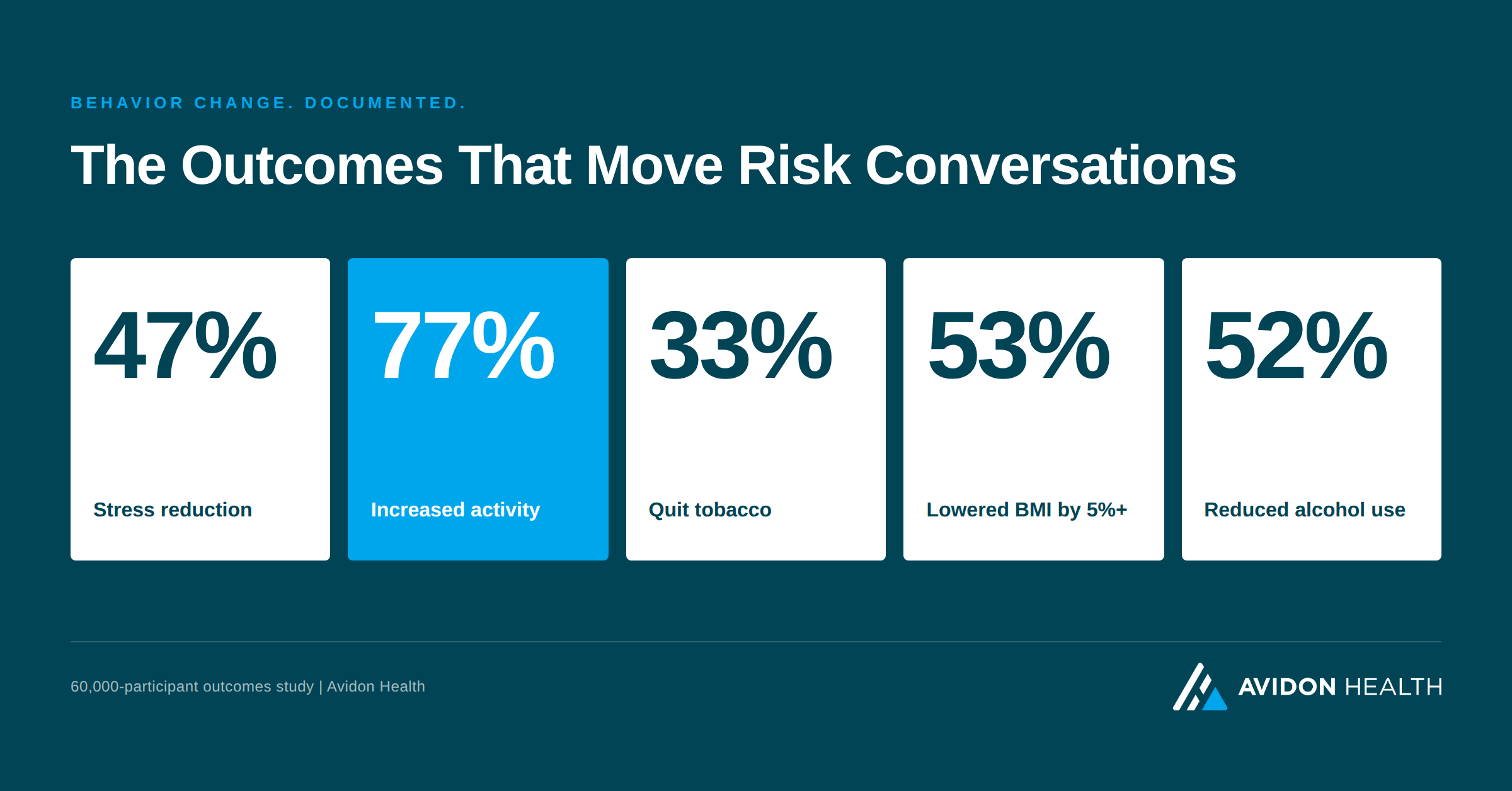
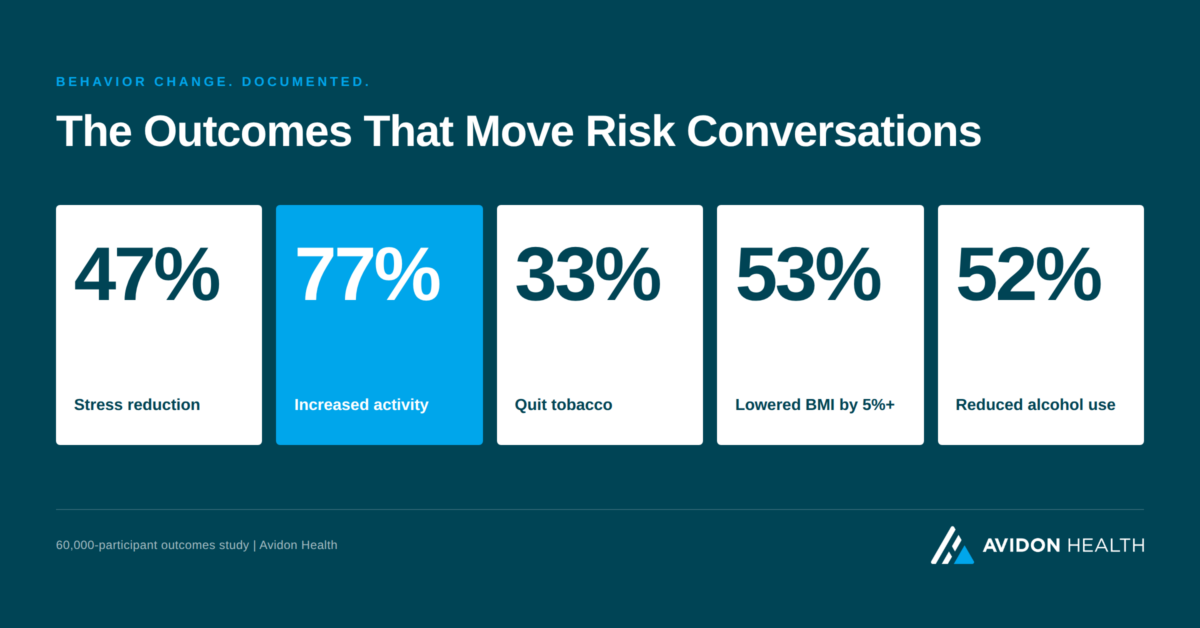
60,000+
Participants in outcomes study demonstrating measurable behavior change across stress, activity, tobacco, BMI, and alcohol
47% stress reduction among participants
77% of inactive participants increasing activity
53% lowering BMI by more than 5%
52% reducing alcohol use

The GLP-1 adherence angle: behavior change programming addresses the lifestyle scaffolding that determines whether a GLP-1 investment holds. Without it, the drug's ROI erodes. With it, the employer is protecting a significant pharmacy spend. That framing resonates with any CFO currently staring at a GLP-1 line item.

The tobacco quit rate: 38.1% at six months in a controlled trial. Tobacco is still one of the highest-cost, most addressable drivers of employer health spend. A documented quit rate is one of the cleaner ROI calculations in the benefits stack.

Where this fits in the RFP conversation.

The right moment to introduce the behavior change reframe is not the wellness section of the RFP. It is the medical and pharmacy trend section, where the client is already talking about cost. Framing behavior change as a clinical complement to disease management and pharmacy spend, not as a culture-and-engagement add-on, changes which decision-makers are in the room and how the budget conversation goes.

The consultants getting traction with this frame right now are leading with outcomes, naming the conditions they can move, and letting the OPM signal do some of the credibility work. The window is open. The question is whether the program you're recommending can hold up the claim.

Common Questions About Behavior Change and Corporate Wellness ROI.

What benefits consultants and brokers ask most when reframing wellness for the RFP conversation.

How is a real behavior change program different from a wellness app or nudge platform? +

A real behavior change program is grounded in cognitive behavioral training, delivered by trained content experts and certified coaches, and validated in controlled outcomes studies. A nudge app changes a moment — a streak, a reminder, a points balance. A CBT-grounded program changes the underlying habit response. For a risk committee, only one of those holds up as a cost containment argument.

How does behavior change programming connect to GLP-1 and pharmacy trend? +

GLP-1 adherence is not just whether an employee takes the medication — it is whether the lifestyle scaffolding around it sticks. Without behavioral support, the investment in the drug erodes. The same logic applies upstream of hypertension, diabetes, and depression scripts. Behavior change programming addresses the adherence layer that pharmacy benefit management alone cannot reach.

What outcomes evidence exists for behavior change programs in employer settings? +

In a 60,000-participant study, incentivized behavior change courses produced 47% stress reduction, 77% of inactive participants increasing activity, 33% quitting tobacco, 53% lowering BMI by more than 5%, and 52% reducing alcohol use. Avidon's tobacco cessation program showed a 38.1% quit rate six months post-completion in a controlled San Diego State University study.

Why does the OPM "well care" signal matter for commercial employers? +

OPM elevating digital therapeutics and well care as a carrier priority is the clearest regulatory signal yet that behavior change is moving from optional to expected. Commercial employers and their consultants can use that federal cue to reopen behavior change conversations with clients who closed them during the 2022–2024 point solution fatigue cycle.

Ready to bring a real behavior change program to your clients?

See how Avidon Health gives brokers and consultants a defensible, outcomes-backed program to put in front of any self-insured employer.

Categories
Employers & HR Leaders

Digital Coaching: A Cost-Effective Wellness Option for Small Businesses

Digital Coaching

In today’s fast-paced world, most of us know we need to make changes in our lives to improve our sleep, manage stress, get more exercise, eat well, maintain a healthy weight, and, in some cases, reduce our use of alcohol or other substances. But knowing we should change and following through are two very different things. Health and wellness programs offer a structured way to support these changes, but the programs that work can be costly, especially for small businesses. And even with the best intentions, there’s no guarantee that employees will consistently stick to these programs—because, well, they’re only human.
For small businesses with limited budgets, this unpredictability makes it hard to justify an investment in wellness programs that may not yield consistent engagement. Many wellness offerings are comprehensive but too rigid and hard to integrate into real life. They may be one-size-fits-all and fail to account for the unique lifestyles, challenges, and limitations of each employee. Live, one-on-one coaching is incredibly effective but can quickly become cost-prohibitive if a small business wants to make it available to all employees on an ongoing basis.
The Rise of Digital Coaching
This is where digital coaching steps in as a cost-effective and flexible solution. Digital coaching can replicate the personalized guidance, support, and accountability typically provided by human coaches, but in a format that’s more scalable and affordable for small businesses. Think of digital coaching as a wellness coach in your employee’s pocket—always accessible, flexible, and adaptable to individual goals.
Digital coaching programs, when done well, can provide personalized recommendations based on each user’s health goals and challenges, and they include tools to help employees track progress, adjust their goals, and stay motivated. Unlike static wellness programs, digital coaching adapts to an individual’s journey, making it more realistic and effective for the ups and downs of real life.
Behavior Change and Cognitive Training: The Essentials
For any wellness program to be worth the investment, it must focus on true and sustainable behavior change. Small businesses should avoid programs that only address superficial lifestyle changes without including components for cognitive training, such as stress management techniques, habit-forming strategies, and mental resilience exercises. Real change is about understanding why we do what we do and gradually shifting those habits over time. Digital coaching that integrates cognitive training can help employees make these changes in a way that’s accessible and sustainable.
While digital coaching may not fully replicate the depth of a live coaching session, it’s the next best option for companies on a budget. Digital coaching has the added benefit of being more approachable for employees who may find jumping into deeply personal issues with a live coach intimidating. In fact, many employees may find the digital format less intrusive, allowing them to address sensitive issues at their own pace and feel a greater sense of autonomy.
 
 
The Perfect Complement to Live Coaching
For companies that already offer live coaching sessions, digital coaching can be a valuable complement. Employees can use digital coaching between live sessions to reinforce the healthy habits they’re working on. This combination maximizes the benefits of live coaching by helping employees maintain focus on their wellness goals and stay engaged, even when they’re not in direct contact with a coach.
 

Final Thoughts 

Digital coaching isn’t a replacement for live, one-on-one coaching, but it’s the most effective, affordable alternative for small businesses wanting to support their employees’ well-being without breaking the budget. It offers the flexibility, accessibility, and personalization needed for sustainable behavior change, all at a fraction of the cost of traditional wellness programs. For small businesses, investing in digital coaching can be a smart move that provides employees with an approachable, engaging, and scalable way to achieve lasting health improvements. 
Categories
Individuals

A Father’s Perspective: I Don’t Have Time to Count My Kids Calories

I Don’t Have Time to Count My Kids Calories
family wellbeing
Family Wellbeing Can Be Fun!

Recently, a valued client asked us to collaborate on helping pediatricians promote healthier eating and physical activity to families. What surprised me wasn’t the project itself, but the reality: there simply aren’t enough quality resources to effectively promote family wellbeing through better health. In my initial research, most of what I found were apps that either provided education that felt unrelatable or focused on rigidly counting calories. No offense to those apps that track kids’ meals, but that approach doesn’t work for me. Maybe some parents can manage it, but for many of us, it’s just not realistic. 

The next step for me was to find a subject matter expert who could help guide us in the right direction. I searched high and low until it hit me—I have four kids, and I’m both the subject matter expert and the end user. As a father of a large family, I never imagined how much planning and effort it would take to create a healthy atmosphere for my children. When my wife and I began this journey, we understood the importance of good nutrition and staying active but building these habits within the chaos of family life proved to be far more challenging than we expected. 

Our kids need help. Our families need help. We cannot continue to accept the decline in our nation’s health. Living longer is one thing, but living longer and healthier? That’s a different story. As a father, I will do anything to put my kids in the best possible position to have healthy minds and bodies. It’s personal for me, and while I’m still a work in progress, I feel I’m starting to see more wins than losses. 

The Challenges and the Realities 

What I’ve learned, both as a dad and in my professional life surrounded by coaches who change lives daily, is that the key isn’t perfection. It’s about making consistent, small steps forward and stacking up more victories than defeats. In my home, the first step was setting a goal to eat dinner together at least five times a week. This may seem unrelated to traditional health goals, but it made the biggest difference. Sharing meals as a family promotes not only better eating habits but also emotional wellbeing. It creates an opportunity for connection, reduces stress, and helps foster open conversations about health, allowing us to reinforce healthy choices in a relaxed, supportive environment. 

This approach is crucial for the long-term health and happiness of our children. We don’t need to be perfect parents. What we need is a balance that sets a strong foundation, while teaching our kids not to stress over every choice. After all, a healthy mindset is just as important as a healthy body. 

What I’ve Learned: Simple Strategies for Family Wellbeing 
 Make It Fun and Simple 
  • Kids learn best when they’re having fun. We try to keep things simple, using storytelling to explain why certain choices, like eating too much sugar or relying on processed foods, aren’t great for their bodies. I don’t get into all the science with them, but I bridge the gap by showing how what they eat now affects their health in the long term.  
Balance Is Key  
  • One thing I’ve learned is that balance matters. Yes, we need to help our kids make healthy choices, but they also need the freedom to enjoy life. Let them have that ice cream or birthday cake. The goal is not to be rigid but to teach them moderation. If they’re stressed about every choice, we’re not doing them any favors. 
Lead by Example 
  • As parents, we’re our children’s first role models. They need to see us committed to making healthy choices, but they also need to see that we’re human. I’m not perfect—I fail at times, and I think it’s important for my kids to see that too. When they see me recover from a setback and get back on track, it teaches them resilience and perseverance. 
Make It Interactive  Family wellbeing
  • By prioritizing family wellbeing, we can create a supportive environment that fosters healthy habits and emotional resilience. We try to involve the kids in meal planning, grocery shopping, and even cooking. When they feel part of the process, they’re more likely to make healthier choices. Plus, it becomes a shared family experience, and those are moments that will stay with them long after they’ve grown up.
Small Wins, Big Impact 

At the end of the day, my goal is simple: to have more little victories than defeats. The small wins—whether it’s getting the kids to try a new vegetable or choosing an outdoor activity over screen time—add up over time. These habits will help set the foundation for a healthier future, not just for my family, but for all families who are willing to make the effort. 

The road to family wellbeing isn’t always easy, but it’s worth the work. We may stumble, but it’s the commitment to keep going, to adjust and improve, that matters most. And if we can make the journey fun, balanced, and full of love, then we’re on the right path. 

— A Father Still Learning and Striving for Better 
Looking to join our team? Click here for an important message