
This article is for informational purposes only and does not constitute legal advice. Employers should consult qualified legal counsel before making plan design decisions.
Most employers who cover GLP-1 medications for diabetes but not for weight loss made that call quickly, under cost pressure, with the assumption that a clinical distinction would hold up legally. That assumption is under active challenge. Indication-based GLP-1 exclusions have become one of the most rapidly evolving compliance questions in employer health plan law, and open enrollment is the right time to find out if your plan is exposed.
The Core Legal Question: Does Your Plan Design Create ADA Exposure?
Employers covering GLP-1 medications for diabetes but excluding them for weight loss are not automatically in violation of the Americans with Disabilities Act. But they are operating in territory where the legal ground is shifting.
The ADA prohibits discrimination in the terms, conditions, and privileges of employment, a standard that courts and the EEOC have long interpreted to include employer-sponsored health plan design. According to a January 2026 client alert from Morgan Lewis, indication-based GLP-1 exclusions can raise ADA concerns in two ways: first, if obesity itself qualifies as a disability in the relevant jurisdiction; second, and more immediately, if employees with obesity also have covered comorbidities, including diabetes, cardiovascular disease, and sleep apnea, that are independently recognized as disabilities under federal law.
Most federal appellate courts have held that ordinary obesity is not an ADA disability unless it results from an underlying physiological condition. The EEOC, however, takes a broader view. And because many individuals being prescribed GLP-1s for weight loss also have comorbidities that are ADA-covered disabilities, the line between covering for diabetes and denying for a disability is not as clean as plan documents often suggest.
No federal court has issued a final ruling holding that GLP-1 exclusions for weight loss constitute disability discrimination. However, active litigation is underway. According to a February 2026 employer FAQ from Fisher Phillips, the EEOC's track record on indication-based benefit exclusions is worth taking seriously. The risk is real and increasing, even if it is not yet settled law.
It's Not Just an ADA Question: The Full Compliance Stack
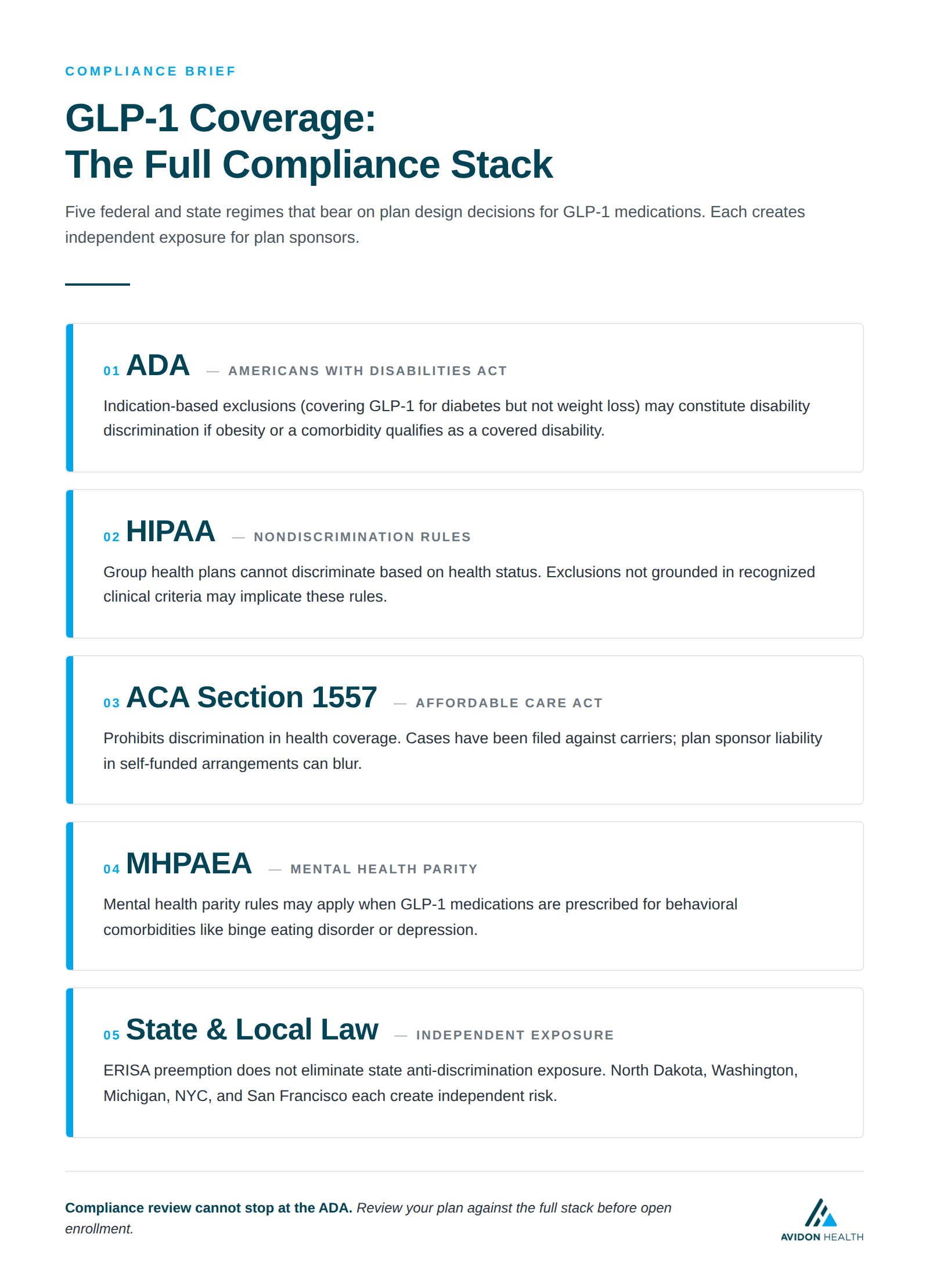
Employers who evaluate their GLP-1 coverage solely through an ADA lens are missing several other legal exposure points.
HIPAA nondiscrimination rules prohibit group health plans from discriminating against participants based on health status, including the conditions they have. Indication-based exclusions that effectively target employees who need treatment for a health condition may implicate these rules, particularly if the exclusion is not grounded in recognized clinical criteria. Trucker Huss flagged this risk in its October 2025 plan sponsor analysis.
ACA Section 1557 prohibits discrimination in health coverage based on several protected characteristics. GLP-1 exclusion cases have been filed against insurance carriers under this provision. Most have targeted carriers directly rather than employers, but the distinction between insurer liability and plan sponsor liability in self-funded arrangements can blur.
MHPAEA becomes relevant when GLP-1 prescriptions are connected to behavioral or psychiatric conditions, including binge eating disorder and depression, both of which are associated with obesity and treated with GLP-1 medications in some clinical contexts.
State and local law creates independent exposure that ERISA preemption does not fully eliminate. Washington State classifies obesity as a disability under its law. San Francisco, New York City, and Michigan prohibit weight-based employment discrimination. North Dakota added GLP-1 medications to its essential health benefits benchmark plan, becoming the first state to mandate coverage for certain plans. Several additional states are considering similar mandates or have active litigation underway. Self-funded employers operating under ERISA are generally not subject to state insurance mandates, but state anti-discrimination laws that apply to employment practices can still reach plan design decisions.
The Wellness Program Trap: When Cost Management Creates New Risk
Many employers have tried to control GLP-1 cost exposure by tying coverage to participation in a wellness program: attend a nutrition class, complete a coaching program, meet certain activity thresholds. This approach is understandable, but it introduces its own compliance layer.
Health-contingent wellness programs that offer GLP-1 coverage as a reward for meeting health standards, including BMI targets, must comply with HIPAA's wellness program rules. Those rules cap financial rewards at generally 30% of the cost of employee-only coverage, require a reasonable alternative standard for employees who cannot meet the health target, and impose notice requirements. Programs that do not meet these standards are noncompliant regardless of how they are marketed.
ADA concerns in wellness design arise when programs impose higher cost-sharing on employees who do not participate. If an employee cannot participate because of a disability, penalizing them through cost-sharing effectively creates a disability-based plan differential. Trucker Huss flagged this as a particular risk for programs that gate access to high-cost medications rather than general wellness incentives.
There is a meaningful compliance distinction worth noting: wellness programs that do not require disability-related inquiries or medical examinations are generally not subject to the ADA's wellness program requirements. A structured behavioral or lifestyle coaching program that encourages healthy habits without clinical testing, medical questionnaires, or biometric screening falls outside the ADA constraints that apply to health-contingent wellness designs. This distinction matters when evaluating how to structure program access in a way that is both cost-effective and legally defensible.
What the State Law Trend Means for Your Plan
The North Dakota GLP-1 mandate is the most concrete signal of where state law is heading. North Dakota added GLP-1 medications to its essential health benefits benchmark plan, creating a coverage mandate for fully insured plans in the state. It is the first such mandate in the country, but legislative activity in other states suggests it will not be the last.
Self-funded employers operating under ERISA are generally exempt from state insurance mandates under federal preemption. But that exemption does not cover state employment discrimination laws or state anti-discrimination statutes, which can reach plan design as an employment practice.
The practical implication: what is legally permissible under current federal law may become noncompliant in specific states within the next 12 to 24 months, depending on how state legislatures and courts move. Employers with employees in multiple states should map their GLP-1 coverage rules against the specific legal landscape in each state where they have plan participants.
How Employers Are Responding: Practical Approaches That Hold Up
Given the legal uncertainty, the question most HR and benefits teams are asking is: what do we actually do? The following approaches reflect what plan sponsors and their advisors are using now.
Prior authorization and clinical criteria
The most common and legally defensible baseline. Require a diagnosis, physician documentation, and alignment with FDA-approved indications before coverage is approved. This approach is not bulletproof, but it grounds the coverage decision in clinical criteria rather than categorical exclusion by indication.
Targeted access tied to conditions
Rather than excluding weight loss broadly, cover GLP-1s for cardiovascular disease plus obesity, or for diabetes, or for other FDA-recognized indications. This narrows cost exposure while reducing the differential treatment argument: the plan is covering a medication for specific clinical indications, not denying coverage based on a disability category.
Program pairing as a condition of coverage
Require participation in a structured behavioral support program, including nutrition counseling, lifestyle coaching, or a combined coaching model, as a condition for ongoing coverage. Multiple legal analyses describe this as both a cost management tool and a compliance buffer, provided the program design complies with HIPAA wellness rules and does not penalize employees with disabilities for non-participation.
The outcomes data supporting this approach is strong. A Cleveland Clinic-affiliated telehealth program pairing GLP-1 therapy with intensive lifestyle coaching across more than 2,600 participants achieved average weight loss of 15.6% at 12 months. Pairing medication with behavioral support also improves medication adherence, which matters directly for long-term cost management.
Documentation and consistent application
Whatever the coverage decision, document the clinical rationale, apply the rules consistently across all similarly situated plan participants, and review plan language to confirm that exclusions are not explicitly tied to a disability or a protected characteristic. Inconsistent application of plan rules is one of the most common triggers for discrimination complaints and litigation. Pharmacy benefit manager contracts should also be reviewed whenever coverage terms change, as PBM formulary structures do not automatically align with plan design changes employers make outside the formulary review process.
Employer Decision Checklist: Before Open Enrollment
Use this checklist to assess your current position before plan documents are finalized. For any "no" or "unsure" answer, flag for legal counsel review. Most plan document deadlines fall 60 to 90 days before the plan year start, which means the window is shorter than it feels.
- Has your legal counsel reviewed your GLP-1 coverage terms for ADA and HIPAA nondiscrimination compliance?
- Are your GLP-1 coverage rules applied consistently to all similarly situated plan participants regardless of disability status?
- If you exclude GLP-1 for weight loss but cover it for diabetes or other conditions, have you documented the clinical rationale for that distinction?
- Have you verified whether your state or local jurisdiction treats weight or obesity as a protected characteristic independently of any ADA analysis?
- Does your plan have participants in North Dakota, Washington State, or another jurisdiction with active coverage mandate legislation or ongoing litigation?
- If you use a wellness program to condition GLP-1 access, has the program design been reviewed for compliance with HIPAA health-contingent wellness rules, including the reasonable alternative standard requirement?
- Have you reviewed your pharmacy benefit manager contracts in the context of any coverage changes you are considering?
- Have you communicated clearly to plan participants about what is covered, what is not, and the clinical basis for that distinction?
The compliance question around GLP-1 coverage is not going away. Active litigation, accelerating state law activity, and increasing employee awareness of coverage distinctions mean that plans with unreviewed indication-based exclusions are carrying more risk going into 2027 than they were a year ago.
The most defensible position combines documented clinical criteria, consistent application, and structured behavioral support. Pairing GLP-1 coverage with a behavioral coaching program addresses both the clinical evidence for better outcomes and the legal rationale for a program design that does not penalize employees based on a health condition.