
The language of workplace mental health has shifted. Benefits leaders who were talking about EAPs and crisis resources two years ago are now using a different phrase: mental fitness at work. The shift is not just semantic. It reflects a real change in how organizations are thinking about employee well-being, and what the evidence says actually moves the needle.
Understanding what mental fitness means, how it differs from mental health care, and what employers are actually doing about it is increasingly table stakes for HR and benefits leaders who want to stay ahead of the conversation.
What mental fitness actually means.
Mental health describes your current emotional and psychological state, including mood, functioning, and diagnosable conditions. It is a measure of where you are. Mental fitness is the proactive practice of building the habits and skills that shape that state over time. It is a measure of what you are actively doing about it.
The physical health analogy is useful here. You would not wait until a patient had a heart condition to recommend exercise and nutrition. Mental fitness applies the same upstream logic: build the capacity for stress regulation, emotional resilience, and cognitive flexibility before the conditions that require clinical intervention emerge.
The term itself has a clinical grounding. Research published in PMC/NCBI defines psychological fitness as a multidimensional construct covering emotional, social, family, spiritual, and physical dimensions, with strong parallels to how physical fitness is operationalized in performance and preventive health contexts.
According to Mind Share Partners and Qualtrics, 76% of U.S. workers reported at least one symptom of a mental health condition in 2025, up from 59% in 2019. That trajectory is not a crisis that can be addressed through crisis tools alone. It is a structural condition that requires a structural response.
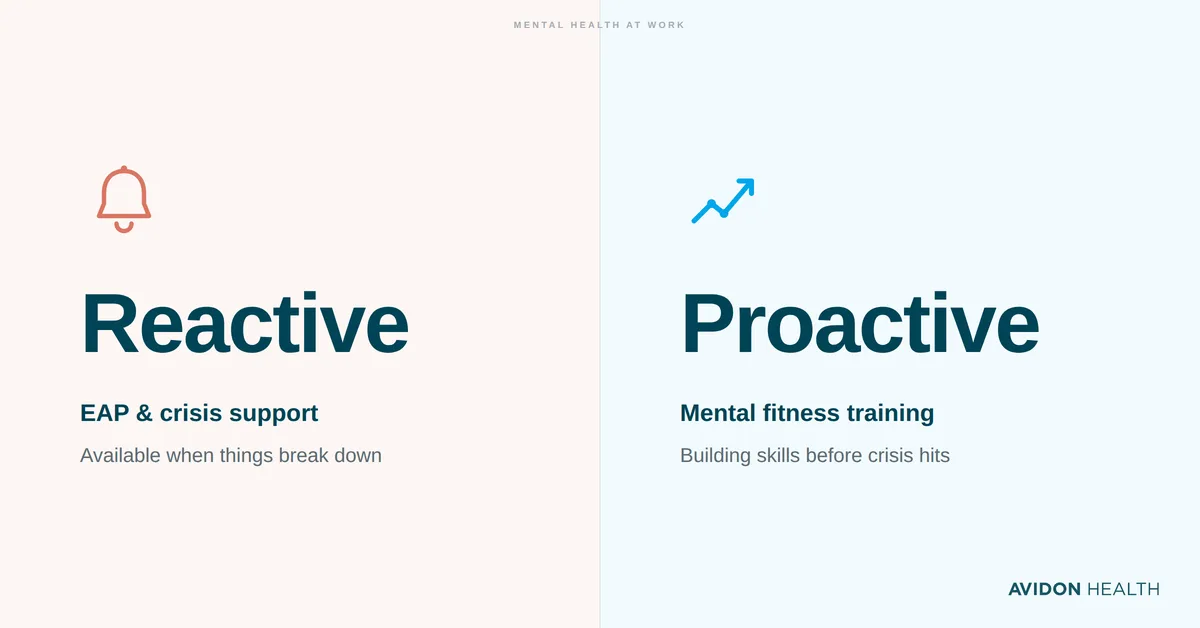
Why the EAP model is no longer sufficient on its own.
EAPs remain important. They serve a critical function for employees who need clinical support, short-term counseling, or crisis intervention. The problem is that they were designed for a specific use case, and that use case covers a narrow slice of the actual well-being demand inside most organizations.
EAPs average 2 to 5% annual utilization. A 2024 NAMI survey found that 51% of employees said they would use confidential mental health support if access felt genuinely safe and easy. The gap is not demand. It is design. Employees associate EAPs with crisis, stigma, and formal clinical processes, not with skill-building or everyday resilience work.
The Deloitte research on workplace mental health ROI found that organizations investing in proactive, evidence-based programs consistently generate positive returns, with the strongest results coming from population-level interventions rather than crisis response tools. Programs mature over time, with companies seeing greater returns the longer they are in place.
The cognitive overload problem.
One of the most significant findings in the 2025 workplace wellness research is the elevation of cognitive overload as the leading burnout predictor. The Deloitte 2025 Workforce Intelligence Report identified mental fatigue, decision friction, and cognitive strain as the top burnout driver for the first time, surpassing workload volume.
The implication is significant. It is not how much work employees have. It is the fragmented, context-switching, notification-saturated nature of modern work that depletes cognitive resources fastest. Mental fitness programs that teach attention management, cognitive reframing, and recovery habits address this directly. A resource guide does not.
A December 2024 systematic review published in BMC Psychology confirmed that emotional competencies including stress regulation and cognitive resilience improve meaningfully through structured training. The underlying mechanism is neuroplasticity: repeated mental habits reinforce neural pathways, making resilience more accessible over time.
What employers are actually doing.
The WorldatWork January 2026 Total Rewards Survey found that 68% of organizations now include some form of mental fitness or resilience programming in their benefits strategy, up from 41% in 2023. The programs that are gaining traction share a few structural characteristics.
They target the full workforce, not just employees who have reached a crisis point. They deliver skill-building content in formats that fit the flow of work, short, habit-forming, and accessible without a clinical referral. They include a coaching or behavioral support layer that addresses the cognitive and emotional dimensions, not just the informational ones. And they measure outcomes, completion rates, engagement patterns, and where available, claims data and absenteeism trends.
According to Gallup's 2026 State of the Global Workplace report, global employee engagement fell to 20% in 2025, its lowest level since 2020, costing the global economy an estimated $10 trillion in lost productivity. For HR leaders making the case for proactive investment, that number is the stakes. The cost of disengagement now has a global price tag.
The SHRM 2025 Employee Benefits Survey also found that mental health benefits ranked second only to health insurance among the factors employees say influence their decision to stay with an employer. For HR leaders thinking about retention, the mental fitness conversation is no longer a wellness nicety. It is a talent strategy.
What makes a mental fitness program work.
The research on program effectiveness points to a consistent set of active ingredients. Multi-component design matters: programs that combine digital habit-building tools, structured coaching, and behavioral skills training consistently outperform single-modality interventions. Accessibility matters: programs that require a clinical referral or a separate login with high friction consistently underperform on utilization. And sustained delivery matters: one-time workshops and annual lunch-and-learns show minimal durable effect.
Cognitive behavioral training (CBT) is the methodology with the deepest evidence base for workplace applications. A 2024 BMC Psychology systematic review confirmed that CBT-based approaches produce statistically significant improvements in stress, anxiety, and emotional regulation across working populations. The effect sizes are meaningful, not marginal.
According to Eagle Hill Consulting, employees who report access to proactive mental wellness resources are 2.4 times more likely to report feeling engaged at work and significantly less likely to report burnout symptoms in the prior 90 days.
Want to See What This Looks Like in Practice?
Avidon's behavior change courses and coaching programs are built on cognitive behavioral training, the same methodology the research supports as effective for building emotional regulation, stress resilience, and mental fitness habits at scale.
The full efficacy report has the outcomes data, no form required. And if you want to understand the financial case for proactive wellness before taking any next step, the true cost of unhealthy habits at work is a useful frame.