
The return-to-office mandate wave is real, it's accelerating, and it's mostly outside any individual HR leader's control. What you can control is whether the transition damages your people's mental health or protects it.
As of 2026, more than 40 major employers, including Amazon, JPMorgan Chase, AT&T, Goldman Sachs, Dell, and Walmart, plus the federal workforce, require five-day in-office attendance. According to JLL, 54% of Fortune 100 employees now face five-day requirements, up from just 11% a year earlier.
The mental-health stakes are high. According to a 2025 Modern Health survey of 1,000 full-time U.S. employees, 70% reported heightened anxiety about returning to the office, and 74% of strained caregivers considered cutting hours or leaving. Working parents and the "sandwich generation" caring for both kids and aging relatives report the sharpest strain.
The same research isn't all bad news, though. 85% of employees said a return can strengthen culture and collaboration when it's handled well. So the question isn't really whether people come back. It's how you design the return.
The numbers behind the return
RTO isn't a neutral logistics change. The data shows a real mental-health cost, and it's concentrated among your highest-value, highest-flight-risk employees. It also shows a clear signal of what makes a return succeed.
Sources: Modern Health 2025 employee survey (n=1,000); JLL Q2 2025 Office Market Dynamics; Bloom et al., Nature (2024) randomized controlled trial.
Why most RTO wellness responses fail
Most companies respond to RTO stress by reaching for a perk: a meditation app, a resilience webinar, a mindfulness seminar. The best research we have says those do little to nothing for employee well-being.
According to a 2024 Oxford study of 46,336 workers across 233 organizations, the usual individual-level wellness offerings, including mindfulness apps, resilience courses, and stress-management seminars, showed no measurable well-being benefit compared with employees who didn't take part.
The study's lead researcher put the takeaway bluntly: employers need to change the workplace itself, not just ask the worker to cope better.
That's the part that actually matters. What holds up under scrutiny is structural and active: schedule flexibility and job design, plus sustained behavior change instead of a passive download. A meditation app your people open once doesn't move the needle. Real flexibility paired with ongoing behavior support does.
Note: critics point out the Oxford study was a single point-in-time snapshot and didn't account for program quality, so read it as a strong caution against passive perks, not proof that all support is pointless.
The three-tier RTO well-being playbook
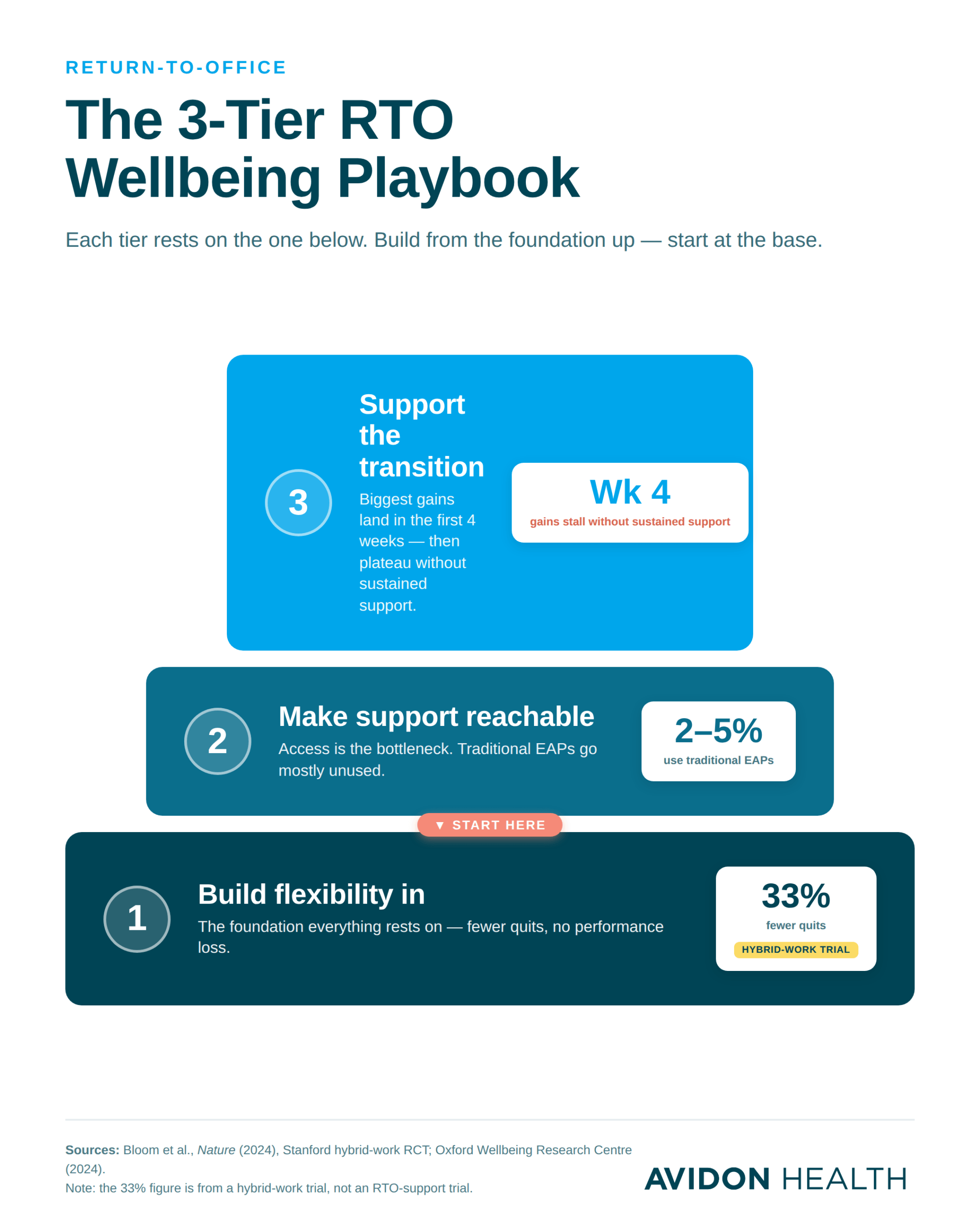
An evidence-based RTO plan works in three tiers: build in flexibility first, make mental-health access genuinely reachable, then support the behavior transition. They're in that order on purpose. Flexibility has the deepest research behind it, so it's where you start.
Tier 1: Build flexibility into the policy itself
Flexibility is the single highest-evidence lever in this whole space. A 2024 randomized controlled trial published in Nature, led by Stanford economist Nicholas Bloom, assigned 1,612 employees to either hybrid work (two days from home) or full in-office. Hybrid work cut quit rates by a third, with no measurable effect on performance or promotion over the next two years.
The retention benefit was strongest for non-managers, women, and employees with long commutes, which is exactly who the survey data flags as most at risk during a return. Practical moves: structured hybrid schedules, schedule autonomy, and saving in-office days for real collaboration instead of solo work done under supervision.
Tier 2: Make mental-health access genuinely reachable
Offering a benefit isn't the same as that benefit reaching people. Traditional Employee Assistance Programs see only 2 to 5% utilization, and roughly 53% of employees say they don't even know how to access their employer's mental-health care.
When people do engage, the clinical effect is real. A 2025 peer-reviewed evaluation found participant distress scores dropped sharply after a structured behavioral-health program, with most people returning to full function. The lesson for RTO planning: put real effort into access design, meaning visibility, speed to a first appointment, and stigma reduction, not just into whether a program technically exists.
Tier 3: Support the transition itself
A return to office is, at its core, a behavioral transition. People have to rebuild sleep, movement, meal, and commute routines that the remote years reshaped. The commute itself wears people down: a systematic review links longer commutes to higher anxiety, stress, and depression risk.
This is where point solutions keep failing and sustained support wins. Research on digital wellness tools shows the biggest gains, around a 29% drop in anxiety, happen in the first four weeks and then plateau, with a lot of drop-off when tools are used on their own. Rebuilding habits works when it's paired with steady, active behavior-change support, not handed over as a standalone app.
The hidden cost of getting it wrong
Rigid mandates carry lopsided risk: the morale and turnover costs land whether or not any productivity upside ever shows up. The case that mandates boost output is weak. The case that they raise turnover is well documented.
| Approach | Turnover signal | Productivity evidence | Mental-health effect |
|---|---|---|---|
| Rigid five-day mandate, no support | Higher; strict-RTO firms show elevated attrition vs. flexible peers | Weak; mandates often follow stock-price drops rather than drive performance | Heightened anxiety, especially for caregivers, parents, and long-commuters |
| Structured hybrid plus real support | Lower; hybrid cut quit rates by a third in a controlled trial | Neutral to positive; no measured performance loss from hybrid | Protected when flexibility and reachable support are built in |
One finding really drives the point home: about a quarter of executives have admitted they hoped mandates would push people to quit on their own. As Stanford's Nicholas Bloom has warned, using a return mandate to thin headcount is a blunt instrument, because you don't get to pick who leaves, and your strongest people usually have the most options.
Here's the part worth sitting with. Most of this risk sits with the mandate, and the mandate may not be yours to set. The support you build around the return usually is. If a return is already on your calendar, that support layer is the variable still in your hands, and the evidence says it's the one that decides whether your highest-strain people stay or start looking.
How Avidon Health supports a healthier return
HR leaders tell us a version of the same thing again and again: the mandate wasn't theirs to set, but the fallout lands squarely on their desk. That's the spot this piece is really written for, and it's where the support you design makes the difference.
Avidon Health is a digital behavior-change platform built on cognitive behavioral training methodology, made for exactly the transition RTO creates: rebuilding healthy routines and keeping them going past the four-week mark where standalone apps fall off.
The evidence points away from passive perks and toward sustained, active behavior change, and that's the layer Avidon is built for. Where a meditation app gives you a one-time download, Avidon's coaching and habit-building approach supports the ongoing work of rebuilding sleep, movement, and stress-management routines around a new in-office schedule.
For HR teams, that means the support you offer during a return can pass the test the Oxford research sets: it's structural and participation-based, not a perk that looks supportive but doesn't move outcomes. And for your highest-strain people, like caregivers and working parents, sustained behavior support hits right where the risk is concentrated.
Related reading: Wellness ideas for hybrid teams