The Perception Gap Nobody Is Talking About.
Most HR mental health strategies are built around what HR leaders believe employees are struggling with. In 2026, that belief is wrong by a wide margin.
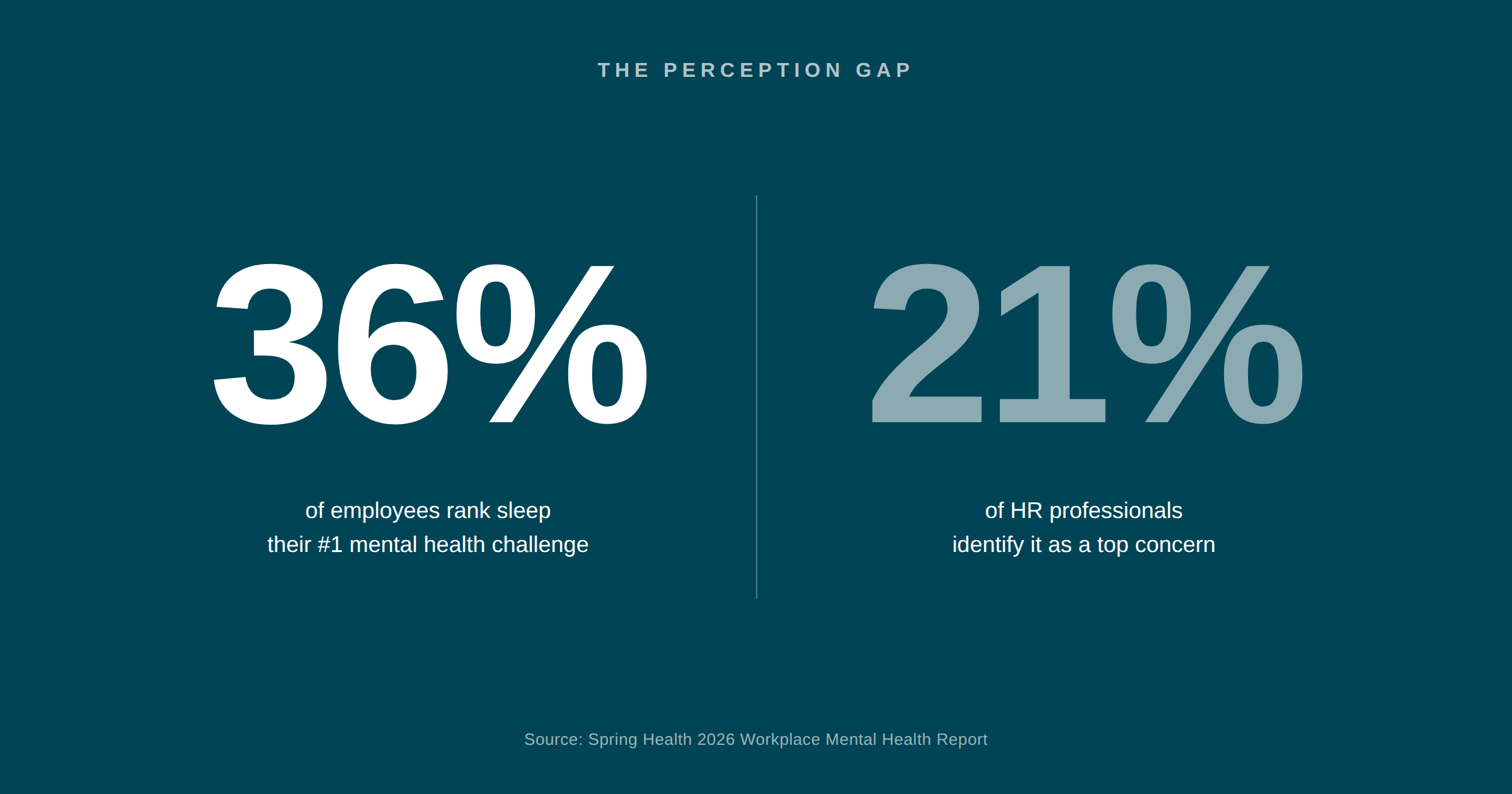
A 2026 workplace mental health survey of more than 2,000 HR leaders and employees across five countries found that employees rank sleep as their #1 mental health challenge, while HR ranks it #5. The report describes this kind of misalignment as the type that "delays intervention and compounds downstream risk."
The downstream risk is real. Sleep problems do not appear after a mental health crisis — they typically precede it. Employees with insomnia are 10 times more likely to experience clinically significant depression and 17 times more likely to experience anxiety, according to clinical research published in The Lancet Psychiatry. When HR programs address anxiety and burnout without addressing sleep, they are treating effects while leaving the cause in place.
Who Is Most Affected.
The prevalence data is consistent across multiple large-scale surveys. A 2026 survey of more than 5,000 full-time employees across 10 countries found that 69% of employees sleep fewer than the recommended seven hours per night. Nearly half of those employees (47%) identify stress or anxiety as what keeps them awake.
Managers are the highest-risk group and the highest-leverage intervention point. Four in 10 managers report sleep as a top personal challenge. These are the same people responsible for spotting burnout on their teams, making high-stakes decisions under pressure, and keeping headcount stable. When managers are sleep-deprived, the performance impact does not stay contained to one person. It spreads.
Younger workers are disproportionately affected as well. Employees under 55 report sleep issues at nearly twice the rate of those 55 and older (40% vs. 21%). Since Gen Z and millennials now constitute the majority of the workforce, sleep is not a niche wellness issue. It is a workforce performance issue at scale.
What Poor Sleep Is Actually Costing Employers.
Sleep deprivation generates costs across three categories that HR and finance leaders both care about: productivity, healthcare spend, and safety.
Productivity
According to RAND Europe's peer-reviewed economic analysis, the U.S. loses more than 1.2 million working days per year to insufficient sleep. The primary mechanism is presenteeism, not absenteeism. Employees show up, but they work at reduced cognitive capacity. Roughly 60% of Americans report that poor sleep negatively impacts their productivity, and approximately the same share say it leads to errors and difficulty managing workloads.
Safety
Employees who are chronically sleep-deprived are 70% more likely to be involved in a workplace accident, according to National Sleep Foundation data. In high-stakes roles such as healthcare, logistics, and manufacturing, this creates direct liability exposure beyond the performance cost. For HR and legal teams managing workers' comp and OSHA compliance, sleep deprivation is not a wellness issue. It is a risk management issue.
Healthcare Spend
Short sleep duration (under 6 hours per night) is associated with significantly increased risk of type 2 diabetes, cardiovascular disease, hypertension, and obesity, according to peer-reviewed research published in the NIH journal system. These are the chronic conditions already driving the highest line items on most employer health plans. A research review from Warwick Medical School found that insufficient sleep roughly doubles the risk of adverse cardiometabolic outcomes. Addressing sleep upstream reduces the downstream clinical cost.
Sleep and Mental Health: The Direction of the Arrow.
One of the most important reframes for HR leaders is understanding the direction of the relationship between sleep and mental health.
For decades, poor sleep was treated as a symptom of depression and anxiety. The current evidence is more complex and more actionable. A 2021 meta-analysis published in The Lancet Psychiatry reviewed randomized controlled trials and found that improving sleep quality produced significant downstream improvements in mental health outcomes, independent of any direct mental health treatment.
The American Psychological Association synthesized 154 studies spanning five decades and found that all three types of sleep loss — extended wakefulness, shortened sleep, and nighttime awakenings — reduced positive emotions and increased anxiety symptoms. This effect appeared even after losing just one or two hours of sleep relative to an individual's normal baseline.
The same 2026 employer survey data referenced above replicates this pattern across every mental health challenge category measured. For trauma, anxiety, depression, and financial stress alike, rates were consistently higher among employees who had identified sleep as a top challenge. Sleep is not one item on the mental health checklist. It is a leading indicator of which employees are at elevated risk across the board.
According to Columbia University's Department of Psychiatry, sleep actively regulates the brain's capacity to process stress, maintain attention, and regulate emotion. That framing shifts sleep from a wellness perk to a cognitive performance input, which is exactly how it should be positioned in employer planning conversations.
Why Most Sleep Programs Fail Before They Start.
Fewer than 10% of U.S. employers currently offer sleep-focused wellness programming, according to a peer-reviewed systematic review published in the Journal of Clinical Sleep Medicine. Meanwhile, roughly one-third of employers offer nutrition or exercise programming, despite sleep having comparable or stronger links to productivity outcomes.
The low adoption rate is partly a prioritization failure. But when employers do attempt sleep programming, they often rely on the wrong approach: a one-time sleep hygiene workshop, a tips email, or an article in a benefits newsletter. These formats do not produce lasting behavior change because sleep problems are not primarily a knowledge problem.
Employees generally know they should sleep more. The challenge is behavioral. Late-night screen time, irregular schedules, stress-triggered wakefulness, and the normalization of always-on work culture are all ingrained routines. A single awareness moment does not compete with ingrained routines. Only consistent habit formation does.
This is why Cognitive Behavioral Therapy for Insomnia (CBT-I) is the first-line recommended treatment for insomnia, endorsed by both the American College of Physicians and the Mayo Clinic. CBT-I does not teach employees to try harder at sleep. It restructures the habits, associations, and thought patterns that perpetuate poor sleep, which is why it produces durable improvements that awareness-only programming cannot.
What the Evidence Says About Employer-Led Sleep Interventions.
The evidence base for workplace sleep programs is stronger than the adoption rate suggests.
Workplace-delivered digital CBT-I has been evaluated in randomized controlled trials. A 2025 randomized controlled trial published in PMC found measurable reductions in insomnia symptoms and improvements in work productivity through a digital CBT-I and emotion regulation program delivered to employees. An earlier workplace trial of sleep education and screening programs found significant reductions in injuries and disability day usage.
The ROI case is also visible in the same survey data: employees with access to formal wellness programs that include sleep components are nearly twice as likely to report quality sleep compared to those without access (39% vs. 21%).
5 Actions HR Teams Can Take Now.
HR leaders do not need a complete platform overhaul to start moving on sleep. These five actions represent a practical, evidence-grounded starting point.
1. Add sleep health to your existing wellness program
Most wellness platforms have room for sleep content. The key is using structured, habit-formation content — two-week sleep consistency challenges, wind-down routine goals, and regular check-ins — rather than one-time informational pieces. Structured challenges that build consistent behavioral patterns outperform awareness events at improving reported sleep quality.
2. Include sleep in manager training
Managers are the highest-prevalence group and the highest-leverage intervention point. Training managers to recognize signs of sleep-related performance decline — difficulty concentrating, increased irritability, decision fatigue, and higher error rates — and directing employees to resources is a low-cost, high-reach intervention. A manager who understands their own sleep deficit is also more likely to stop inadvertently creating conditions that worsen their team's.
3. Audit your scheduling policies
This is the one action that costs nothing and has an immediate structural impact. Expectations of late-evening email responses, back-to-back early morning meeting starts, and irregular shift patterns structurally undermine sleep before any wellness program begins. If your organization is sending all-hands messages at 9pm and scheduling 7am standups, no sleep program will overcome that. A scheduling policy review that identifies and removes the most disruptive norms is a prerequisite for any sleep initiative to succeed.
4. Pilot digital CBT-I as an employee benefit
Digital CBT-I programs are increasingly available as a standalone benefit or through behavioral health platforms. Given the low current employer adoption rate, early movers gain both a talent differentiation advantage and a head start on building internal outcome data. Look for programs with at least 6 weeks of structured habit-formation content and measurable outcomes, not just tip sheets dressed up as courses.
5. Measure sleep-related outcomes in your wellness data
Self-reported sleep quality, energy levels, and focus scores are lagging indicators of program impact and leading indicators of burnout risk. Adding these to your well-being KPIs creates an internal evidence base that supports continued investment and flags population segments that need earlier intervention.
The Habit Formation Connection.
Avidon Health's approach to sleep improvement is grounded in the same cognitive-behavioral principles that make CBT-I the clinical gold standard. The methodology is built on the understanding that sustainable behavior change requires more than knowledge. It requires restructuring the stimulus-response patterns, thought loops, and environmental cues that drive behavior on a daily basis.
In practice, that means Avidon's sleep courses do not open with a tip list. They open with a behavioral assessment that identifies the specific patterns disrupting sleep for each individual — from late-night screen time to inconsistent wake times to stress-triggered wakefulness. From there, the program builds a personalized routine over four weeks, with check-ins that reinforce the habit rather than relying on initial motivation to carry the work.
The same employees who know they should sleep more but cannot sustain the change are not failing at willpower. They are working against ingrained behavioral patterns without the structure to change them. Habit-based coaching provides that structure. And for HR teams that have tried awareness-only approaches and seen limited results, that is where the evidence points: the mechanism matters as much as the message.